Parking a Rig on a Busy Weekend
A crowded Washington trailhead can turn the first part of a ride into a stressful round of backing, shuffling, and wondering whether your truck and trailer are blocking someone else. This guide explains how to plan parking for a busy weekend, choose a workable staging spot, protect your rig, and avoid common access problems at popular off-road areas.
Plan for the parking area, not just the trail
Check access details before loading up
A ride plan is more than picking a trail on a map. Before you leave, check the riding area’s current access information, including closures, staging locations, parking notices, and any pass requirements. A trailhead that looks straightforward on a map may have limited space for trailers, a narrow approach road, or a gate that changes how vehicles can enter and turn around.
This matters at places such as Walker Valley, Capitol State Forest, Reiter Foothills, Tahuya State Forest, and Evans Creek. Each area has its own layout and conditions, and the lot that worked on a quiet weekday may feel very different during a holiday weekend. Avoid assuming that an old forum post, saved route, or familiar parking routine still reflects today’s access.
Use official area information as your first check. A mapping tool such as onX Offroad can help you understand the surrounding roads and orient yourself, but don’t treat a map layer as permission to park or ride somewhere. Confirm that the route is open and that the parking area is intended for the type of vehicle you’re bringing. You can also review Washington Trail Closures to Check First and Reading a DNR Recreation Map while putting your plan together.
If you’re new to an area, decide in advance where you’ll turn around if the main staging lot is full. That might mean choosing a different legal staging area or changing the day’s plan—not pulling onto a shoulder, blocking a gate, or squeezing a trailer into a spot that was not designed for it. A backup plan can save a lot of frustration when you arrive and see a line of rigs waiting to unload.
Match your rig to the lot
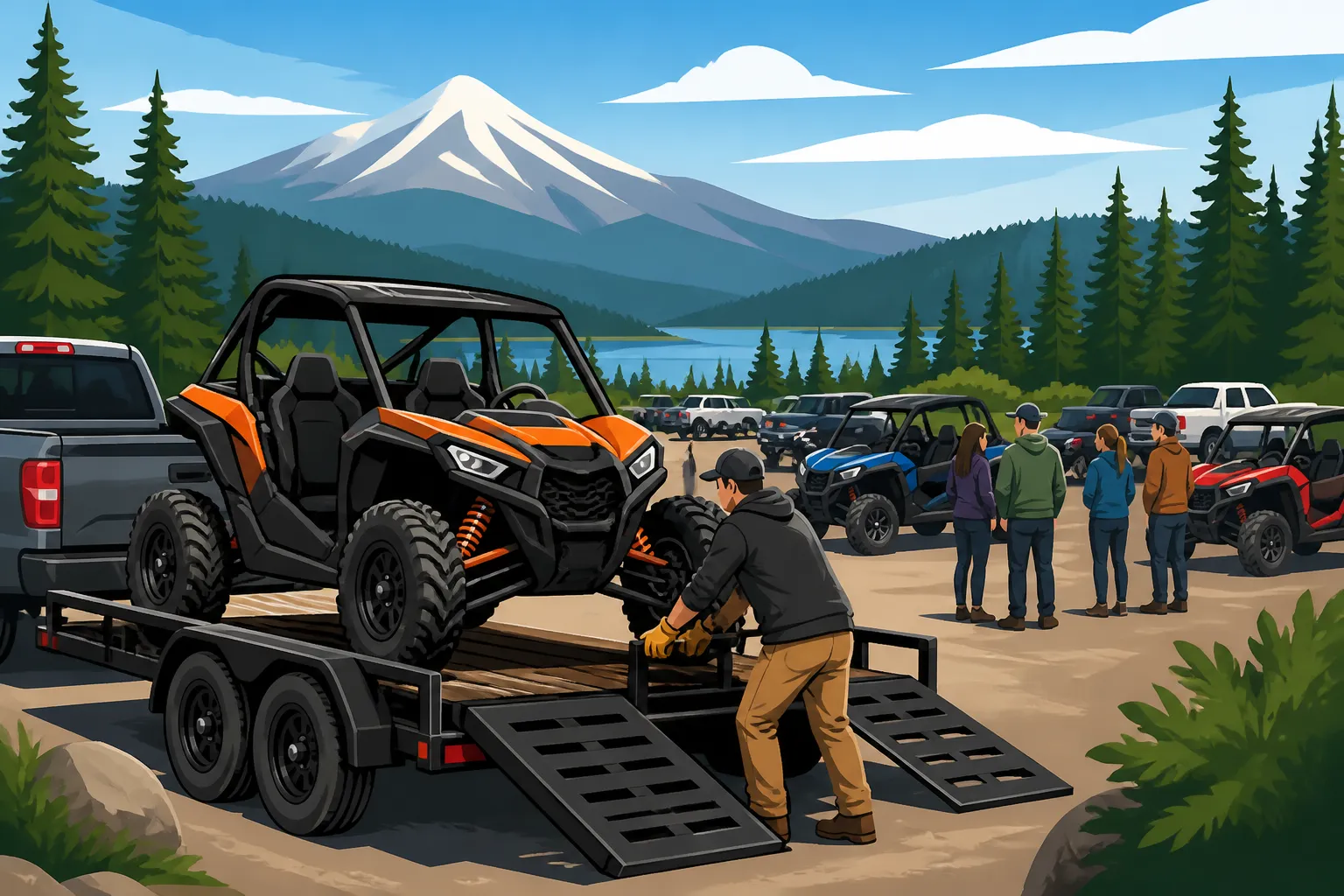
A pickup with a short trailer is easier to place than a long truck-and-trailer combination, but both need room to maneuver. Think about the complete footprint of your setup: truck, hitch, trailer, ramps, and the space needed to unload your machine. A parking space that fits the truck alone may not accommodate the trailer without sticking into a travel lane or narrowing access for others.
Before setting out, consider whether your trailer can turn around in the intended staging area. If you have a wide side-by-side or a tandem-axle trailer, a tight approach may be difficult even if the lot itself looks spacious. At smaller or less formal access points, arriving with a simple plan for backing and unloading is especially useful.
If your group is bringing several machines, coordinate who will drive, who will spot, and where each rig will wait. Agreeing on that before you reach a crowded entrance is easier than having several vehicles stop in different places while everyone tries to decide what to do. A passenger can help guide a trailer, but should stand where the driver can see them and where they are out of moving traffic.
Choose a parking spot that keeps access clear
Leave room for other users and emergency access
At a busy staging area, the most convenient open patch is not automatically a suitable parking space. Keep gates, access roads, turnarounds, marked routes, and emergency access areas clear. Don’t park where a vehicle would have to cross soft ground, squeeze between a trailer and a barrier, or make a blind turn to get through.
When there are marked spaces, use them and follow any posted instructions. If parking is unmarked, look at how vehicles are already arranged and choose a spot that preserves a clear path for both arriving and departing rigs. Avoid extending a trailer into the road or placing a ramp where it becomes a trip hazard. If a lot is full, don’t create a second row unless the layout clearly allows it and the arrangement does not obstruct traffic or access.
A simple rule helps: imagine a larger vehicle arriving behind you. Could a truck with a trailer pass, turn, and reach the unloading area without needing you to move? If the honest answer is no, adjust your position before unloading. Courtesy is practical here; one badly placed rig can make a crowded lot harder for everyone.
Keep in mind that the parking area may serve more than off-road riders. Hikers, cyclists, horseback riders, nearby residents, agency staff, and land managers may use the same road or access point. Be patient when people are moving through the area, and don’t assume that an open-looking shoulder is public parking. For planning a route from a campsite or nearby road, Riding From a Campground to a Trailhead can help you think through the access part of the day as well as the riding.
Park with an easy exit in mind
Backing into a space can make it easier to leave, especially when several trailers are arriving at once. But only do this if you can maneuver safely and without holding up traffic or blocking the entrance. If backing in would create a bottleneck, pull into a space the way the layout allows and leave yourself room to depart calmly.
Before you unhitch or unload, check the ground. A sloped surface can let a trailer roll if it is not secured, while loose gravel, mud, or uneven ground can make ramps unstable. Use the trailer’s normal safety equipment and follow its instructions. Set ramps firmly, keep bystanders clear during loading and unloading, and avoid placing a machine where it could roll into a traffic lane.
A passenger or friend can spot while you back, but agree on clear hand signals before moving. If you lose sight of your spotter, stop rather than guessing. On a busy day, stopping for a moment is far better than bumping another trailer or forcing someone walking through the lot to jump out of the way.
Don’t leave a rig positioned so that it can only exit by making a difficult reverse onto a busy access road. If you arrive and discover that the available space makes a safe exit unlikely, reassess before unloading. A different legal parking area or a different riding destination may be the less aggravating choice.
Use a simple arrival routine on busy weekends
Arrive ready to unload without holding up the lot
Prepare as much as you can before reaching the staging area. Secure loose gear, know where your straps and ramps are, and make sure the machine is ready to unload. When you arrive, take a moment to read signs and watch how traffic is moving. Avoid stopping in the entrance while you sort out helmets, paperwork, or who is riding which machine.
If the lot is busy, unload efficiently and move your truck and trailer fully into a suitable parking position before doing extended gear checks. Don’t leave a vehicle idling in the travel path while your group gets organized. If you need more room to dress or adjust equipment, do that after parking rather than turning the access lane into a staging space.
A phone map can help with orientation, but keep the driver focused on vehicle movement. If you’re using onX Offroad to check your route, passenger navigation is often easier than trying to study a screen while backing a trailer. Save the map and route details before you reach an area with poor reception, and use posted information on site to confirm local access conditions.
Use this arrival checklist:
- Slow down before the entrance and look for signs, traffic, and pedestrians.
- Confirm that the lot is the intended staging area for your vehicle and trailer.
- Choose a position that leaves gates, routes, and turning space clear.
- Secure the truck and trailer before unloading.
- Keep ramps, gear, and machines out of the access path.
- Check that your group is ready before moving onto the riding route.
If the area has a posted parking arrangement, follow it even if another arrangement looks more convenient. Parking in a way that respects the site can reduce conflict with other visitors and help keep access usable.
Make a backup plan if the lot is full
A full lot is a signal to pause and reassess—not an invitation to park wherever there is bare ground. Don’t block a gate, park across a narrow road, or leave a trailer where it forces other vehicles onto soft or fragile ground. If there is no clear, lawful space, use your preplanned alternative or choose another destination.
This is where planning pays off. Before leaving home, identify another suitable staging area or a different riding area that fits your group and vehicle. Check that the alternative is open and that its access and pass requirements work for your plans. The nearest visible pullout is not necessarily an authorized place to leave a truck and trailer.
For a group ride, tell everyone the backup plan before anyone leaves home. If the group gets split up, designate a meeting point that does not block the entrance or parking flow. Don’t ask arriving riders to circle a narrow access road indefinitely; that can create a new hazard while the lot is already congested.
onX Offroad may help you compare route options and keep the group oriented, but use it as a planning aid rather than a substitute for current local notices. If the only apparent alternative involves an unmarked shoulder, a closed road, or private land, don’t assume it is available for parking. You can also review Parking a Rig on a Busy Weekend alongside Finding a Staging Lot With Room and Parking a Rig on a Busy Weekend when planning how to manage a crowded arrival.
Protect your vehicle and leave the site in good shape
Secure your truck, trailer, and belongings
Before leaving your rig for the ride, check that doors are locked, windows are closed, and valuables are out of sight. Keep keys and important documents in a secure place, and avoid leaving tools or riding gear scattered around the truck. If you’re carrying fuel, store and secure it in a way that follows the container’s instructions and applicable site rules.
Make sure the trailer is properly secured, including the hitch, coupler, and any equipment that should be locked when unattended. Check that ramps are stowed and that straps or loose items cannot blow away or become hazards. A quick walk around the setup before heading out can catch a forgotten ramp, open tailgate, or unsecured cooler.
Weather can complicate parking in Washington. Rain may turn a firm-looking shoulder or lot edge into soft ground, while dust and wind can spread loose gear. Avoid parking on vegetation or ground that looks vulnerable to rutting. If your vehicle begins to sink or spin, stop rather than repeatedly powering through and making the area worse. For rainy-day planning, Washington Riding in the Wet Season and Parking a Rig on a Busy Weekend are useful reminders that the condition of the lot can change along with the trail.
Leave the staging area as usable as you found it
Pack out your trash and any small items that fall during unloading. Don’t dump wash water, fuel, oil, or other fluids at the trailhead. Keep noise and idling to a minimum, particularly near homes or other visitors, and follow posted instructions about waste, fires, and overnight parking.
When you return, check the lot before loading. Look for people moving through the area, secure ramps, and wait for a clear space to load without blocking another rig. If another vehicle is trying to leave, give it room rather than starting a loading operation that traps it. A little patience at the end of the ride makes the whole site work better.
Before driving away, walk around your truck and trailer. Check that the machines are tied down, the trailer connection is secure, and nothing has been left on the ground. If you rode in muddy conditions, consider how you’ll clean the machine without carrying mud or plant material to another riding area. Washing a Machine Before You Leave offers additional guidance for keeping the next site in mind.
| Situation | Better choice | Avoid |
|---|---|---|
| Main staging lot is crowded | Pause, check signs, and use a planned alternative if needed | Parking in an entrance or blocking a gate |
| Trailer needs room to turn | Use a spot with enough maneuvering space | Forcing a tight turn that obstructs other vehicles |
| You need to unload | Park and secure the rig before setting out ramps | Leaving ramps or machines in the travel lane |
| Group arrives separately | Agree on a meeting point that does not block access | Waiting in a narrow road or entrance |
| Ground is soft or wet | Choose firm, suitable parking and avoid vegetation | Spinning tires or creating ruts |
| You’re unsure whether a spot is permitted | Check posted information or choose another location | Assuming an open shoulder is public parking |
A busy weekend does not have to begin with a parking dispute. Check access information before leaving, bring a rig that fits the plan, keep the lot clear, and have an alternative ready if the preferred staging area is full. Those small decisions make arrival safer and leave more room for everyone to enjoy the ride.
Disclaimer
This article is for general informational purposes only and does not constitute professional advice. Laws, prices and regulations vary by location and change over time. Consult a qualified professional for guidance on your specific situation.