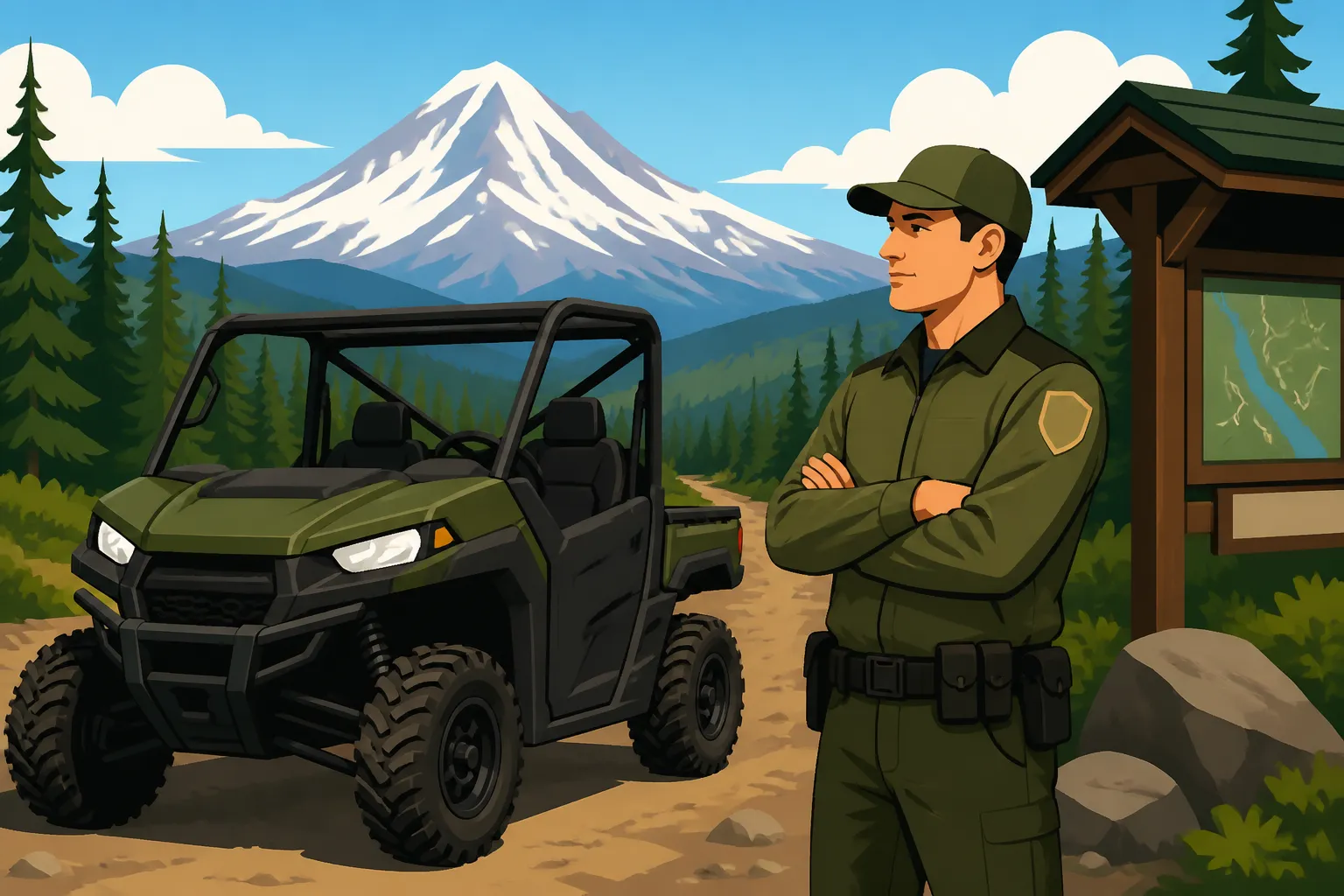
A Ranger at a Washington Trailhead
A ranger at a Washington trailhead may check more than whether your machine has tabs. Registration, recreation passes, route access and rider requirements can all matter, and they are separate issues. Knowing what to carry and how to answer a question calmly helps you avoid a preventable delay—and, more importantly, avoid riding somewhere your machine is not allowed.
What a ranger may check at a Washington trailhead
A trailhead check is usually about whether you and your machine are prepared to use that particular area lawfully. The ranger or other land manager may ask to see registration, a required recreation pass, or documents showing that an out-of-state machine is properly registered. They may also ask where you plan to ride, because a legal machine can still be on a closed road or unauthorized trail.
Requirements depend on who manages the land and what kind of riding you plan to do. A state-managed site, a federal recreation area and private timberland do not necessarily use the same passes or access rules. A pass that works for one part of a trip may not cover another.
| What may be checked | What it demonstrates | Why it is separate |
|---|---|---|
| Machine registration, tabs or permit | The machine is registered or otherwise authorized for the type of use | Registration does not necessarily pay for parking or site access |
| Recreation pass | You have paid for or are covered by a required land-access pass | A pass does not register the machine or make a closed route legal |
| Route or area rules | The trail, road or staging area is open to your machine | A valid registration does not grant access to every route |
| Rider requirements | Riders meet applicable age, supervision, equipment or safety rules | Requirements can depend on the rider, machine and location |
For example, a Washington ORV registration and a Discover Pass serve different purposes. The registration relates to the machine’s permitted use; the pass relates to access to certain state recreation lands and facilities. Federal sites may have their own pass requirements. If your route crosses between land managers, check each part rather than assuming one pass covers the full outing.
The same distinction applies to an out-of-state registration. Washington’s reciprocity rules may allow some visitors to ride using their home-state credentials, but that does not automatically settle every question about a recreation pass, route closure or local rule. Review Washington ORV Reciprocity With Other States before relying on a home-state sticker.
A ranger may also want to know whether you understand the area’s boundaries and current conditions. A map, posted notice or closure sign can matter just as much as paperwork. If you are unsure whether a road is open to your machine, do not treat a map line or another rider’s route as proof. Check the relevant land manager’s current information and ask before heading out.
What to carry and how to keep it ready
Carry the machine’s registration documents in a way that keeps them available and readable. Wet weather, mud and vibration can turn loose paperwork into a soggy mess. A sealed document pouch stored in a secure place on the machine is a simple option; pouches are available from outdoor retailers and Amazon. Keep the documents protected without placing them where they could interfere with controls or become a hazard in a rollover.
For practical preparation, carry:
- The machine’s registration or permit documents
- Any recreation pass required for the site, displayed or presented as its terms require
- Your driver license or other identification when relevant to the ride
- A map or saved route information for the area
- Any documents needed to explain a nonresident registration or temporary permit
- A phone or written note with the land manager’s contact details, if available
Rules about what must be carried on the machine are worth checking before departure. Carrying the Registration in the Machine covers that specific question. Do not assume that a photo of a document on your phone will be accepted in place of the required physical registration, or that a pass displayed in one way is valid at every site. Follow the instructions for the particular credential and location.
It also helps to keep documents organized by machine. If you are bringing two machines, confirm that you have the right registration paperwork for each one, not just the paperwork for the vehicle towing them. A temporary permit may be tied to a particular machine, so do not assume it can be moved to another machine or handed to a riding companion. Confirm the terms before traveling.
Before you leave home, check whether the destination requires a separate recreation pass. Showing a Discover Pass at a Washington Trailhead explains the practical issue of presenting that pass at a trailhead. If the outing includes federal land, check whether a different pass applies. Some recreation sites require a Northwest Forest Pass, while others have different access arrangements. See Which Trailheads Ask for a Northwest Forest Pass if that may affect your route.
A pass is not a substitute for checking closures. Trail work, weather, fire restrictions, timber operations and other conditions can change what is open. Check alerts close to departure and again at the trailhead if notices are posted. Checking Alerts Before You Load Up is useful when a trip depends on a particular route being available.
Visitors, reciprocity and temporary permits
If you live outside Washington, work out your machine’s registration status before you arrive. A visitor with current home-state registration may have a different path from a visitor whose home state does not register or authorize that type of machine. Reciprocity is not simply a general permission to ride: the machine and its credentials need to fit the applicable rules.
Start by confirming that the home-state registration is current and applies to the machine you are bringing. Then check whether Washington recognizes it for the planned type of use. Do not rely only on a seller’s assurance, an old online discussion or a registration sticker that has expired. Riding Washington With an Out-of-State Registration and What a Visitor With No Home-State Registration Buys address two situations that can look similar at the trailhead but may require different preparation.
A temporary ORV permit may be an option in some visitor situations, but it is not a universal substitute for registration, and its terms can limit where or how you ride. Confirm the current eligibility, duration and use restrictions with the appropriate official source before buying or relying on one. Washington Temporary ORV Permit for a Visitor explains the visitor-specific question, while Why a Temporary Permit Stops at the Pavement is relevant if you are considering riding on roads.
Pay attention to the distinction between getting to a trailhead and riding on a road. A permit intended for off-road use may not allow you to ride on public pavement, even for a short connection. You may need to trailer the machine to the riding area or use a route that is specifically authorized for that machine. A trailhead parking lot does not create permission to ride along the road outside it.
Reciprocity also does not erase local land rules. Even with valid registration, you may need a site pass, and the machine must stay on routes open to its type and width. Rules can differ between state-managed and federal land, or between adjacent properties. If your day includes more than one area, verify the requirements for each rather than treating the first trailhead’s rules as universal.
If you have paperwork that may need explanation, keep it accessible and answer questions directly. Be ready to identify the machine, show the relevant registration and explain your planned route. If the ranger says a credential is not valid for that location, do not ride first and try to resolve it later. Ask what requirement is missing, where the official rule is posted and whether there is a lawful alternative.
Handling a trailhead check calmly
A roadside or trailhead check can feel inconvenient, especially when a group is waiting. A straightforward response usually makes the interaction easier: stop where directed, turn off the machine if asked, keep your hands visible and follow instructions. Have documents ready, but do not reach suddenly into a bag or storage compartment without saying what you are doing.
If the ranger asks about your route, answer accurately. Do not claim a road is open because another rider used it, or because a map app shows it as passable. If you realize you are not sure, say so and ask where to verify the route. A route that is physically rideable is not necessarily open to ORVs.
When something appears wrong, separate the issues. For example, a ranger may be questioning your recreation pass rather than your registration, or may be directing you away from a closed route despite valid tabs. Ask which requirement is at issue and what action is needed. If you believe you have the correct document, present it calmly and ask for clarification rather than arguing at the trail entrance.
If you forgot a pass, do not assume that a receipt, an expired pass or another vehicle’s pass will count. Follow the site’s instructions for buying or obtaining a valid pass, if that is permitted. Otherwise, leave the area and return when you have the right credential. What Happens If You Forget Your Discover Pass covers the practical consequences of arriving without one.
If your machine’s registration is the problem, do not continue riding while you try to sort it out. Park or trailer it as directed, then contact the licensing or land-management office that can confirm the correct next step. A ranger may be able to explain what is missing, but may not be able to issue or correct every registration document on the spot.
Before unloading, make one last check: the machine is properly registered for the ride, the needed land pass is covered, the route is open, and each rider meets the applicable requirements. For state-managed land, review Washington Rules for Riding DNR Land as well as any area-specific notices. Taking a few minutes at home and at the trailhead is usually easier than turning a planned ride into a paperwork problem.
Disclaimer
This article is for general informational purposes only and does not constitute professional advice. Laws, prices and regulations vary by location and change over time. Consult a qualified professional for guidance on your specific situation.