Do Rentals Come With Their Own ORV Tabs?
Renting an ATV or UTV in Washington raises a practical question: does the machine already have the tabs needed for public trails, or must you arrange a permit yourself? Usually, the rental provider handles the machine’s registration. But tabs do not automatically cover every land-access pass or make a trail machine legal on roads.
How ORV tabs work on a rental
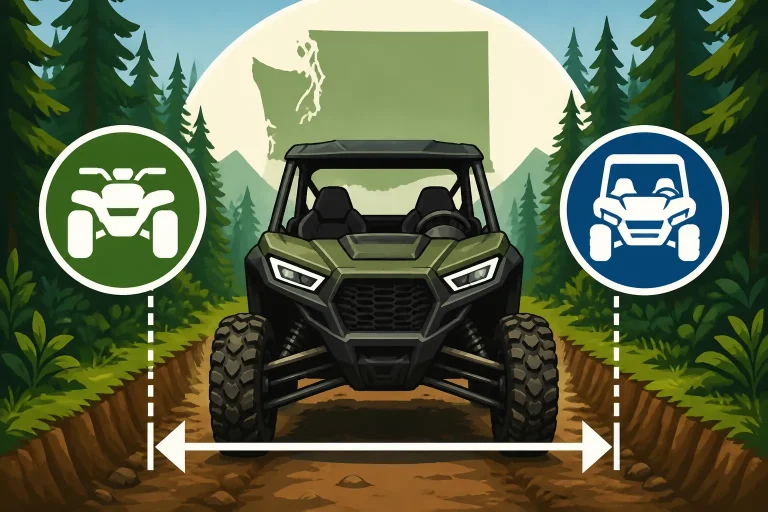
Washington ORV tabs are associated with a specific machine, not with the person renting it. A rental company that prepares machines for public riding will generally arrange the required registration and display the decals on each machine. That means you usually do not need to register the rental in your own name just to ride it during the rental period.
The key word is usually: do not assume the machine is properly registered just because it came from a rental shop. Ask the provider what registration applies to the machine and where you are allowed to ride it. For more detail on the basic registration setup, see Washington’s Off-Road Tab Explained and Washington’s Two-Tab System.
| Item | Usually handled by | What to confirm before riding |
|---|---|---|
| ORV registration and tabs | Rental provider or machine owner | The tabs are current and belong to the machine you are taking |
| Registration documents | Rental provider supplies or keeps them as required | What paperwork must be carried and where it is stored |
| Land-access pass | Depends on the riding area and provider | Whether a separate pass is needed for the parking area or site |
| Road-use eligibility | Provider and rider, under applicable rules | Whether the machine and route are approved for public-road use |
| Temporary permit or reciprocity question | Depends on the machine and circumstances | Whether the provider’s registration is accepted for your planned ride |
A rental agreement is not itself an ORV registration. It may identify the machine and explain your responsibilities, but it does not replace required tabs or paperwork. The decals should be attached to the machine as required, and any registration card or other document that must accompany it should be available in the manner the provider specifies. See Washington ORV Registration for a Rental Fleet for the fleet-owner side of the process.
Before you leave the pickup location, check that the decals are present and legible. If you cannot see them, or the staff cannot explain the machine’s registration status, pause and ask for clarification. A missing decal may have been damaged or lost, but you should not assume that is the explanation or head to a public riding area without resolving it.
Also ask what “registered” means for the ride you have planned. An off-road tab may cover the machine for certain off-road use, but it does not automatically make the ATV or UTV legal on every street or road. A rental machine may be intended strictly for trails, even if the route to the trailhead appears short. The rental company’s permission to use its machine is separate from public-road authorization.
Tabs stay with the machine
The tabs on a rental are not a pass you take home or transfer to your own ATV. They identify the machine’s registration status. If you switch to a different rental machine, check that machine’s decals and paperwork too; do not assume that documents for one vehicle apply to another.
This distinction matters when riding in a group. A friend’s registered machine does not make an unregistered rental compliant, and a registration card for one rental should not be treated as proof for the whole group. Each machine should be accounted for individually.
The same principle applies if you are visiting from another state. A rental operator may have a Washington-registered machine ready for you, in which case your personal home-state registration may not be the central issue. If the rental is registered elsewhere, or the provider says it relies on reciprocity, ask what rule applies to that specific machine and where it may be ridden. Washington ORV Reciprocity With Other States explains why reciprocity should not be assumed to cover every situation.
What tabs do not cover
Having ORV tabs does not mean every cost, access rule, or permission is settled. Tabs address registration. Riding areas can have separate requirements for entry, parking, land access, equipment, age, or route use. Ask the rental provider about each part instead of treating “the machine has tabs” as an all-purpose answer.
Passes and site access
Some riding destinations require a separate pass or other authorization, while others do not. A pass may be tied to access or parking rather than to the rental machine’s ORV registration. Whether a rental company supplies one depends on its arrangements and the destination.
Ask directly: “Does the rental include the pass required at the riding area, or do I need to get one?” Then name the destination. If the pass is not included, ask what type is accepted, where it must be displayed or carried, and whether it applies to the parking vehicle, the ORV, or both. Does a Rental Carry Its Own Pass? covers this distinction, and The Discover Pass and Washington Riders can help when state-managed access is involved.
Do not assume that a pass from the rental shop is valid everywhere. Access rules differ by land manager and site, and a parking pass is not permission to ride a closed trail or cross land where motorized use is prohibited. Check the riding area’s current notices and map before loading up.
Road use is a separate question
An ORV tab alone does not authorize a rental ATV or UTV to travel on public roads. Washington road use depends on the machine’s eligibility and equipment, the route, and local authorization. A route being paved, quiet, or commonly used by other riders does not establish that it is open to your rental.
For a planned road segment, ask the provider whether the exact machine is approved for that use and whether the specific road is open to it. If the answer is unclear, keep the rental off the road and use a trailer or another lawful route to reach the riding area. Washington Rules for a Rented Machine and Riding a Rented WATV on Washington Public Land offer more context for rental use.
A machine with both off-road and on-road tabs may still face restrictions on where it can travel. A road-use tab is not a blanket permit for every county road, city street, or highway. The vehicle must meet applicable road requirements, and the road itself must allow the use. Ask the rental shop whether the machine is trail-only; do not infer road eligibility from its lights, mirrors, or other equipment.
A permit for visitors may not be the answer
Visitors sometimes see information about temporary ORV permits and assume they need to buy one for a rental. That may be unnecessary if the rental machine already has the registration required for the planned ride. It could also be the wrong solution if the real issue is a separate land pass, an out-of-state registration question, or permission to use a particular road.
Before buying anything, give the provider the details: where the machine is registered, where you plan to ride, and whether you intend to use any public road. Ask whether the rental already meets the registration requirement and what, if anything, you must obtain yourself. Washington Temporary ORV Permit for a Visitor explains the visitor-permit topic, but the rental provider should clarify what applies to the specific machine you will receive.
If the machine has out-of-state plates or decals, do not guess that Washington accepts them everywhere. Reciprocity can depend on the registration and the kind of use. The rental company should be able to tell you the machine’s status and any limits it knows; confirm uncertain rules before riding. A temporary permit is not a substitute for asking whether the machine is allowed on the land or route you have chosen.
What to check before leaving the rental shop
A quick conversation at pickup can prevent a wasted trip or a roadside problem. Get specific answers rather than relying on a general assurance that the rental is “ready to ride.”
- Identify the machine. Confirm the make, model, and identifying number on your rental paperwork match the machine you are taking.
- Inspect its tabs. Locate the decals, check that they are readable, and ask whether they are current for the planned use.
- Ask about required documents. Find out whether registration paperwork must be carried on the machine, supplied by the operator, or kept elsewhere. If you are responsible for carrying a document, know where it is before you leave.
- Name the riding area. Ask whether the machine’s registration is suitable there and whether that location requires another pass or access authorization.
- Settle the road question. If your route uses pavement, ask whether the rental is approved for road use and whether the exact route is open to it. If not, arrange a route that stays off public roads.
- Clarify who obtains extra permits. Ask whether the company provides any needed pass or whether you must buy it separately. Do not purchase a permit on the assumption that it is needed until you know what the machine already carries.
- Get the restrictions in writing. Check the rental contract or ask staff to mark approved areas and prohibited routes. Keep the agreement and any required paperwork dry and accessible.
If you need to protect paperwork from rain or mud, a small waterproof document pouch can help; a retailer such as Amazon may carry them. It is a convenience, not a replacement for the required registration document or a pass.
Keep the rental agreement separate in your mind from the machine’s legal status. The agreement may limit where you can ride even when public rules allow broader use. Conversely, a rental company’s permission does not override trail closures, land-manager rules, or road restrictions. Follow both the contract and the rules for the place you are riding.
The practical answer is simple: the rental company will generally handle ORV tabs for its machine, but you should verify the decals and ask about the specific ride. Then confirm any separate site pass, visitor-registration issue, or road restriction. That short check is more reliable than assuming the tabs cover everything.
Disclaimer
This article is for general informational purposes only and does not constitute professional advice. Laws, prices and regulations vary by location and change over time. Consult a qualified professional for guidance on your specific situation.