Riding a Road That Crosses Private Land
A road can look public, appear on a map, and still cross land you do not have permission to enter. In Washington, the key question is not just who owns the ground beneath the road, but whether the route is public, privately controlled, or subject to an access agreement. Here’s how to check before riding, and what to do when the status is unclear.
First identify what kind of road you are looking at
A road crossing private land is not automatically a private road. Public roads can pass through privately owned parcels, and a landowner may own the land around a public road without controlling lawful travel along it. The reverse is also true: a road that looks like a county route or appears on a recreational map may be a private road with no general public access.
Before riding, separate two questions:
- Who controls access to the road? It might be a public agency, a private landowner, a timber company, or more than one party under an easement or agreement.
- Is your machine allowed on that road? A road can be open to some traffic but not to an ATV or UTV, or it can be open only under specific conditions.
A paved or gravel surface does not settle either question. Neither does the fact that other riders have used it. A tire track is not proof of public access, and a route shown on an old map may have been closed or changed. If you are planning to use a county road, check the county’s current information rather than assuming that every road through the county is open. Finding a County’s Approved Road List explains why the approved list matters.
| Road situation | What it usually means for a rider | What to check |
|---|---|---|
| Public county or city road crossing private parcels | The road may be public, but ATV or UTV use can still be restricted | Current local road rules, posted limits, and whether that road is open to the machine |
| Private timber or farm road | Public access is not automatic | Permission, permit conditions, signs, and gates |
| Road covered by a public easement | The easement may allow limited public travel, not every kind of use | Who holds the easement and what uses it permits |
| Road with unclear or conflicting signs | The status is uncertain | Stop and confirm with the road authority or landowner before proceeding |
| Closed road or locked gate | Do not ride past it without specific authorization | Closure notice and the person or agency responsible for access |
Washington’s road rules for machines matter even when a road is public. A route may have a posted speed limit, local restrictions, or an approved-use list that determines whether an off-road vehicle can travel there. For a broader look at route-specific requirements, see Washington Rules for Riding a County Road. A machine’s registration, tabs, or road equipment do not create permission to use private property.
Public access does not mean access to every road
Private ownership and public access can overlap, but riders should not assume that a road is public just because it connects two places or looks like a through route. A public road may cross private land, while a privately controlled road may connect with a public road at both ends. The visual layout tells you little about the legal access rights.
County roads are generally managed through local government, but a road’s status and suitability for off-road vehicles can vary by location. Check the road authority’s current records and the rules for the specific segment. Do not rely on a route line in a navigation app alone: mapping services may show roads without explaining whether they are public, open, or suitable for your machine.
A private road can also be subject to a public easement or another access arrangement. That does not necessarily make it open to all riders. An easement may be limited to particular users or purposes, and its terms may not allow recreational ATV or UTV travel. If the route’s public status is not clear, ask the county or other responsible road authority rather than trying to interpret a parcel map on the trail.
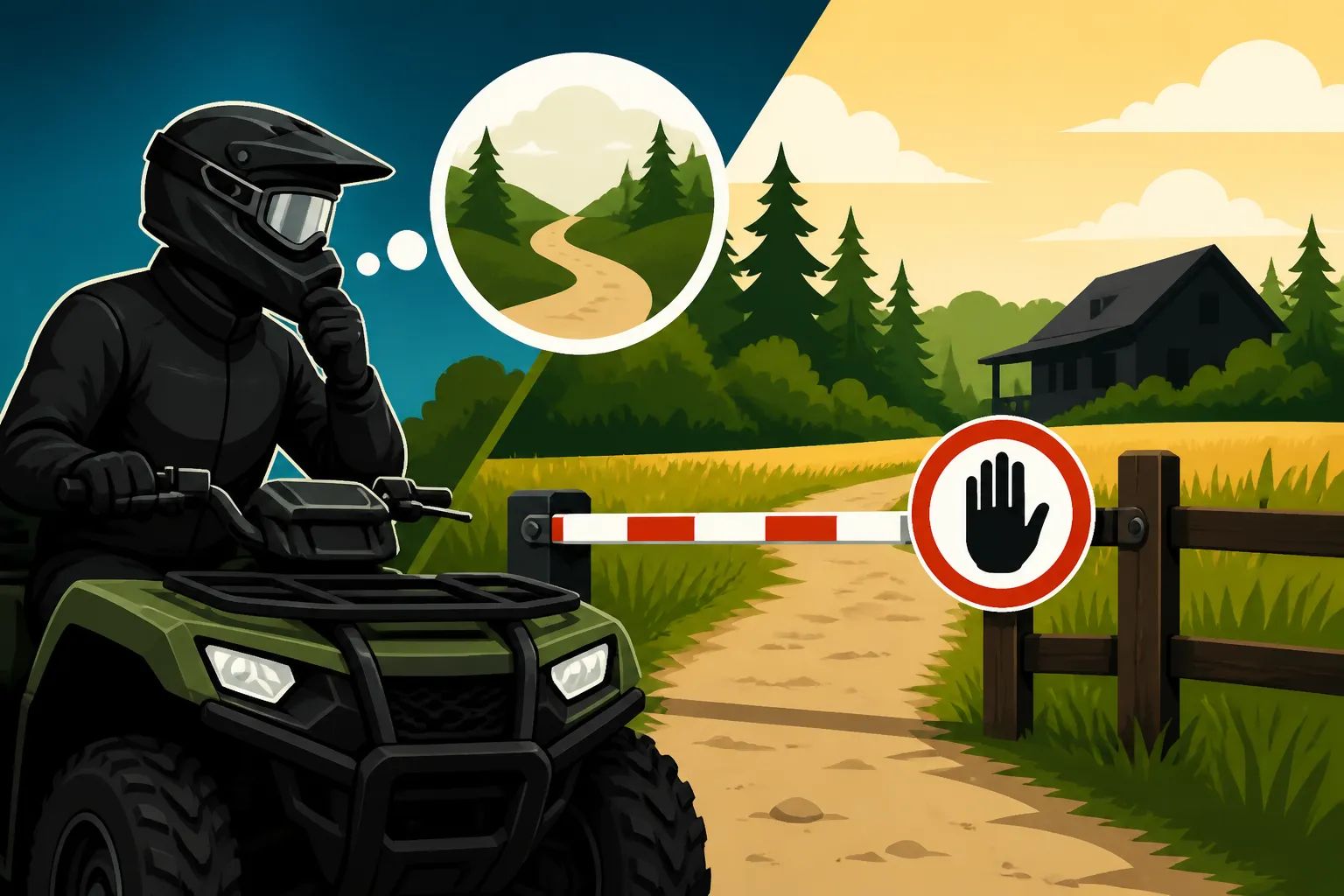
Pay close attention to signs and physical access controls. A “private road” sign, a gate, or a closure notice should be treated as a reason to stop and verify access. A gate being open does not necessarily mean the road is open to the public; it may have been left open for work, deliveries, or residents. Likewise, a sign at one entrance may apply to the road beyond it even if the next stretch appears unmarked.
If your route includes a road that crosses private property, plan a legal alternative before leaving home. A detour on a public route may take longer, but it is safer than turning around at a closed gate or risking a trespass complaint. For roads that are visibly controlled by a timber company or other landowner, the rules in Washington Rules for Riding a Logging Road are especially relevant.
Getting permission to ride a privately controlled road
If a road is private, get permission from the person or organization that controls access before you ride. Do not assume that a nearby homeowner, a person working at a gate, or someone who uses the road has authority to grant permission on behalf of the owner. Ask who manages the route and what the permission covers.
For a casual ride, permission should be specific enough to avoid misunderstandings. Confirm:
- The exact road or route you may use, including where you may enter and exit.
- Whether ATVs, UTVs, or both are allowed.
- The dates or time period permission applies to.
- Whether there are restrictions on speed, passengers, noise, group size, or stopping.
- Whether you may use side roads, spurs, staging areas, or turnaround areas.
- Whether a gate must be closed or locked behind you.
- Whether conditions such as logging activity, fire danger, or wet weather can suspend access.
A text or written message can help both sides remember what was agreed, but it is not a substitute for permission from someone with authority. Keep any permit or access instructions with you, and make sure every rider in the group understands the limits. A permission granted to one rider may not cover friends, additional vehicles, or a later trip.
Timber companies and other landowners may use permits, seasonal access rules, or temporary closures. A permit can allow access only on named roads and only while those roads remain open. It does not necessarily authorize travel through every gate or onto neighboring parcels. See A Timber Company Permit in Washington for the kinds of details to confirm, and Asking a Landowner Before You Ride for a practical approach to making the request.
Access can change after permission is granted. A landowner may close a road for hauling, maintenance, fire risk, or other work. Treat a new closure sign or a locked gate as current information, even if you received permission earlier. Do not move, climb over, or ride around a barrier to continue your route. If you reach a gate you expected to be open, stop in a safe place and contact the person who authorized access. What to Do at a Locked Timber Company Gate covers that situation in more detail.
Permission also does not cancel other rules. You may still need the correct Washington ORV registration or permit for the kind of riding and location, and a road-legal WATV must meet applicable road-use requirements where those apply. Visitors should check whether their home-state registration or permit is recognized for the trip; reciprocity does not give access to private land. Start with Washington ORV Reciprocity Rules if you are bringing a machine from another state.
What to do when access is uncertain
If you cannot confirm whether a road is public or private, do not treat uncertainty as permission. Stop before entering the questionable segment, check signs and maps, and contact the authority or landowner responsible for the route. If you cannot get a clear answer, choose a route with confirmed access.
A sensible pre-ride check can prevent most access problems:
- Map the full route. Note every road that may cross private land, not just the destination and trailhead.
- Check current local information. For county or city roads, look for the current route list, ordinance, or road-use notice. For private roads, look for the landowner’s access requirements.
- Confirm machine eligibility. Verify that the specific road allows your ATV or UTV, rather than assuming that access for cars or trucks also includes off-road vehicles.
- Ask for permission where needed. Get approval from someone who can authorize your use, and clarify the route and conditions.
- Carry the relevant information. Keep permits, permission details, and contact information accessible in case a gate or sign raises a question.
- Follow changes on the ground. A current closure notice takes priority over an old route plan. Turn around if access is closed or unclear.
Do not use a parcel map as a complete access guide. Parcel maps can help identify owners, but they do not always establish the legal status of a road or explain an easement. Similarly, a road displayed on an online map may be a private route, may have changed, or may be incorrectly classified. When the information conflicts, ask the responsible county office, land manager, or landowner.
If you find that you have entered a road without permission, do not continue deeper into the property or look for another way around a barrier. Turn back by the route you came in, where it is safe to do so, and contact the landowner if appropriate. If a gate is locked behind you or an emergency makes retreat unsafe, seek help rather than damaging a gate or forcing an exit.
The practical rule is simple: confirm both the road’s status and your machine’s right to use it. A public road through private land may be legal to ride only if local rules allow your machine. A private road may be usable only with clear permission. And a registration, sticker, or map line is not a substitute for either.
Disclaimer
This article is for general informational purposes only and does not constitute professional advice. Laws, prices and regulations vary by location and change over time. Consult a qualified professional for guidance on your specific situation.