Washington Fines for Riding a Closed Trail
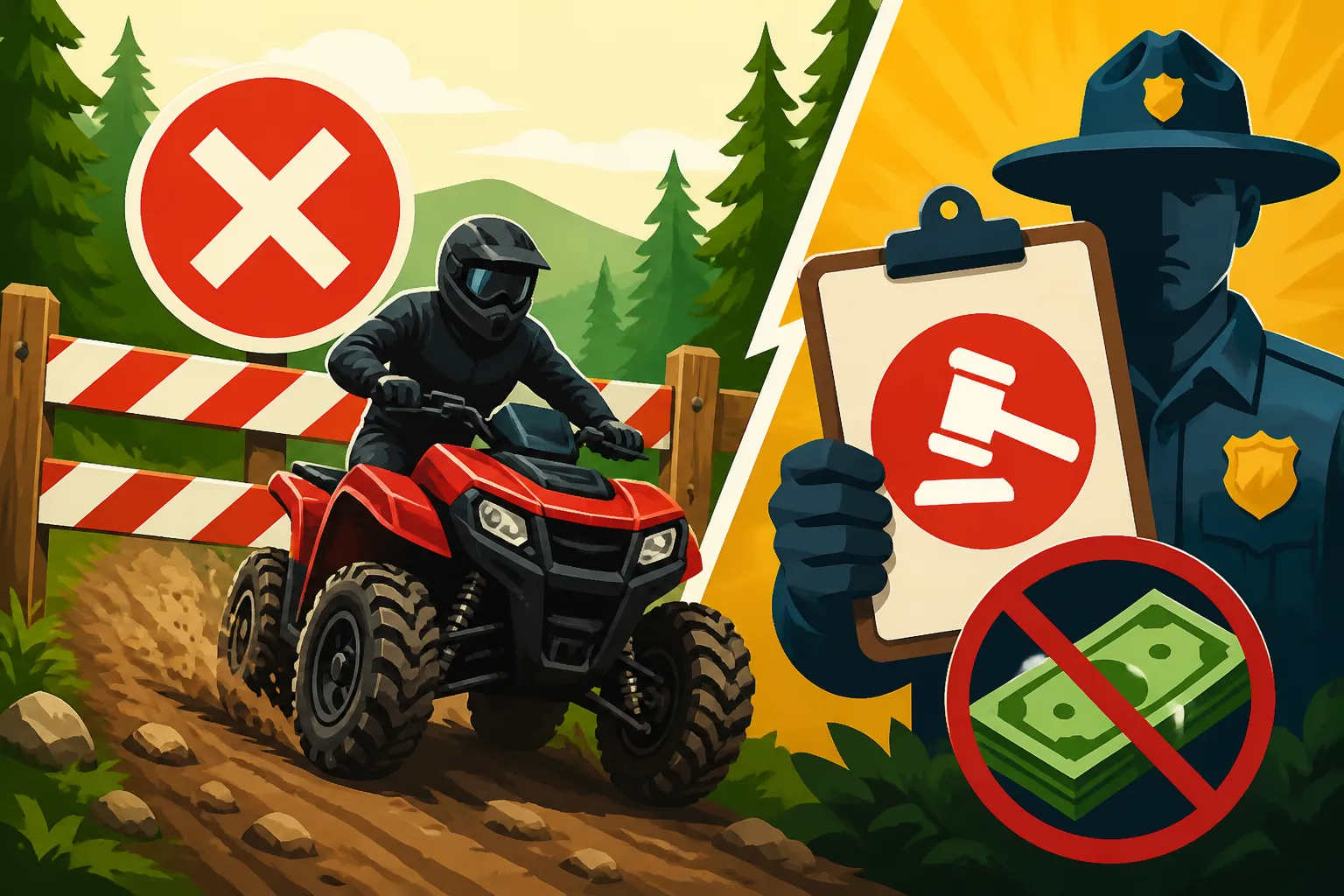
Riding an ATV or UTV on a closed trail in Washington can lead to a citation, but there is no single fine that applies to every closure. The outcome depends on who manages the land, why access is restricted, and what the posted notice says. Knowing how closures are enforced—and what to do if you receive a citation—can help you avoid turning a ride into a costly problem.
Why riding a closed trail can lead to a fine
A trail closure is more than a suggestion to choose another route. It may be based on a land manager’s rules, a temporary safety restriction, environmental protection, fire danger, timber operations, or another legal access limit. Riding past a sign, gate, or barricade can violate the rules that apply to that land, even if the trail looks passable or you have ridden it before.
The possible consequence is not determined by the word “closed” alone. A route may be closed under one agency’s recreation rules, while a different closure may involve a road, private property, or a restricted area. The land manager and the legal basis for the closure matter. So do the details of the incident, such as whether the closure was clearly marked and whether the rider continued after being told to turn around.
There is no one statewide fine amount to rely on for every closed-trail situation. An officer or land manager may issue a citation under the rule that applies to that location. In some situations, riding beyond a closure may also raise a separate trespass or access issue. More serious consequences may be possible if the conduct involves damage, disregard of an official direction, or entry onto land where access is prohibited. The exact outcome depends on the facts and the applicable rules.
A Discover Pass, ORV registration, temporary permit, or out-of-state registration does not authorize riding on a closed route. Those documents may meet separate access or registration requirements, but they do not cancel a closure. The same is true of permission to ride elsewhere on the property. A valid permit for one area or activity does not automatically apply to every trail nearby.
| Situation | Why it matters | Practical response |
|---|---|---|
| A trail is closed by a sign or gate | The restriction may be enforceable even if the route appears usable | Stop and find an open route |
| A closure is temporary | Conditions may change, but reopening is not automatic | Check the land manager’s latest alert |
| A route crosses private land | Public access may be restricted separately from nearby public trails | Do not assume a public trail map grants permission |
| You have a valid permit or pass | A pass does not override a closure | Follow the closure and use an eligible open area |
| The closure notice is unclear | The boundary or instructions may need confirmation | Avoid entering and contact the land manager |
The rules for a closed trail can differ from rules for an unapproved public road. For example, a closed forest trail is not necessarily treated the same way as riding a WATV on a road that has not been opened to that use. If the incident involved pavement or a road corridor, see Washington Fines for Illegal WATV Road Use and Washington Rules for Riding a Closed Road. For trail access on state-managed land, Washington Rules for Riding DNR Land explains the separate access considerations.
What affects the penalty and how enforcement works
A citation usually depends on the rule that applies at the location, not on a single statewide schedule for all closed trails. Washington has public land managed by different entities, along with private land and routes that may cross several ownership boundaries. A trail map may show a route, but the map alone does not prove that it is currently open or that a particular vehicle can use it.
The land manager and reason for the closure
A closure may come from a state, federal, county, city, or private land manager. The reason can affect both how long the restriction lasts and what conduct it covers. A closure for active logging, storm damage, fire danger, habitat protection, or a safety emergency may have different terms from a long-term restriction on motorized use.
The agency or owner responsible for the land can explain which rule applies and where the closure begins and ends. If a route crosses between properties, a closure on one section can make the continuous route unavailable even if the adjoining section remains open. Do not treat an open trailhead or nearby staging area as proof that every connecting route is open.
The notice, boundary, and conduct
A clear sign, locked gate, or barricade is an important warning to stop. But the absence of an obvious sign is not a guarantee that the route is open. Some restrictions are posted online, at a nearby junction, or at an entrance rather than beside every segment. A trail may also close after a map or printed guide was published.
If you encounter a closure, do not move a barricade, ride around a gate, or continue to see whether the route opens farther ahead. Those actions can make the circumstances worse and may create damage or safety risks. If you are unsure whether a sign applies to your route, stop in a safe place and contact the land manager before proceeding.
The type of violation
An enforcement officer may focus on the specific restriction that was violated. That could involve riding on a closed trail, ignoring an access restriction, crossing onto private property, or operating without a required registration or pass. These are not interchangeable issues, and one citation does not necessarily cover every possible violation.
For example, a rider who has the correct tabs may still be subject to a closure citation. A rider on an open route may face a separate registration issue if the machine is not properly registered. Washington Fines for Riding Without a Tab covers that distinct problem. Keeping the paperwork in order is worthwhile, but it does not replace checking the route’s status before riding.
Damage or disregard of instructions
A ride that causes damage to a trail, vegetation, a gate, or other property may have consequences beyond simply entering a closed route. The same may be true if a rider ignores a direct instruction from an officer or land manager. Do not assume a warning will always be offered before a citation.
If you are stopped, remain calm, follow lawful directions, and avoid arguing at the scene. You can ask which rule or closure applies and how to obtain the written citation or incident information. Keep your account factual. Do not remove signs or make changes to the trail in an attempt to resolve the situation yourself.
What to do if you receive a citation
A citation is not the right time to guess about deadlines or assume the issue will disappear. Read the notice carefully, keep a copy, and follow the response instructions printed on it. The process and deadlines can depend on the type of citation and the issuing authority, so use the information on the document and confirm any unclear point with the court or agency listed there.
Take these steps:
- Keep the citation and related paperwork. Save the original document, any photographs, maps, permit records, and messages you receive from the land manager.
- Write down what happened while it is fresh. Record the date, approximate time, location, direction of travel, weather, signs you saw, and any conversation with an officer or staff member.
- Preserve location details. Save a map screenshot or GPS track if you have one, but do not edit it in a way that could make it misleading. Note where the closure sign or barrier was in relation to your route.
- Identify who manages the land. The agency or property owner can clarify the closure and may be able to provide the notice or map in effect at the time.
- Follow the response process on the citation. If you want to contest it, use the stated process and meet the applicable deadline. Do not rely on informal conversations to replace a required response.
- Get legal advice if the consequences are significant or unclear. A qualified attorney can review the specific citation and circumstances.
Photographs can help establish what you saw, but they do not automatically determine whether a citation is valid. If you take photos later, do so from a safe, lawful location. Do not go back onto a closed route to recreate the scene or collect evidence.
A closure notice may have changed after your ride, so ask for the version that applied on the date of the incident. If you believe the boundary was confusing, document the actual location of signs and junctions rather than relying only on a general trail map. A detailed, accurate record is more useful than assumptions about what the map should have shown.
If the citation relates to private property, access rights can be especially fact-specific. A route that appears on a map, runs beside a public road, or has been used by other riders is not necessarily open to public motorized travel. Washington Trespass Law and Off-Road Riders discusses why permission and land boundaries matter.
How to avoid riding a closed trail
The best way to avoid a citation is to check access before unloading and keep checking during the ride. Conditions can change because of fire restrictions, weather damage, maintenance, logging, or safety concerns. A trail that was open on a previous trip may be closed today.
Use current information from the agency or landowner responsible for the area. Look for closure notices, recreation alerts, maps, and signs at the entrance and at trail junctions. If different sources conflict, treat the route as uncertain and confirm it directly with the land manager. An old map, a social media post, or another rider’s recollection may not reflect the current status.
A practical pre-ride routine is:
- Confirm which organization manages the riding area and check its current closures.
- Check whether the specific trail or road is open to motorized use, not just whether the general area is open.
- Look for temporary closures and restrictions on vehicle type or route direction.
- Review the conditions at the trailhead, including posted signs and gates.
- Download or save the relevant map and alert information before losing cell service.
- Plan an alternative route in case a closure is in place.
- Turn around when you encounter an unexpected barrier or closure notice.
A permit or pass may still be required for access to an otherwise open riding area. Those requirements are separate from a closure, so check both. Washington ORV Permits Explained covers permit considerations, while Washington ORV Reciprocity Rules is relevant to riders relying on registration from another state. Neither should be read as permission to ride a closed trail.
When a closure is temporary, do not assume it will end on a particular date unless the land manager says so. Some notices identify a reopening date; others remain in effect until conditions are reviewed or work is complete. Check for an update before returning. Reading a Closure Notice Posted at a Gate, Checking Alerts Before You Load Up, and How to Know When a Trail Reopens Mid-Season can help with that routine. For closures caused by weather, Riding a Trail After a Storm Closure explains why a route that looks passable may still be unsafe or restricted.
If you find a closure notice that is damaged, unclear, or apparently out of date, do not remove it or ride through while waiting for an answer. Note the location and contact the responsible agency. Until the status is confirmed, choose a route that is clearly open. A few minutes spent checking is usually easier than dealing with a citation, a property-damage claim, or a ride interrupted by an enforcement stop.
Disclaimer
This article is for general informational purposes only and does not constitute professional advice. Laws, prices and regulations vary by location and change over time. Consult a qualified professional for guidance on your specific situation.