Washington ORV Permit for Visitors
Visiting Washington with an ATV or UTV raises a practical question before you unload: does your home-state registration let you ride here, or do you need a Washington permit? The answer depends on your machine’s registration and Washington’s reciprocity rules. Here’s how to check, when a temporary permit may apply, and what it does not allow.
Do visitors need a Washington ORV permit?
Not every visitor needs to buy a Washington permit. If your machine is properly registered in your home state and Washington recognizes that registration for off-road use, you may be able to ride without a Washington temporary permit. Reciprocity is not simply a matter of having any sticker or registration document; the rules depend on how the home jurisdiction regulates off-road vehicles.
Before traveling, check the current requirements with the Washington Department of Licensing (DOL). Be ready to identify your home state or province, your machine type, and the registration or permit you carry. You can also review Washington ORV Reciprocity With Other States and Riding Washington With an Out-of-State Registration to understand the distinction between a recognized home-state credential and a Washington permit.
If your home jurisdiction does not require ORV registration, or its credential is not accepted under Washington’s reciprocity rules, a nonresident may need a Washington temporary ORV use permit to ride in places where that permit is required. Washington’s temporary permit is intended for eligible off-road use; it is not a substitute for ordinary vehicle registration or a road-use authorization. See [Washington Temporary ORV Permit for a Visitor] for more about that visitor-specific option.
A simple starting point is:
| Your situation | What to check |
|---|---|
| Your machine has current home-state ORV registration | Ask whether Washington recognizes that registration for your machine and intended use |
| Your home jurisdiction does not require ORV registration | Check whether Washington requires you to obtain a temporary ORV use permit |
| Your sticker or permit is expired | Do not assume it qualifies for reciprocity; confirm what Washington accepts |
| You plan to ride on a road | Check road access and on-road requirements separately; an off-road permit does not make the machine road-legal |
| You plan to use a state or federal recreation site | Check site-specific access passes and closures as well as ORV credentials |
Keep your registration or permit paperwork with you while riding. A decal may show that a machine has a credential, but it may not answer every question about the machine’s legal status or your eligibility to ride. Carrying the supporting document makes it easier to show what you have when asked.
Also make sure the credential applies to the machine you bring. A permit or registration associated with one machine should not be treated as permission for a different ATV or UTV. Washington’s visitor permit is generally tied to the machine, so review Why a Temporary Permit Stays With One Machine before assuming it can be shared.
When a temporary permit may be the right choice
A Washington temporary ORV use permit is primarily a short-term option for eligible nonresident riders who do not have a home-state credential that satisfies Washington’s rules. It can help make a visitor’s off-road use properly documented without registering the machine as a Washington resident-owned vehicle.
The permit has limits. It is intended for off-road riding, not for regular travel on public roads. Do not rely on it to make an ATV or UTV street legal, to replace a required road tab, or to provide access to every trail or recreation area. The specific conditions and validity period can change, so confirm the current terms with DOL before you travel or purchase a permit. The related pages Washington’s Temporary ORV Use Permit and Washington Temporary Permit for Nonresidents cover the permit’s purpose and visitor eligibility.
If you think you need one, use this process:
- Check your home credential. Confirm that your registration or permit is current and covers the machine you are bringing.
- Ask whether Washington recognizes it. Check the current reciprocity requirements with DOL rather than relying only on a salesperson’s comment, an old online post, or a sticker from another jurisdiction.
- Confirm whether your machine is eligible for a temporary permit. The applicable process may depend on the type of machine and your residency.
- Check the current permit conditions. Confirm how long it is valid, where it can be used, how it must be displayed, and what documentation you need.
- Keep proof with the machine. Carry the permit and supporting paperwork while riding, and make sure the displayed credential is readable.
Get this sorted out before setting off for a trailhead. Permit availability, issuing locations, and current requirements are details to verify with DOL. If you plan to buy a permit in person, confirm that the location can issue the visitor permit you need rather than assuming every licensing office handles every ORV transaction.
A permit also does not remove the usual responsibilities for riding. You still need to follow applicable equipment rules, age and supervision requirements, trail restrictions, sound limits, and closure notices. For example, a youth rider’s eligibility is a separate question from the machine’s permit status; see Washington’s Supervision Rule for Riders Under 16 for the age-related rules.
What the temporary permit does not cover
A common mistake is to treat an ORV permit as an all-purpose pass. It is not. A permit establishes a particular kind of off-road-use authorization; it does not automatically grant access to a specific trail, forest, campground, or road.
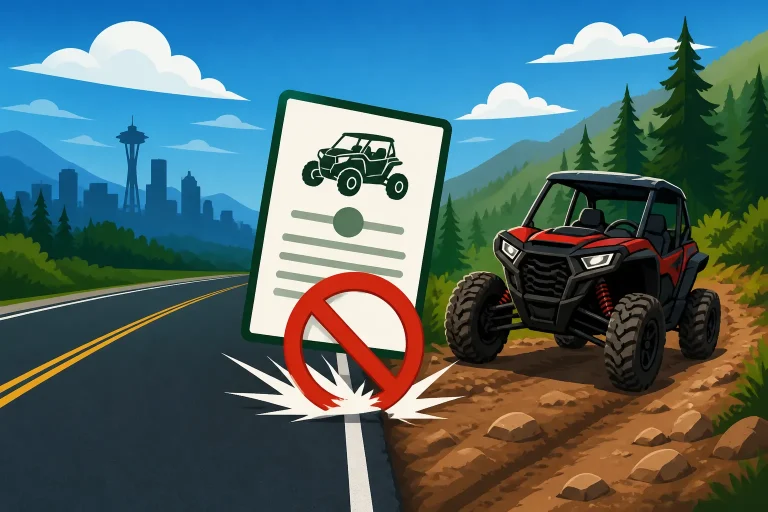
It does not authorize pavement use
An off-road permit does not give an ATV or UTV permission to travel along public roads. Road use has separate rules involving the route, the machine’s equipment, the rider’s license, and any required on-road registration. Even a machine that is permitted for off-road riding may be barred from a road or road segment.
Washington’s road-tab system is distinct from an off-road credential. If you are considering pavement use, start with Washington’s Two-Tab System and Washington’s Off-Road Tab Explained. For a temporary permit specifically, Why a Temporary Permit Keeps You Off Pavement explains why it should not be treated as road authorization.
Do not assume that a short public-road connection between a parking area and a trail is permitted just because the road looks quiet or the route appears on a map. Check the rules for the exact road and jurisdiction. The route may be closed to ORVs, or it may require a qualifying road registration and equipment that an off-road temporary permit does not provide.
It does not replace a recreation-site pass
Some places require a separate vehicle or recreation pass, while other locations use different access arrangements. A Washington ORV permit is not the same as a Discover Pass or a federal recreation pass. The land manager determines what is needed at a specific trailhead or recreation site.
Before you leave, check the site’s current access requirements and any notices about seasonal closures, fire restrictions, construction, or maintenance. The Discover Pass and Washington Riders page explains how a state recreation pass fits into a ride, while Washington Rules for Riding Federal Land covers the separate rules that can apply on federal land.
The same principle applies to private timberland, tribal land, and other property with its own access conditions. A valid ORV credential does not give permission to enter land that is closed or requires the landowner’s approval. Check the managing agency or owner and stay on routes that are open to your machine.
It does not override machine and rider rules
Registration and permits are only part of a legal ride. A machine may have to meet applicable requirements for its use, and the rider may have to follow rules concerning helmets, passengers, minimum age, supervision, and trail behavior. A permit does not excuse riding a closed trail, exceeding a posted restriction, or operating a machine in a way that violates land-use rules.
For a trip on Washington Department of Natural Resources land, review Washington Rules for Riding DNR Land and look for current site notices. For any public riding area, confirm that the route is open to your vehicle’s type and size. A trail that allows a quad may not be suitable or open to a wide side-by-side.
A visitor’s pre-ride checklist
The safest approach is to settle the paperwork, access, and route questions separately. That avoids arriving at the riding area with a valid credential that does not meet the site’s other requirements.
Before leaving home:
- Confirm whether Washington recognizes your home-state or home-province registration for off-road use.
- If it does not, ask DOL whether you need a temporary ORV use permit and how to obtain one.
- Check the permit’s current validity, display, and machine-specific conditions.
- Carry the registration or permit documents with you.
- Check whether the trailhead requires a separate recreation pass.
- Confirm that the riding area and your chosen routes are open to your machine.
- Review rules for riders, passengers, equipment, and any road crossings on your planned route.
- Recheck closures and access notices close to the day of the ride.
If you are bringing more than one machine, check the status of each one separately. Do not assume that a credential for the ATV also covers a UTV, or that one visitor permit can be moved between machines. If you are borrowing or renting a machine, ask the owner or rental provider what registration it carries and what paperwork must stay with it.
Keep a photo or copy of important documents as a backup, but do not assume a digital copy replaces any document you are required to carry or display. Verify what Washington currently accepts. If there is uncertainty about reciprocity, get an answer before riding rather than trying to resolve it at a trailhead or during a roadside check.
For visitors, the key distinction is straightforward: first determine whether your home credential is recognized; if not, check whether a Washington temporary permit applies. Then separately confirm that the land, trail, and route are open to your machine. A permit can address the first issue without solving the others.
Disclaimer
This article is for general informational purposes only and does not constitute professional advice. Laws, prices and regulations vary by location and change over time. Consult a qualified professional for guidance on your specific situation.