Spark Arresters on Washington Trails
A spark arrester can look like a small part, but it matters when riding Washington’s forests and other public lands. Riders often aren’t sure whether their ATV or UTV already has one, whether a replacement must meet a particular standard, or whether a fire restriction changes what they can do. Here’s how to check the machine and the land rules before heading out.
What a spark arrester does and why it matters
A spark arrester is a device in the exhaust system that helps prevent hot carbon particles from escaping and starting a fire. It does not eliminate fire risk, and it is not a substitute for sensible riding during dry conditions. But an approved, properly maintained arrester is an important safeguard when a machine with an internal combustion engine is used in forested or otherwise fire-prone areas.
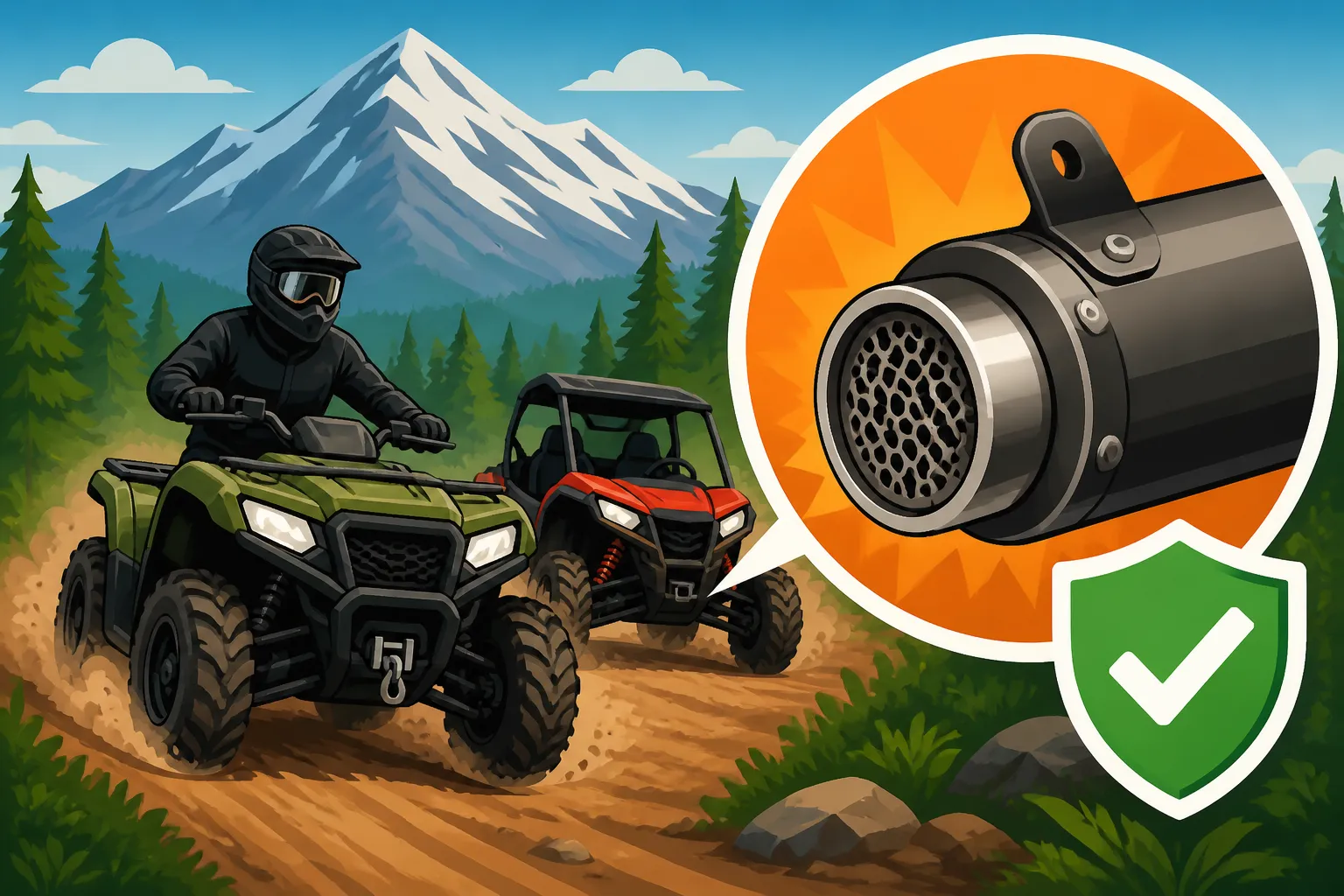
The device is usually part of the muffler or exhaust assembly. Depending on the machine, it may use a screen or another design to trap or cool particles before they leave the exhaust. Some manufacturers install a spark arrester as standard equipment; on other machines, the required component may be an insert or a replacement exhaust part.
A muffler and a spark arrester are not interchangeable terms. The muffler reduces exhaust noise. The arrester is intended to reduce the chance of sparks escaping. A muffler can be quiet without having an approved arrester, and an arrester does not automatically make an exhaust system quiet enough to meet land rules. Riders should check both requirements separately. For noise rules, see Washington Sound Limits for ORVs.
On Washington public lands, riders should plan to use a serviceable spark arrester that meets the applicable land manager’s requirements. Rules can differ by land type, trail system, and temporary fire restriction. A machine’s use on one route does not prove it can be used on every public route. Check the current requirements for the specific riding area, especially when moving between state and federal land.
The practical reasons to take the requirement seriously are straightforward:
- Fire prevention: Hot particles can ignite dry needles, grass, or other combustible material.
- Access: A route or land manager may require an approved arrester as a condition of motorized use.
- Inspection: A ranger or other authorized official may check the exhaust equipment during a stop.
- Mechanical protection: A damaged or clogged exhaust component can affect how the engine runs.
A spark arrester is only one part of responsible fire-season riding. A machine can have the correct component and still be a poor choice during a closure or restriction. Check [Washington Rules for Riding During Fire Season] and Washington Fire Restrictions That Close Trails before loading up.
How to tell whether your ATV or UTV has one
Start with the owner’s manual and the machine’s model information. Look for “spark arrester” in the maintenance or exhaust section, and check whether the manual identifies the installed exhaust as compliant for off-road use. If you have the original paperwork, it may also describe the exhaust assembly and any required screen or insert.
A visible screen at the end of the exhaust can be a clue, but appearance alone is not proof of compliance. Screens can be missing, damaged, modified, or replaced with parts that do not meet the relevant standard. Some designs do not have an obvious screen at the outlet. Don’t assume a machine has an approved arrester just because it is new, quiet, or sold for off-road use.
Use this process to check:
- Identify the exact machine. Record the make, model, model year, and, if needed, the VIN. Parts that fit a similar-looking model may not be correct for yours.
- Consult the manual or manufacturer. Confirm whether the stock exhaust includes a spark arrester and what replacement part or service procedure the manufacturer specifies.
- Inspect the exhaust outlet. Look for a missing screen, loose fasteners, cracks, holes, signs of tampering, or a non-stock component. Do not reach into a hot exhaust.
- Check for documentation or markings. Some components carry a marking or identification information. If you cannot tell what the marking means, ask the manufacturer or a qualified repair shop rather than relying on a seller’s description.
- Confirm the land rule. Check with the relevant land manager for the riding area. The device, proof, or inspection expectations may depend on the land and route.
A used machine deserves extra attention. Previous owners may have removed a screen to address a performance complaint, fitted an aftermarket exhaust, or replaced a damaged part without preserving the original equipment. Ask what work has been done and look for service records, but verify the component yourself before riding public land. For a broader used-machine inspection, Checking a Used Machine in Washington can help you assess other condition issues.
If the manual is missing, search for it through the machine manufacturer or contact an authorized dealer or repair shop with the model details. Avoid treating a generic internet photo as a reliable identification guide. Exhaust parts can vary across trims and model years, and a visually similar part may not be approved for your machine or the land where you plan to ride.
When in doubt, do not remove a part or rely on a vague product listing. A listing on Amazon or another marketplace can help identify possible replacement components, but compatibility claims and customer reviews do not establish that a part meets the requirements for a particular Washington trail. Verify the part number and approval information with the manufacturer and land manager.
Choosing a replacement and keeping it compliant
If an arrester is missing or damaged, use a replacement intended for the exact machine and exhaust configuration. The safest starting point is the manufacturer’s parts information or a qualified shop familiar with off-road exhaust systems. Ask for the documentation that supports the part’s compliance, not just confirmation that it will physically fit.
A replacement may be a complete muffler assembly, a screen, or a service component, depending on the design. Do not assume that every aftermarket muffler includes an approved spark arrester. Likewise, do not assume that an exhaust described as “quiet,” “race,” or “off-road” meets a land manager’s arrester requirement. Those descriptions address different features, and marketing language is not the same as technical approval.
Before buying, confirm:
- The part is listed for your exact make, model, and model year.
- The part is intended to function as a spark arrester, not only as a muffler or exhaust tip.
- The seller or manufacturer can provide identifying information or documentation.
- The installation method does not require removing or altering required emissions or safety components.
- The land manager accepts the device for the routes you intend to ride.
Avoid drilling, cutting, removing, or otherwise altering the exhaust screen or arrester. A modified component may no longer perform as designed, and it may no longer meet the applicable requirements. If the machine has been modified, have a qualified technician assess the entire exhaust assembly rather than just the part visible at the outlet.
Rules for public-land riding can involve several separate checks. A compliant spark arrester does not replace required registration, tabs, permits, or land-access passes. It also does not authorize riding on a closed trail or road. Check the rules that apply to the land itself, including Washington Rules for Riding DNR Land or [Washington Rules for Riding a National Forest], depending on your destination. For the broader registration picture, see Washington ORV Permits Explained.
Cleaning and routine inspection
The owner’s manual should set the service interval and explain how to inspect or clean the arrester. Follow that procedure. A screen can collect carbon and restrict exhaust flow, while corrosion, impact damage, or poor installation can leave openings where there should not be any.
Make inspection part of regular maintenance, and check again after a rough ride, exhaust repair, or change to the machine. Look for:
- A screen or insert that is missing or loose
- Cracks, holes, broken welds, or a distorted outlet
- Heavy carbon buildup or blockage
- Corrosion that has weakened the component
- Fasteners that have backed out
- Evidence that someone has cut, drilled, or removed part of the assembly
Let the exhaust cool fully before touching it. Use the cleaning method in the manual; do not improvise with tools or chemicals that could damage the screen or coating. If cleaning does not restore the component or you cannot assess its condition, replace it with the specified part or have a repair shop inspect it.
A machine that suddenly loses power, runs poorly, or sounds different may have an exhaust problem, but those symptoms do not identify the cause on their own. A clogged arrester is one possibility among several. Do not remove the screen as a quick fix. Have the machine diagnosed and repaired while preserving the required equipment.
Requirements, fire restrictions, and roadside checks
There is no single answer that covers every trail, forest, and temporary closure. State, federal, and other land managers can apply different rules, and fire restrictions can change what is allowed even when a machine’s equipment is in good condition. Before riding, confirm the rules for the exact trail system and check for current closures or alerts. Washington Trail Closures to Check First explains why a map or old trip report may not reflect current access.
As a practical baseline, fit and maintain an approved arrester for public-land riding, then confirm whether the agency managing your route has additional requirements. The rules may address the type or approval of the device, equipment inspections, seasonal restrictions, or whether motorized use is closed altogether. When the official information is unclear, contact the land manager instead of assuming that a neighboring area follows the same rule.
A fire restriction can be broader than the spark-arrester rule. It may close a road or trail, restrict certain activities, or limit access during periods of elevated fire danger. An arrester does not grant an exception to a closure. Nor does compliance with a general equipment rule guarantee that a particular route is open that day.
A ranger or other enforcement official may check equipment along with registration, permits, and where you are riding. Keep the machine’s exhaust intact and be prepared to identify the installed component. If you are unsure what documentation is useful, ask the relevant land manager before the trip. Requirements for public land are explained further in Washington Arrester Rules on Public Land.
| Situation | What to do |
|---|---|
| Stock exhaust, manual confirms an arrester | Inspect it for damage or tampering, then verify the route’s current rules. |
| Used machine with unknown exhaust history | Identify the exhaust and part number; confirm compliance before riding public land. |
| Aftermarket muffler or exhaust | Ask the manufacturer for arrester documentation and confirm it is accepted for the destination. |
| Missing, damaged, or modified screen | Repair or replace it with the specified compliant component before the ride. |
| Active fire restriction or closure | Follow the current land-manager notice; an arrester does not override a closure. |
| Moving between state and federal land | Check each land manager’s requirements rather than assuming they match. |
If you find a damaged or missing arrester at the staging area, the responsible choice is to postpone that ride or use a machine that meets the rules. Do not count on being able to fix the issue trailside, and do not ride a closed route to reach another area. You can review the general process for A Ranger at a Washington Trailhead and prepare documents in advance with Which Paperwork You Must Carry While Riding.
A practical pre-ride checklist
A little preparation avoids a frustrating trip and helps prevent damage or fire. Use this checklist when planning a ride, particularly if the machine is new to you, has an aftermarket exhaust, or will be used during dry weather.
Before leaving home
- Identify the land manager for the riding area.
- Check the official trail, road, and fire-status information for closures or restrictions.
- Confirm the area’s spark-arrester requirement.
- Check the machine’s manual and inspect the exhaust while it is cool.
- Verify that a replacement component, if installed, is the correct part and has supporting documentation.
- Confirm your tabs, permit, access pass, and other required riding paperwork.
At the staging area
- Look over the exhaust for loose parts, cracks, holes, or a missing insert.
- Do not start a ride if the machine’s arrester appears altered or damaged.
- Recheck posted notices; conditions can change after the trip was planned.
- Keep clear of dry vegetation when parking or stopping, and follow any posted fire-safety instructions.
- Carry out your trash and avoid activities prohibited by the land manager.
These steps do not guarantee that a fire cannot start. Mechanical heat, hot exhaust, and other sources can still create hazards. They do make it more likely that the machine is equipped properly and that the ride follows current access rules.
If your machine needs service, make the repair before the trip rather than trying to improvise at the trailhead. A repair shop can verify the component, install the correct part, and check that the exhaust is secure. Keep the work order or parts information with your maintenance records, especially if the machine has a non-stock exhaust.
Frequently Asked Questions
Does every Washington trail require a spark arrester?
Requirements depend on the land manager, route, and current restrictions. For public-land riding, plan to have a serviceable, approved arrester and confirm the specific rules for your destination. Do not assume that a requirement on one trail applies identically to another.
Is a spark arrester the same as a muffler?
No. A muffler reduces exhaust noise; a spark arrester helps prevent hot particles from escaping. A component may perform both functions, but one does not automatically prove the other requirement is met.
Can I ride if the arrester screen is missing?
Do not ride public land with a missing, damaged, or modified arrester when the applicable rules require one. Replace it with the correct component and verify the route’s requirements before heading out.
Does an arrester let me ride during a fire closure?
No. Equipment compliance does not override a trail closure or fire restriction. Check the land manager’s current notice and follow it.
Disclaimer
This article is for general informational purposes only and does not constitute professional advice. Laws, prices and regulations vary by location and change over time. Consult a qualified professional for guidance on your specific situation.