Washington Sound Limits on Public Land
Washington Sound Limits on Public Land
A loud ATV or UTV can turn a routine trail ride into a failed sound check, a citation, or a complaint that affects access for everyone. Washington riders need to know that sound requirements can depend on the machine, the land manager, and the test method. This article explains what to check, how to prepare your machine, and what to do at a sound test.
Why sound limits matter on public land
Noise rules are not just about how loud a machine seems beside the trail. Washington sets sound standards for off-road vehicles, and public-land managers may enforce those standards along with site-specific rules. A machine that sounds acceptable to its rider may still exceed a limit when measured using the required procedure.
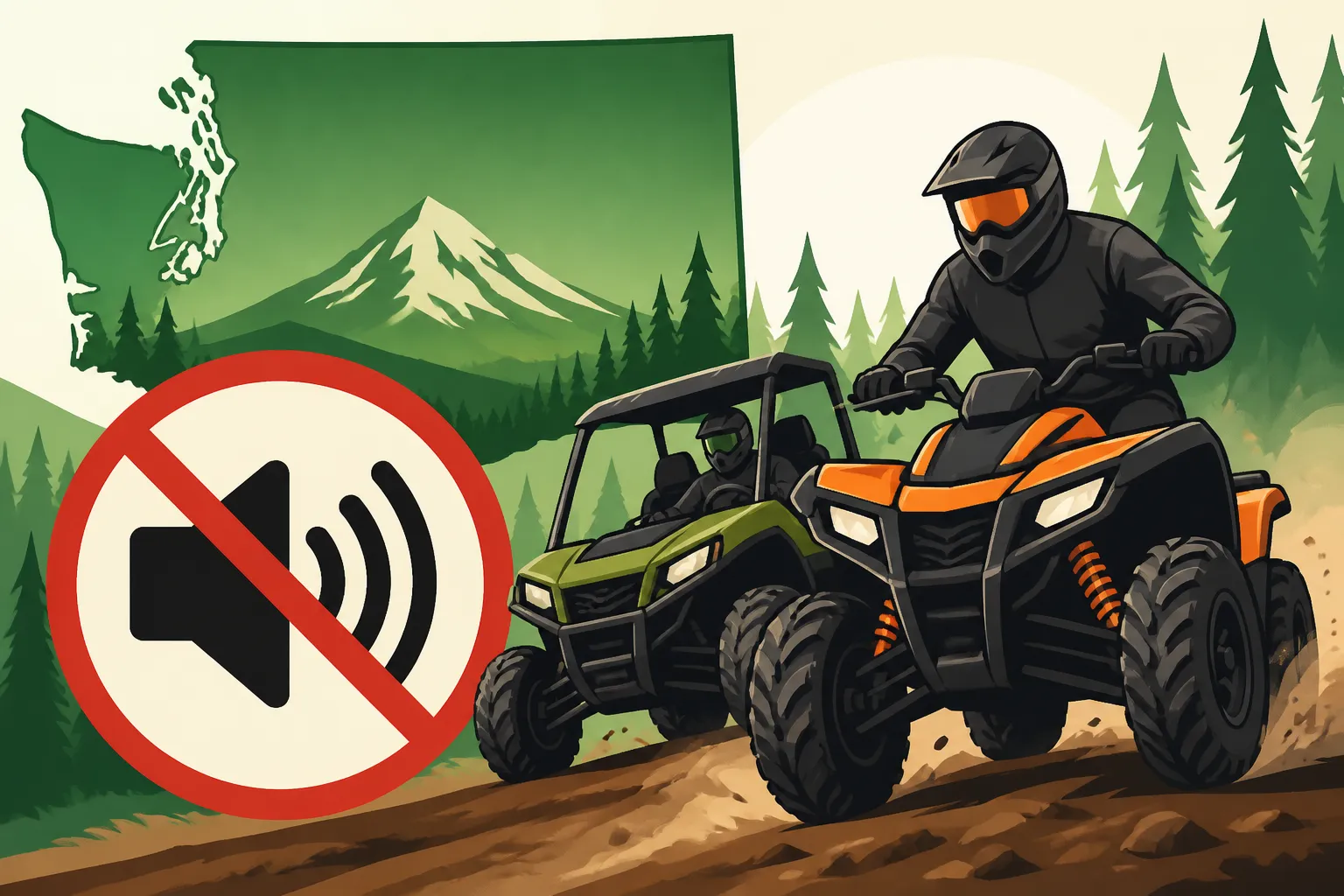
Washington’s off-road sound standards are commonly summarized as 96 dBA for motorcycles and 98 dBA for other off-road vehicles, including ATVs and UTVs. The applicable vehicle category, measurement procedure, and current rule matter. Do not treat a reading from a phone app, a casual estimate, or a test method used elsewhere as proof that your machine complies. Check the current requirements with the agency managing the land and follow any instructions posted at the riding area.
A sound limit and a muffler requirement are related, but they are not the same thing. A machine may need a functioning muffler even if it seems quiet, and passing a sound test does not automatically mean the machine meets every other equipment rule. Requirements for spark arresters, for example, are a separate issue; see Washington Arrester Rules on Public Land and Spark Arresters on Washington Trails.
Sound rules help reduce disturbance to nearby residents, other visitors, and wildlife. They also help preserve access. Repeated complaints about noise can put pressure on land managers to restrict routes, change operating conditions, or close areas. A quiet, properly maintained machine is one practical way riders can help avoid those conflicts.
Public land is not one uniform rulebook
“Public land” can mean a Washington Department of Natural Resources (DNR) forest, a state park, a national forest, or land managed by another agency. Those managers may use different enforcement processes and may post additional requirements for a particular trailhead or route. A sound test at one staging area does not necessarily tell you what will be required somewhere else.
Before a trip, identify who manages the riding area. Check that agency’s current rules, alerts, and signs at the entrance. A route shown on an old map may have new conditions, and a general rule for off-road vehicles does not override a local closure or restriction. For DNR riding details, see Washington Rules for Riding DNR Land. For federal land, check [Washington Rules for Riding a National Forest].
This is especially important for visitors bringing a machine from another state. A registration or permit that allows the machine to be used in Washington does not waive Washington’s sound or equipment rules. Permits and reciprocity address permission to ride; they do not guarantee that an exhaust system meets the applicable sound standard. Washington ORV Reciprocity Rules explains the separate question of out-of-state registration.
How a sound test works
A sound test is a measurement made under a specified procedure, not a judgment based on whether an engine sounds loud. For off-road vehicles, the procedure may use a stationary test, such as one based on SAE J1287. The test uses a sound meter positioned in a prescribed location and an engine speed set according to the procedure. The reading is recorded in A-weighted decibels, written as dBA.
The exact setup matters. Distance and angle from the exhaust, the engine speed, the test location, and background noise can all affect the result. That is why two readings taken casually in different places may not be comparable. If an agency conducts a formal test, follow the tester’s instructions rather than trying to reproduce the test using a different setup.
A phone sound-meter app can be useful for spotting a change or comparing your machine before and after maintenance. It is not a reliable substitute for a properly calibrated meter and the required procedure. Phone microphones vary, and wind, nearby engines, hard surfaces, and other background sounds can distort readings. Consumer sound meters are available through retailers such as Amazon, but buying a meter does not make an informal reading an official pass.
| Question | Practical answer |
|---|---|
| What unit is used? | A-weighted decibels, usually written as dBA. |
| Can I rely on how loud the machine seems? | No. A formal test uses a specified measurement procedure. |
| Does a phone app prove compliance? | No. It may help identify a change, but it is not a formal test. |
| Is every public-land test identical? | No. Confirm the applicable rule and follow the land manager’s test instructions. |
| Does a passing sound test cover other requirements? | No. Muffler condition, spark arresters, and other rules may apply separately. |
A reading just below a limit should not be treated as a safe margin. Test conditions and equipment can vary, and an exhaust system can become louder as packing wears, a joint loosens, or a component is damaged. If your machine is close to the applicable limit, have it inspected and repaired rather than counting on a favorable test setup.
What the number does and does not tell you
Decibels are not a simple scale where each additional number represents the same small increase in perceived loudness. A few dBA can matter in a sound test, and a small reading difference may affect whether a machine meets the limit. But the number alone does not describe every kind of disturbance. A sharp exhaust note, repeated hard acceleration, or a group of machines passing close to homes can be disruptive even when each machine is maintained.
The test is also not a substitute for considerate riding. Avoid unnecessary revving at staging areas, trailheads, and camps. Use a steady throttle where conditions allow, and do not idle for long periods near other visitors. Keeping speed and engine load appropriate for the trail helps reduce both noise and wear.
Preparing your ATV or UTV to meet the limit
The most useful preparation is regular exhaust-system maintenance. Sound problems often have a repairable cause: worn muffler packing, a cracked exhaust, a loose connection, or an aftermarket component that changes the machine’s noise output. Check the owner’s manual for maintenance requirements, and use parts designed for your machine and for off-road use where required.
Start with a visual inspection when the machine is cool:
- Look for cracks, holes, dents, and signs of exhaust leakage.
- Check that the muffler and exhaust connections are secure.
- Inspect mounting points and fasteners for looseness or damage.
- Check serviceable muffler packing or other sound-control parts according to the manufacturer’s schedule.
- Confirm that any removable insert or baffle required by the exhaust system is installed.
- Listen for a new rattle, hiss, or unusually sharp exhaust note when the machine is running in a safe location.
- Repair problems before riding on public land, rather than waiting to see whether the machine passes a test.
An exhaust that has been modified for a louder tone or more airflow may not meet public-land requirements. Removing a baffle, changing the muffler, or altering the exhaust can also create other problems, including leaks and poor engine performance. A part marketed as a performance upgrade is not necessarily suitable for every public riding area. Check the machine’s manual and the part manufacturer’s information, and confirm compliance with the land manager’s rule.
If the machine has an adjustable or repackable muffler, follow the maker’s service instructions. Improvised packing or a damaged internal component can change sound output and may create a safety concern. If you are unsure whether an exhaust is intact or compliant, ask a qualified repair shop to inspect it. Keep records of maintenance and the parts installed; they can help a technician diagnose a problem, though they do not replace a sound test.
Keep the rest of the machine in good shape
Noise can come from more than the exhaust. A loose heat shield, vibrating body panel, worn belt cover, or damaged engine mount can create rattles that sound like an exhaust problem. These noises may not determine whether the machine passes a formal test, but they can signal a maintenance issue worth addressing before a long ride.
For a UTV, check that doors, panels, and accessories are secured. For an ATV, inspect racks, skid plates, and guards for loose fasteners. Do not remove required equipment to quiet a rattle, and do not assume that an unusual sound is harmless simply because the muffler looks intact.
Before loading up, give the machine a short run in a safe place and listen for changes. If it sounds noticeably louder than usual, investigate the cause. A new exhaust leak or a loose muffler mount can worsen during a ride. For a more detailed inspection before a trip, Checking a Used Machine in Washington covers common mechanical checks that also matter when assessing an older machine.
What to expect at a public-land sound check
Some riding areas may test machines at a staging lot or trailhead, while others may address noise through roadside or on-trail enforcement. Procedures can change by location and operating conditions. Check the riding area’s current notices before leaving home, and follow signs and staff instructions when you arrive. How a DNR Staging Lot Sound Check Works explains what riders may encounter at a DNR test site.
If a test is offered or required, arrive with the machine in normal operating condition. Do not warm it by revving aggressively near other visitors. Make sure the exhaust is not visibly damaged, and allow room for the tester to position the meter safely. Follow directions about where to park, when to start the engine, and how to hold the throttle. Do not touch or reposition testing equipment unless asked.
If the machine does not pass, ask what the next step is. The process may depend on the land manager and the site. You may need to repair the issue and be retested, move the machine off the riding area, or follow another direction given by staff. Do not assume that a temporary permit, an out-of-state registration, or a prior test result permits you to continue riding after a failed test.
An enforcement interaction is also a chance to clarify which rule applies. Stay calm, listen to the explanation, and ask where you can find the current written requirement. A reading is meaningful only in the context of the correct test procedure and vehicle category, so it is reasonable to ask which procedure was used. Do not obstruct staff or argue at the test location; if you believe a citation or decision is wrong, use the formal process available through the relevant agency.
Noise checks are only one part of trail compliance. Rangers and other authorized staff may also check registration, decals, permits, equipment, and whether the route is open to your machine. Keep required documents accessible and make sure your decals are displayed as required. For a broader overview of a trailhead interaction, see A Ranger at a Washington Trailhead and What to Expect at a Roadside WATV Stop.
Planning a quieter, compliant ride
A little preparation can prevent a sound issue from disrupting the day. Use this checklist before you travel:
- Confirm the land manager and read the current rules for the specific riding area.
- Check for closures, posted restrictions, and any notice about sound testing.
- Verify that your machine falls within the applicable vehicle category and sound standard.
- Inspect the muffler, exhaust joints, mounts, and sound-control components.
- Replace or repair damaged parts before riding.
- Avoid unnecessary revving at the staging area, on shared roads, and near camps.
- Be especially considerate near homes, campgrounds, and other sensitive areas.
- Carry out maintenance before a long trip rather than relying on a last-minute test.
A quiet machine is not only a compliance issue. It makes conversation easier at a staging lot, reduces disturbance for other trail users, and helps keep riding areas welcoming. When riding in a group, agree on sensible engine use and spacing. Several machines accelerating together can produce a much louder burst of sound than any one machine alone.
Plan around sound requirements the same way you plan around access, fuel, and weather. If a machine is loud or the exhaust system is uncertain, choose a repair stop before the ride instead of hoping that no one notices. If you are visiting an unfamiliar area, check the site’s rules directly and review Washington Trail Closures to Check First. Conditions and restrictions can change, and a previous visit is not a guarantee that the same access or procedures apply now.
If your machine is close to the limit
Treat a borderline reading as a warning, not an invitation to make small adjustments until you get a pass. A worn muffler can deteriorate further, and a different test location or properly calibrated meter can produce a different result. Have the exhaust inspected and serviced, then verify the machine using the applicable procedure.
Do not try to mask noise with temporary materials, and do not rev below the required test speed if the procedure specifies an engine speed. Those approaches can make a reading meaningless and may damage the machine. The sensible response is to identify and fix the source, then confirm the result in a proper test.
Frequently Asked Questions
Is there one sound limit for every ATV, UTV, and motorcycle in Washington?
No. Washington’s off-road standards distinguish vehicle categories, and the applicable test procedure matters. The commonly summarized limits are 96 dBA for motorcycles and 98 dBA for other off-road vehicles, including ATVs and UTVs. Confirm the current requirement for your machine and riding area with the responsible land manager.
Does an out-of-state registration exempt my machine from Washington sound rules?
No. Registration reciprocity does not automatically exempt a visiting machine from Washington’s sound or equipment requirements on public land. Check both the rules for using the machine in Washington and the rules for the specific area you plan to ride.
Can I use a phone app to prove my machine passes?
No. A phone app can provide a rough comparison, but phone microphones and test conditions are not a substitute for the required procedure and a suitable sound meter. Follow the land manager’s instructions for an official test.
Will a quiet muffler also satisfy the spark-arrester rule?
Not necessarily. Sound and spark-arrester requirements are separate. Check whether your machine needs a spark arrester for the area and make sure it is installed and maintained as required.
What should I do if my machine fails a sound check?
Ask the staff member what steps apply at that site. You may need to repair the machine, have it retested, or remove it from the riding area. Do not continue riding on the assumption that a different permit or an earlier test result overrides the direction given.
Disclaimer
This article is for general informational purposes only and does not constitute professional advice. Laws, prices and regulations vary by location and change over time. Consult a qualified professional for guidance on your specific situation.