Washington Rules for Riding Private Timberland
Washington’s private timberland can look open, especially when a gravel road leads into the woods, but a road or trail is not an invitation to ride. The practical rule is to confirm who controls the land, get permission for the specific area and dates, and check what your permission covers before unloading an ATV or UTV.
Permission comes before the ride
Private timberland is not automatically open to recreational riding. A gate may be open, a road may appear on a map, or other machines may be using the area, but none of those facts proves you have permission to enter. The landowner or the company managing the property decides whether recreational access is allowed and what conditions apply.
Permission should come from someone with authority over the land. Depending on the property, that might be an individual owner, a timber company, a land manager, or a person administering an access program. If you are unsure who controls a parcel, do not assume a nearby business, neighbor, or person using the road can grant access on the owner’s behalf.
Ask about the exact property, not just “the woods” or “the road.” Large timber holdings can include many parcels, leased areas, public boundaries, and roads with different rules. An answer that applies to one gate or tract may not apply to the adjoining acreage.
Before you ride, get clear answers to these questions:
- Is recreational ATV or UTV use allowed?
- Which parcels, roads, trails, and staging areas are included?
- Is permission valid on the day you plan to ride?
- Does it cover your machine and the people riding with you?
- Are there limits on group size, time of day, speed, or route?
- Are there active closures, logging operations, or fire restrictions?
- Can you park or unload at the entrance?
- Does the permission allow you to cross adjoining land?
A written permit, email, or other record can help you understand the conditions and show what you were authorized to do. Keep it available during the ride, but do not treat it as broader than its wording. If permission is limited to a named road or parcel, stay within that boundary.
Permission can also have conditions that differ from one property to another. A land manager may require riders to stay on established roads, avoid certain seasons, or leave when work is underway. Follow the terms you receive, even if another rider says a route is usually open. For more on the legal distinction between permission and trespass, see Washington Trespass Law and Off-Road Riders and Asking a Landowner Before You Ride.
Timber company permits and changing access
Some timber companies or private land managers offer recreational access through a permit or registration system. Others do not allow motorized recreation, or may allow it only in particular locations or under limited conditions. There is no single private-timberland permit that grants access across Washington.
A timber company permit is useful only for the land and activities it covers. Read the current terms instead of relying on an old pass, a friend’s permit, or a memory of where a previous trip went. Check whether the permit is tied to a particular person, vehicle, date, season, or property. Ask whether passengers and guests need their own authorization, and whether a permit holder may bring a group.
| Access situation | What it generally means for a rider |
|---|---|
| You have permission for a named parcel or route | Stay within the described area and follow the stated conditions |
| A gate is open but you have no permission | Do not assume entry is allowed |
| A road crosses private timberland | Confirm access for that road and for the land beyond it |
| A company permit is expired or unclear | Ask the issuer before riding |
| A road is closed for hauling, fire danger, or another operation | Do not pass the closure unless the manager explicitly authorizes it |
| A route enters state, federal, tribal, or other private land | Check the rules and permission requirements for each property |
Access is not permanent just because a company previously allowed it. Land managers may close roads for active timber work, safety concerns, fire conditions, environmental protection, or other operational needs. A route that was usable last month may be closed today. Check directly with the manager before each trip, especially when a long time has passed since your last visit.
A permit also does not necessarily authorize every activity on the property. It may permit travel on designated roads without allowing cross-country riding, camping, target shooting, fires, or collecting materials. Ask about these separately rather than assuming that permission to ride includes permission to do everything else.
If you use a timber company’s access program, follow its posted notices and instructions at gates and staging areas. Do not remove signs, move barriers, or follow another vehicle through a restricted entrance. A closed gate can mark an active work zone or a boundary, not merely an inconvenience. The article A Timber Company Permit in Washington covers the permit question in more detail.
Roads, gates, and boundaries
A private logging road is not automatically a public road or an open recreational route. It may be built and maintained for timber operations, and the owner can restrict who uses it. Permission to ride on one road also does not necessarily include permission to leave it, enter a spur road, or continue beyond a property line.
This matters because timberland boundaries can be hard to see on the ground. A wide gravel road may cross several parcels. A route shown on a map may continue onto land owned by someone else, or onto public land with a different access rule. If your authorized route approaches a boundary, stop and confirm where permission ends. Do not treat a map line, tire tracks, or another open gate as proof that the next section is available.
A road that crosses private land may connect two places where riding is allowed, but the connecting section still needs its own access basis. Check who owns or controls that segment and whether the permission covers through travel. See Riding a Road That Crosses Private Land for more on this situation.
A closed road remains closed even if there is room to ride around the barrier. Going around a gate can take you onto a restricted road or into an active work area. Do not move a gate, cut a lock, bypass a berm, or use a nearby trail to get around a closure. If you encounter an unexpected barrier, turn back and contact the land manager for clarification. The related topic [Washington Rules for Riding a Closed Road] explains why a closure should be treated as a firm boundary.
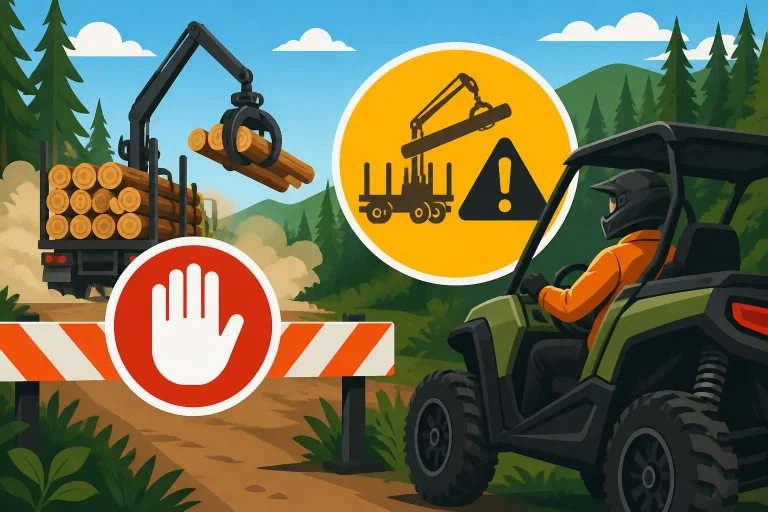
Use extra caution around logging operations. Timber trucks and other work vehicles may use narrow roads, blind corners, and gravel routes at times when recreational riders are present. A road can be physically passable but still unsafe or unavailable for recreation during hauling. Follow posted instructions, yield carefully, keep out of work zones, and leave when directed by the manager or authorized personnel. For road-specific guidance, see Washington Rules for Riding a Logging Road.
Private land permission is not the same as public-land permission
Washington has different land categories, and the rules for one do not automatically carry over to another. Private timberland may be managed by a company, while nearby land may be state trust land, a state forest, federal land, tribal land, or property owned by someone else. A permit for one owner’s land does not give you permission to cross another owner’s parcel.
State trust land is not simply private timberland with a different label. It has its own management and access rules, and motorized recreation may require a separate authorization. Check the rules for the specific parcel rather than assuming a private timber company’s permit will cover adjoining state land. See Washington Rules for Riding State Trust Land for that distinction.
The same care applies when a route connects to public roads or public recreation land. Permission to ride on private property does not automatically make a public road legal for ATV or UTV use, authorize travel on a public trail, or replace an access pass or permit required at a trailhead. Confirm the rules for every part of the planned route.
Out-of-state registration or an out-of-state permit does not create permission to enter private land. Reciprocity concerns whether certain home-state credentials may be recognized for riding under Washington rules; it does not grant a right to use a timber company’s property. Review Washington ORV Reciprocity With Other States if you are visiting from elsewhere, and check the land manager’s requirements separately.
It also helps to distinguish permission to ride from vehicle registration and equipment rules. Requirements can depend on where the machine will be operated. Private-property permission does not by itself make a machine legal for use on a public road or public recreation area. If your route leaves private land or includes public access, check the relevant state requirements and local restrictions before going. Washington ORV Permits Explained is a useful starting point for understanding permits and registration.
A practical check before you unload
A short check before leaving home can prevent a wasted trip or an avoidable trespass problem. Use this process whenever you visit a new property or return after a long gap.
- Identify the land manager. Confirm who controls the parcel and who can authorize motorized recreation. Do not rely only on an online map or informal directions.
- Ask about the exact area. Provide the entrance, road, parcel, or planned route as clearly as possible. Ask whether access includes the full route and the intended staging location.
- Confirm that permission is current. Check the applicable dates, seasons, and closures. Ask whether logging, fire conditions, or other operations have changed access.
- Read the conditions. Note limits on routes, group size, speed, time, passengers, parking, and other activities. Ask about anything that is unclear.
- Check adjoining land. Identify any boundaries or crossings where the route leaves the property covered by your permission.
- Carry proof of permission. Keep the permit or confirmation accessible, and make sure the other riders understand the limits.
- Follow signs and instructions on site. Turn around at a closure or boundary you cannot verify. Do not treat an open gate or existing tracks as authorization.
If the land manager cannot confirm access, choose a riding area where permission and current access rules are clear. Do not try to settle an uncertain boundary by riding farther in. A conservative turn-around is simpler than explaining an unapproved route after a complaint or a roadside encounter.
Frequently Asked Questions
Can I ride a Washington timber road if the gate is open?
Not based on the open gate alone. The road may still be private or subject to restrictions. Confirm that the owner or land manager allows recreational riding on that road.
Does a timber company permit cover every road on the property?
Not necessarily. A permit may apply only to certain roads, parcels, dates, or riders. Read its conditions and ask the issuer if the route is not clearly included.
Can I use a private timberland permit to cross state trust land?
Do not assume so. State trust land has separate access rules. Check with the relevant land manager and obtain any separate authorization required.
Does out-of-state ORV registration let me ride on private timberland?
No. Registration or reciprocity does not replace the landowner’s permission. You need to meet the applicable vehicle requirements and have permission to enter the property.
Disclaimer
This article is for general informational purposes only and does not constitute professional advice. Laws, prices and regulations vary by location and change over time. Consult a qualified professional for guidance on your specific situation.