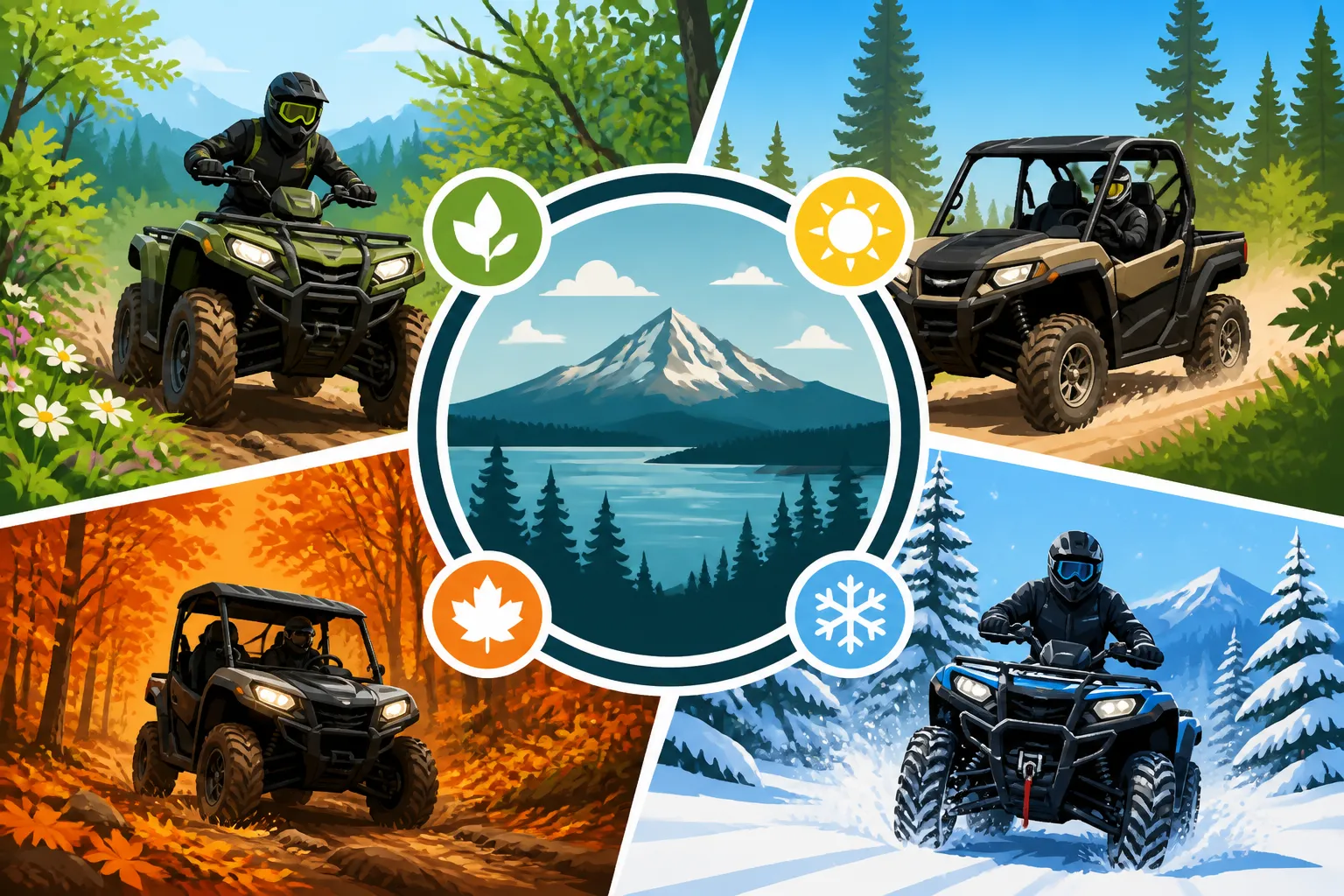
Why Tahuya Rides Year Round
Tahuya’s appeal is that riding doesn’t have to stop when the calendar turns: the forest is accessible through much of the year, and its mix of wooded routes and changing conditions keeps repeat visits interesting. But “year-round” doesn’t mean every trail is always open or comfortable. This guide explains what that really means, how weather affects a ride, and how to plan a safer trip.
What year-round riding means at Tahuya
Access can continue while conditions change
Tahuya State Forest and its off-road riding area are on Washington’s Kitsap Peninsula, near Belfair. Its forest setting and regional climate make it possible to ride in more seasons than at places where winter snow routinely shuts down access. That is the simple reason riders describe Tahuya as a year-round destination: a cold or rainy month does not automatically mean the whole area is unavailable.
The important distinction is between access and rideability. A forest may be open while a particular route is muddy, rutted, temporarily closed, or a poor match for your vehicle and experience. Storm damage, maintenance work, fire restrictions, and other temporary conditions can also affect where you can go. Before loading the trailer, check current land-manager notices and look for signs at the entrance and along the route.
If you are picturing a guaranteed loop that will be open in every season, adjust that expectation. “Year-round” is better understood as a reason to consider Tahuya in more than just summer—not as a promise that every trail stays open or has the same surface all year. For broader context on how Washington riding seasons vary, see [Washington Riding Seasons by Forest].
A year-round destination still needs a day-specific plan
Tahuya can feel like a completely different ride depending on the week. A dry spell may leave some routes dusty, while persistent rain can make low spots slick and bring out mud. A trail that felt manageable in late summer may demand more care after repeated wet days. The forest doesn’t need a dramatic storm to change; a stretch of ordinary rain can make a familiar corner slower and less predictable.
That variability is part of the attraction for some riders and a source of frustration for others. If you have driven a long way with a family or a group of mixed experience levels, arriving to find a trail wetter than expected can change the whole day. Build a flexible plan: choose an area with options, allow time to turn around, and agree beforehand that nobody has to attempt a section that feels beyond their comfort or vehicle.
For an overview of how the broader region’s riding conditions shift with the seasons, [Washington Trails Closed in Winter] may help you compare Tahuya with other destinations. Even at a place known for extended access, check the latest closure information rather than relying on an old map, a past visit, or a social post that may describe different conditions.
How weather changes the ride
Rain affects traction, visibility, and pace
Rain is not just a matter of getting wet. Water can loosen soil, hide the edges of ruts, slick up roots, and reduce visibility through spray. Riders in a group may also spread out more than they intended if one machine slows down or stops to choose a line. On wet days, give the person ahead more room and be ready for a slower pace than the route’s appearance on a map might suggest.
A sensible approach is to treat unknown mud and standing water cautiously. A shallow-looking puddle can conceal a rut or an uneven surface, and charging through can leave a rider stuck or send water toward sensitive areas. If a section looks damaged or is clearly being churned up, turn around rather than making the problem worse. That can feel disappointing when you have planned the trip for weeks, but it is often better than damaging the trail or spending the afternoon recovering a machine.
If wet riding is your priority, read [Washington Trails With Mud] for more on the kinds of conditions that make a mud-focused outing different from a casual forest ride. At Tahuya, as elsewhere, the goal should be to ride within your ability and leave the route in usable condition for the next person.
Dry spells bring different challenges
A dry stretch can make riding feel quicker and easier, but it does not remove all hazards. Loose dust can obscure the view of riders behind you, and the dry surface may be uneven or rutted in places. Keep a generous following distance, slow down when visibility drops, and avoid kicking up dust around other riders, trail users, or people at a staging area.
Dry weather can also bring fire-related restrictions. The fact that a route is physically passable does not mean every activity is allowed. Observe posted restrictions, use designated facilities, and do not assume that rules from your last visit still apply. Washington agencies may adjust access or activities when conditions create added fire risk.
Consider the machine and the group, too. A dusty day can mean more frequent attention to air filters and other equipment after the ride. A beginner who felt comfortable on a damp, slow outing may find a faster, dustier group less enjoyable. The best pace is the one that keeps the whole group in control, not the one that lets the most experienced rider reach the next junction first.
Seasonal conditions at a glance
This table is a planning aid, not a live trail report. Conditions can vary across the forest and from one visit to the next.
| Conditions | What may feel different | A practical response |
|---|---|---|
| Persistent rain | Slick roots, soft ground, hidden ruts, slower travel | Leave more time, reduce speed, and avoid damaging wet sections |
| Short dry spell | Dust, clearer traction in some places, rough or loose surfaces | Increase following distance and watch visibility |
| Cold weather | Chilly hands, reduced comfort during stops, wet gear that takes longer to dry | Dress in layers and pack dry gloves and spare clothing |
| Changing weather | A route that feels manageable early may become harder later | Keep a return option and agree on a turnaround plan |
Choosing routes and navigating responsibly
Start with the map, then confirm on the ground
A map is useful for understanding the layout, identifying possible route connections, and discussing a plan with your group. It cannot tell you everything about the surface under your tires today. Seasonal conditions, temporary closures, and on-the-ground signs matter. Treat a route line as a planning aid, not proof that travel is permitted or that the route is suitable for every machine.
Before the trip, identify a meeting point, a general riding area, and a way back to the staging area. Make sure everyone understands what to do if the group gets separated. At trail junctions, pause when needed so the group can stay together and confirm the next turn. If you are using a phone app such as onX Offroad, save or prepare the map information you need before leaving reliable cell service; do not make a signal-dependent app your only navigation plan.
The same habits apply when comparing areas. [Washington DNR Forests Compared] can help put Tahuya in context with other state-managed riding destinations, while [Washington Trail Maps From DNR] is a useful reminder to consult land-manager mapping as part of trip planning. On the ground, follow posted signs even if a digital map appears to show a route continuing.
Choose a route that suits the whole group
One of the easiest ways to spoil a group ride is to let the most confident rider set the plan for everyone else. Before setting out, talk plainly about machine type, width, experience, and comfort in mud or uneven terrain. A route that feels straightforward to an experienced rider on a familiar quad may be stressful for a new rider, a family group, or someone operating a wider side-by-side.
Agree on a conservative first section, then reassess. If the group is comfortable and conditions cooperate, you can decide whether to continue. If someone is struggling, slow down, take a break, or turn back together. That may mean riding fewer miles than planned, but it keeps the day from turning into a rescue or a disagreement at a junction.
If your group includes newer riders, see [Washington Trails for Beginners] for ideas about matching a destination to experience level. For a side-by-side group, width and route suitability deserve special attention; [Washington Trails for a Wide Side-by-Side] covers that planning issue. Neither an app nor a general area description can replace checking posted restrictions and judging the route in person.
Preparing your machine and yourself
Pack for wet weather even when the forecast looks promising
Conditions in a forest can be different from what you left at home, and the weather may shift during the day. Wear layers that allow you to adjust while riding and stopping. Pack dry gloves, water, food, basic first-aid supplies, and a way to keep important items protected from rain and dirt. A small dry bag or sealed pouch can prevent a registration card, phone, or car key from becoming a soggy problem.
Think about the return trip as well as the ride out. A person who is comfortable while moving may get cold during a long stop, especially if their clothing is damp. Keep spare layers in the tow vehicle, and make sure the group knows where they are. On a longer outing, agree on a check-in plan and carry enough supplies to cope with delays rather than assuming every ride will go exactly as scheduled.
It is also worth reviewing the basics of carrying required paperwork and protecting it from the elements. [Keeping the Registration Card Dry on a Wet Ride] is particularly relevant in a place where rain is part of the riding experience. Pack deliberately instead of discovering at the trailhead that the one important paper is loose in a wet gear bag.
Check the machine before and after a muddy ride
A quick pre-ride inspection can catch problems before they strand you. Check tires, controls, brakes, lights, and visible components for damage or anything that seems loose. If your route is likely to be wet or muddy, pay attention to the condition of vulnerable parts and bring the tools and supplies appropriate to your machine. The right preparation depends on the vehicle and the planned ride; a casual outing close to the staging area is different from a longer day with several riders.
Afterward, rinse off mud and inspect the machine rather than putting it away dirty. Mud can conceal damage and hold moisture against components. A careful cleanup is especially worthwhile after repeated wet rides or creek crossings. Avoid washing debris into sensitive areas, and follow any posted guidance about cleaning equipment before moving between riding areas.
For more detailed upkeep ideas, [Washington ATV Rust and Wet Weather Care] explores issues that matter in the Pacific Northwest climate. Riders planning other forest trips may also find [Washing a Machine Before You Leave] helpful, particularly when moving between areas where clean equipment can reduce the spread of invasive weeds.
Access, etiquette, and deciding when to ride
Confirm passes, rules, and closures before leaving home
A popular riding area can involve more than checking whether the forest is open. Confirm what access pass or permit applies to the land you plan to use, whether your machine’s registration is appropriate, and what the current rules say about the routes you intend to ride. Requirements can differ between land managers, so a pass that works at one location should not be assumed to cover every destination.
Do not rely on an old trip plan for current access information. Check land-manager notices, review any posted restrictions, and look for changes that affect your intended route. If the information is unclear, ask the relevant land manager before the trip. It is far less frustrating to sort out a pass or a closure at home than to discover the issue after towing across the peninsula.
For help separating the different access requirements, [Do You Need a Discover Pass to Ride in Washington?] explains a common point of confusion. Riders visiting from outside Washington can also review [Washington ORV Reciprocity With Other States]. Rules and permits are not interchangeable simply because a machine is allowed on a trail somewhere else.
Share the forest and leave the trail usable
Tahuya is not simply a place to drive as fast as possible between trail junctions. Slow near staging areas, be courteous when meeting other users, and give people space. If dust, mud, or a narrow section makes passing awkward, communicate clearly and wait for a safe opportunity. Keep noise and speed appropriate to the setting, and do not leave trash, damaged equipment, or unwanted trail obstacles behind.
When a route is closed or marked as unsuitable, do not make your own bypass. Riding around a barrier can damage surrounding ground and create new tracks that other riders may mistake for a legitimate route. If you encounter a condition that makes continued travel unsafe, turn around when it is safe to do so and let the group know why. That decision protects both riders and the riding area.
Year-round access works best when visitors respect the forest’s limits. Be especially thoughtful in wet conditions, when repeated wheelspin can quickly worsen a soft section. A careful ride may be slower, but it helps preserve the experience for the next group—and makes it more likely that Tahuya remains a destination worth returning to throughout the year.
Disclaimer
This article is for general informational purposes only and does not constitute professional advice. Laws, prices and regulations vary by location and change over time. Consult a qualified professional for guidance on your specific situation.