Why a Road Posted 40 mph Is Off Limits
It’s a scenario many of us in Washington have faced: you’re heading out to the trails, maybe a great gravel road through the forest, and you spot a perfectly good paved county road with a 40 mph speed limit. It looks like a clear shot, an easy connection to your riding area, and you think, "Can I just hop on that for a bit?" Unfortunately, when it comes to riding your street-legal wheeled all-terrain vehicle (WATV) on Washington’s public roads, that 40 mph sign is a firm, "No, not here." This guide is going to break down exactly why Washington's laws draw a hard line at 35 mph for WATV road use, and what it means for your riding plans.
Washington's Core Law: The 35 MPH Ceiling for WATVs
Washington State law is pretty clear when it comes to where and how you can ride your WATV on public roads. It's a common point of confusion and frustration for riders, especially when you encounter roads that feel perfectly safe for your machine. The bottom line is that the law establishes a specific speed limit threshold, and crossing it can lead to trouble.
Understanding the 35 MPH Posted Limit
The critical piece of legislation to understand here is found in the Revised Code of Washington (RCW) 46.09.455. This section outlines the conditions under which a WATV can be operated on public roads. Among its many provisions, it explicitly states that a WATV can only be operated on roads with a speed limit of 35 miles per hour or less. This isn't about how fast your machine can go, or even how fast you feel safe driving it. It's strictly about the posted speed limit sign on that particular segment of road. If that sign says "SPEED LIMIT 40," "45," or anything higher than 35, your WATV is not permitted to operate on it as a general rule. This is one of the foundational [Washington WATV Road Requirements] every rider needs to internalize.
Imagine you're on your way to [Capitol State Forest Near Olympia, Washington] and you see a pristine, low-traffic stretch of road that would save you a few miles of trailering. If that road is posted 40 mph, it's a no-go, plain and simple. Even if your side-by-side or quad, perhaps equipped with robust aftermarket parts from SuperATV, feels perfectly capable of handling that speed, the law overrides your machine's capabilities and your personal judgment.
Why This Specific Speed Limit?
The reasoning behind the 35 mph limit is rooted in several factors, primarily safety and the design capabilities of WATVs compared to traditional road vehicles. Lawmakers consider the inherent differences: WATVs typically have a higher center of gravity, narrower wheelbase, and different tire compounds not primarily designed for extended high-speed pavement use. While many modern machines are incredibly stable and powerful, the law aims to create a blanket rule that accounts for the wide variety of WATVs on the market and the general public's safety on shared roadways.
It’s also about integration into traffic flow. Roads posted 40 mph or higher are generally designed for faster, more consistent traffic, where a WATV operating at lower speeds could potentially create a hazard. The legislative intent is to allow WATVs access to certain lower-speed, usually rural or connector roads, without compromising overall road safety for all users. This careful balance is what guides the rules for [Washington Rules for Riding a County Road] versus higher-speed arteries.
The Frustration of Nearby Roads and Limited Access
It’s easy to feel frustrated when you see an ideal road segment that connects two trails or gets you from your campground to a staging area, only to realize the posted speed limit makes it off-limits. This limitation often forces riders to find alternative routes or trailer their machines for shorter distances than they’d prefer.
Roads Posted 40 MPH Are Just That: Off-Limits
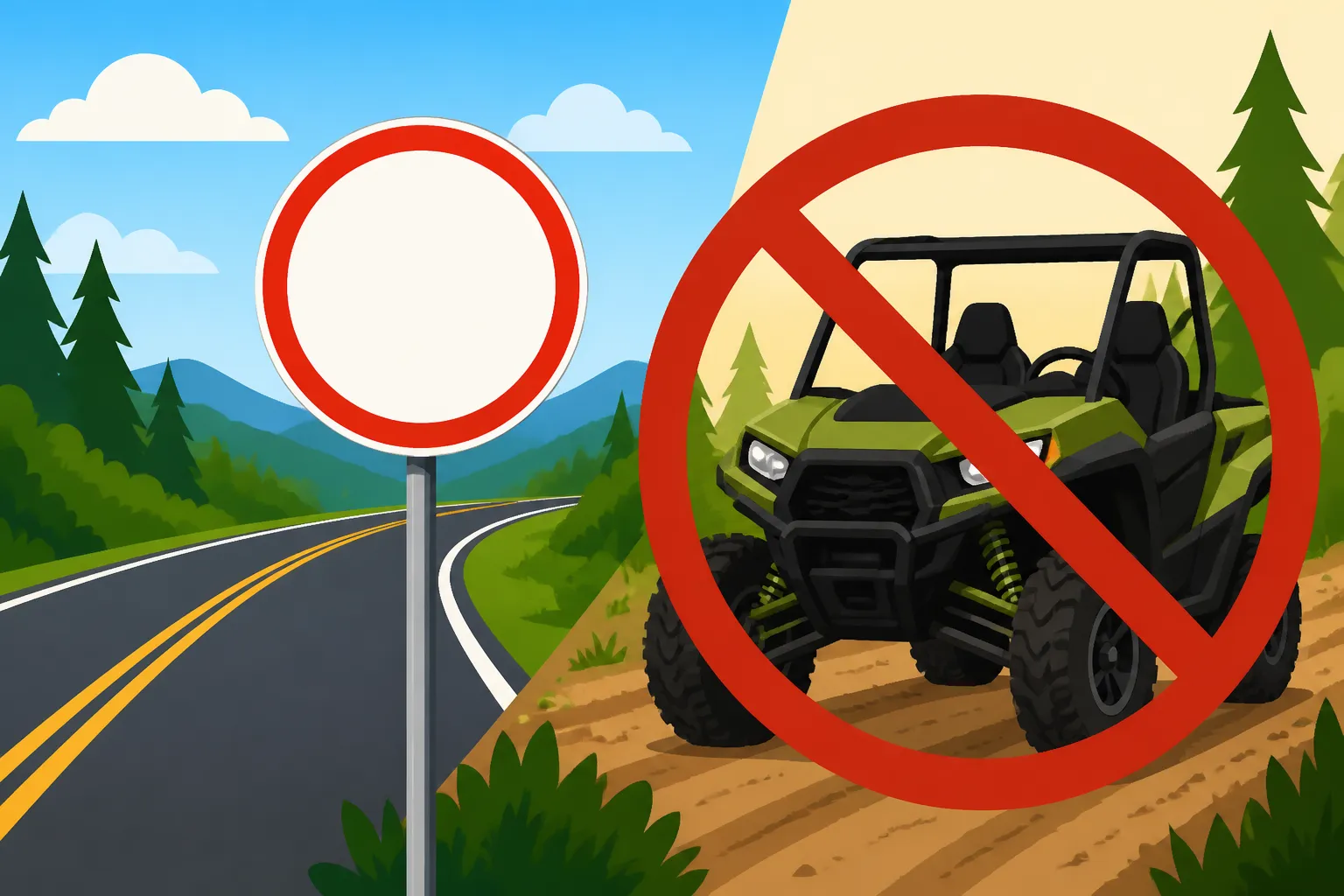
The core issue we're tackling today is the 40 mph posted road. It might seem like a small difference from 35 mph, but in the eyes of Washington law, it's a chasm. There are no exceptions in the general statute for a road simply feeling safe at 40 mph. If the sign says 40, your WATV needs to stay off that segment.
Consider a rider trying to access [Walker Valley ORV in Washington's Skagit County]. They might find a gravel road connecting to a main paved artery. If that main artery is posted 40 mph, even for a short stretch, it becomes a barrier. You can't just 'quickly' cross it if the crossing rules don't apply, or ride along it even for a few hundred feet. This specific limitation is why you need to carefully review local ordinances and maps, because relying on intuition about a road's safety level can lead to citations. Even if you've kitted out your machine with all the best gear, from new tires to a [Washington ATV Winch Costs] from a supplier like SuperATV, it won't change the letter of the law regarding speed limits.
How County Ordinances Impact the Rule
While the state law sets the 35 mph baseline, individual counties in Washington have the authority to "opt-in" and allow WATVs on certain designated county roads. However, this local authority does not override the 35 mph posted speed limit rule. This is a crucial point that often causes confusion. A county can open up miles of roads, but those roads still must have a posted speed limit of 35 mph or less for WATV operation. You can learn more about this by checking out [Washington Counties That Allow WATVs on Roads].
For example, a county might pass an ordinance opening up many of its rural roads. You might find yourself [Riding Old Owen Road] or [Riding Mann Road to the River] in Snohomish County, which are often 35 mph or less. However, if a connecting section of that same county road suddenly has a 40 mph limit, the legal WATV access ends there. It requires vigilance from the rider to constantly be aware of the posted speed limits, not just the general designation of the road.
Distinguishing Between Riding On and Crossing Roads
It's important to understand that there's a significant legal difference between operating your WATV on a road and merely crossing a road. Washington law makes provisions for crossing higher-speed roadways, but these are very specific and do not grant permission for extended travel.
Rules for Crossing Higher-Speed Highways
While you cannot generally ride your WATV on a road posted 40 mph or higher, Washington law does allow for crossing state highways and other higher-speed roads under specific conditions. This is a common necessity for riders trying to get from one trail system to another or simply navigate around their area.
The law typically states that a WATV can cross a public highway where the highway has a posted speed limit of 60 miles per hour or less. However, this crossing must be done at approximately a 90-degree angle to the roadway, and at a location where the crossing can be made safely and without unduly interfering with vehicular traffic. You must stop, yield to all approaching traffic, and proceed cautiously. You cannot ride along the shoulder, in the ditch, or on the main lanes of the higher-speed road before or after the crossing. This limited access is why you need to know [Washington Rules for Crossing a State Highway] inside and out. For more details on what's allowed, refer to [Crossing a Washington Highway Posted Between 35 and 60] and [Crossing a Highway Posted Fifty].
The Role of WSDOT and State Highways
The Washington State Department of Transportation (WSDOT) has its own set of rules and guidelines for state highways, which often differ from county roads. While counties can open up their roads, WSDOT generally has a stricter stance on WATV use on state routes, especially those with higher speed limits.
WSDOT's 2019 guidance, for instance, clarifies when and where WATVs might interact with state highways. This guidance typically focuses on crossing points rather than allowing WATVs to become regular traffic on higher-speed state routes. This means that even if a county road that connects to a state highway is open to WATVs, the state highway itself is usually only an option for a direct, perpendicular crossing, not for traveling on it, especially if it's posted 40 mph or higher. [The 2019 WSDOT Guidance on Washington WATVs] is an important document for understanding these distinctions.
Enforcement, Safety, and Smart Riding Practices
Knowing the law is one thing, but understanding the practical implications for your riding safety and avoiding costly mistakes is another. Law enforcement takes these rules seriously, and for good reason.
What to Expect from Law Enforcement
If you’re caught operating your WATV on a road with a posted speed limit exceeding 35 mph, even if it’s just 40 mph, you can expect a citation. Law enforcement officers, whether state troopers or county deputies, are generally well-versed in WATV regulations, especially given the increased popularity of these machines. They are looking for compliance with registration, equipment, and road-use rules. [What a Washington Trooper Checks Roadside] often includes checking for proper tabs, a valid driver's license (if applicable for road use), and adherence to speed limit designations.
A common scenario might involve a rider taking a "shortcut" on a 40 mph road for just a mile or two. While it might seem harmless, it’s still a violation. Officers might be positioned in areas where these transitions occur, or they might observe riders from higher-speed routes. The fines for illegal road use can vary but are designed to be a deterrent. For more on the consequences, see [Washington Fines for Illegal WATV Road Use].
Equipping Your Machine for Legal Road Use
To even qualify for limited road use on 35 mph or less roads, your WATV must be properly equipped and registered with the Washington Department of Licensing. This includes having the correct on-road tabs, a [Washington WATV Metal Tag], and specific safety equipment that mirrors what’s required for other motor vehicles.
Key equipment includes:
- Headlights and taillights
- Brake lights
- At least one rearview mirror
- Turn signals
- A horn
- A windshield or eye protection for the operator
- Seat belts for all occupants in a utility vehicle (side-by-side)
Many riders choose to enhance their machines with aftermarket parts to meet these requirements or improve safety and comfort. Companies like SuperATV offer a wide range of accessories, from [Turn Signals on a Washington Road Machine] kits to mirrors and enclosures, that can help make your machine more road-ready. However, it's crucial to remember that adding all this gear does not magically make a 40 mph road legal for your WATV. The equipment allows you to meet the baseline for eligible roads; the posted speed limit dictates which roads are eligible.
Smart Riding Practices and Planning
The best defense against unintended legal trouble is diligent planning. Before you head out, familiarize yourself with the area's regulations and map your route carefully, paying close attention to posted speed limits.
Here are some tips:
- Consult County Maps: Many counties that have opted-in to WATV road use provide maps or lists of approved roads. Check these resources online before you go.
- Don't Rely on GPS Alone: While GPS can show you roads, it won't always highlight legal restrictions for WATVs. Cross-reference with official county or WSDOT maps.
- Spot Check Speed Limits: As you ride, always pay attention to posted speed limit signs. They are the final word on whether a road is permissible.
- Prioritize Safety: Even on legal roads, remember you're sharing the pavement with cars, trucks, and other vehicles. Ride defensively, wear appropriate safety gear (including a helmet, as required by [Washington Helmet Law for WATV Riders]), and be predictable in your movements.
By understanding Washington’s 35 mph rule and planning your rides accordingly, you can enjoy the fantastic trail systems and scenic backroads our state has to offer, without the headache of a citation. It might mean a bit more planning, or occasionally trailering your machine where you might have preferred to ride, but it ensures your adventures stay safe and legal.
| Road Type/Situation | WATV Allowed? (General Rule) | Key Condition | Example |
|---|---|---|---|
| County Road Posted 35 mph or Less | Yes | County must have opted-in or be under 15k pop. | Riding a rural backroad connecting two trailheads |
| County Road Posted 40 mph or More | No | Exceeds 35 mph posted limit | Traveling along a main county artery |
| State Highway (Crossing) | Yes | Posted 60 mph or less; 90-degree angle; yield | Moving from a side road across a state route to another side road |
| State Highway (Riding Along) | No | Generally prohibited, especially over 35 mph | Cruising on the shoulder of a state highway |
| Private Roads | Yes (with permission) | Requires explicit permission from landowner | Using a private logging road with a company permit |
Disclaimer
This article is for general informational purposes only and does not constitute professional advice. Laws, prices and regulations vary by location and change over time. Consult a qualified professional for guidance on your specific situation.