Cedar Stumps on an Old Skid Road
An old skid road can look like an easy shortcut through Washington timberland, right up until a buried cedar stump catches a tire or lifts a machine off line. These routes can hide obstacles under ferns, mud, and slash. This guide explains how to spot stump hazards, ride around them safely, and decide when an old road is better left alone.
Why cedar stumps make old skid roads tricky
What makes a stump hard to see
A skid road is a track once used to move logs, not necessarily a maintained riding trail. After logging ends, vegetation can reclaim the route. A stump may be covered with moss, brush, needles, or leaves, while the roadbed around it softens and erodes. From the seat, what looks like a harmless mound may be the top of a solid stump—or a root mass attached to one.
Cedar wood can persist in damp forest conditions, and old stumps may remain as obstacles long after the surrounding ground changes. The stump itself might be low, but its roots can spread into the line you would naturally take around it. A machine can clear the visible center and still catch a tire, skid plate, or footrest on a raised root.
The setting can make judgment harder. On a wet route in the Coast Range or Cascade foothills, dark soil, slick needles, and low light can hide changes in surface height. On a sunny ride, glare through the trees can flatten shadows and make a root look like a patch of mud. If you are following another rider, their machine may block your view of the ground ahead.
How old logging routes change over time
A route that once had a broad, firm surface can narrow as brush grows in from the edges. Water may cut channels through the roadbed, exposing roots and leaving ridges between ruts. In other spots, sediment and plant growth can bury an obstacle just enough to make it difficult to read from a distance.
You may also encounter slash, loose branches, or cut material left beside the track. These can conceal the base of a stump or force you toward a less stable line. Do not assume that a route is safe simply because it appears on a map or has visible tire marks. Tracks show that someone went through; they do not prove the route is open, maintained, or suitable for your machine today.
Use a current, detailed map to understand where you are, but verify access and closures with the land manager. A tool such as onX Offroad can help you review a route before leaving home, but it should be treated as a planning aid rather than permission to ride. For public-land navigation, Reading a DNR Recreation Map offers useful context for interpreting mapped routes, and Washington Trail Closures to Check First is a reminder to check current access before loading up.
How to spot a stump hazard before you reach it
Read the terrain, not just the track
Scan ahead for small changes in color and texture. A rounded patch that stays unusually dark may be damp soil, a hollow, or wood covered in moss. Look for a ring of roots, a raised hump, or a cluster of plants growing differently from the surrounding ground. Stumps do not always appear as tidy, flat-topped columns. They may be broken, tilted, or partly hidden beneath debris.
Pay attention to the road’s shape. If both wheel tracks bend around the same point, there may be an obstacle in the middle. If one side of the road has a fresh rut and the other has a mound, avoid charging into the gap between them before you know what is underneath. A previous rider’s line may have been chosen for a different vehicle, tire setup, or water level.
Stop somewhere stable when visibility is poor. Get off the machine only if you can do so safely, and inspect the obstacle from a position where you are not standing on a steep or unstable edge. A short walk can reveal whether the “stump” is loose debris or a fixed obstruction with roots extending across the route. If you cannot tell what is beneath the vegetation, assume the surface is less predictable than it looks.
Choose a line that keeps the machine balanced
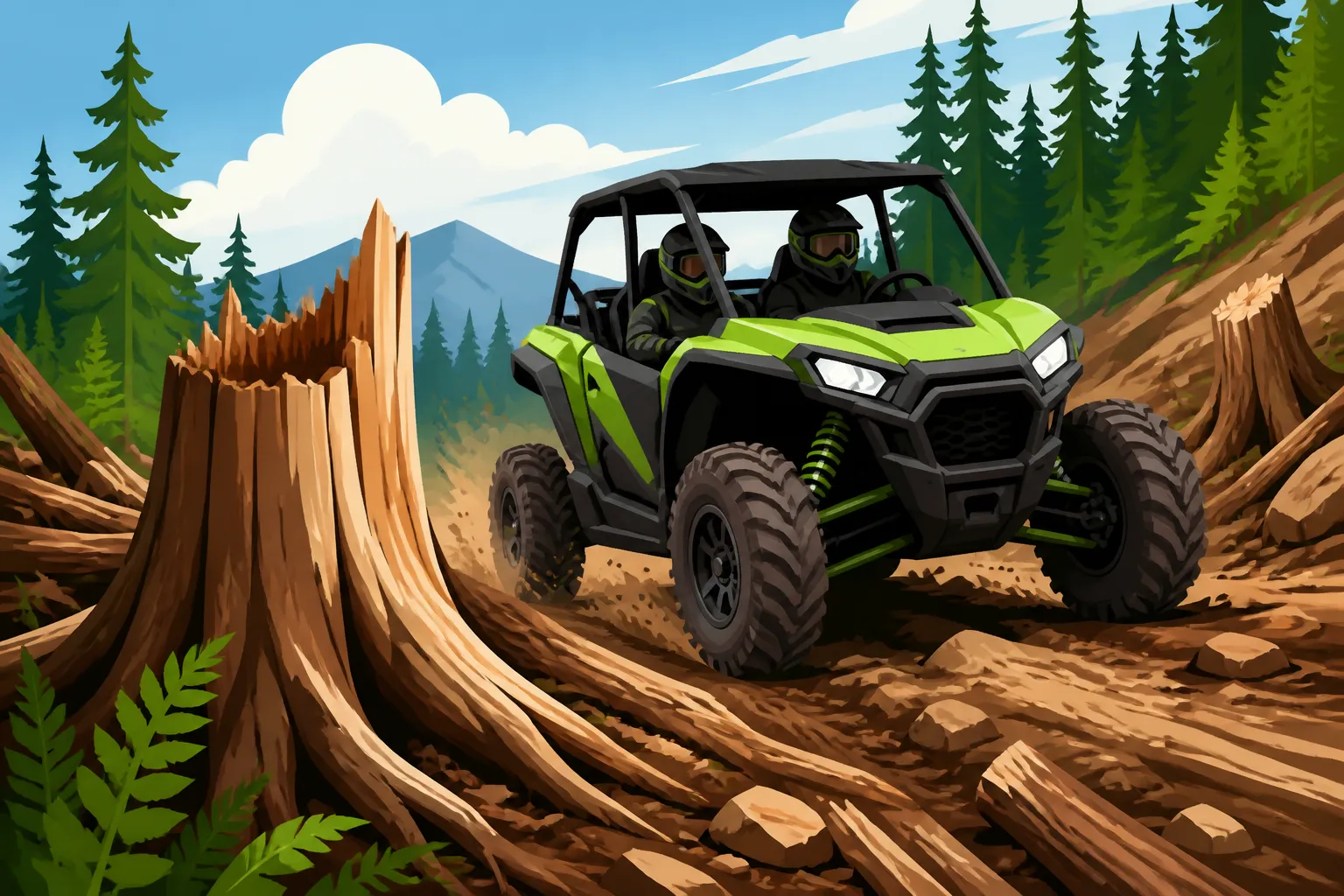
Once you understand the obstacle, pick a line with room to steer and enough visibility to keep both tires on predictable ground. Do not aim directly at a stump and hope the machine will roll over it. A sharp edge can catch a tire, push the front end sideways, or lift one side of the machine. On a UTV, a wheel climbing a root while the opposite side drops into a rut can create an awkward, unstable angle.
Keep your speed low enough to stop before the obstacle. Smooth throttle and deliberate steering are usually more useful than trying to power through. Avoid sudden turns on wet roots, loose soil, or side slopes; a tire that loses grip can send the machine off the chosen line. If you are riding with a group, leave space between machines so each rider can see the ground rather than following blindly through dust, spray, or brush.
If the route requires a line that feels too narrow, steep, or exposed, turn around where it is safe. That is not a failure of skill. It is a sensible decision when the obstacle is fixed, visibility is poor, or the ground offers no stable route around it. For more on conditions that make forest surfaces difficult, see Riding a Wet Forest Trail and Root Balls and Slick Clay.
Riding an old skid road more safely
Prepare before the ride
Before heading out, check that the route is open and appropriate for your machine. A line shown in an older map may have changed because of maintenance, erosion, timber work, or a closure. Compare your planned route with current information from the responsible land manager. onX Offroad can be useful for reviewing a route and your position during trip planning, but confirm access separately rather than relying on a map line as proof that riding is allowed.
Think about your machine’s width and turning space. A narrow quad may be able to maneuver around a stump where a wider side-by-side cannot. Brush can also make a route feel narrower than it appears on a screen. Review Washington Width Limits on a Forest Trail and Washington Trails for a Wide Side-by-Side if vehicle dimensions may affect where you can ride.
Tell someone where you plan to ride, especially if the route is remote or you expect limited cell service. Carry basic recovery and communication equipment suited to your trip, and make sure your group knows how to regroup if one rider stops to inspect an obstacle. If you are riding with children or less experienced riders, set expectations before the trail: no one passes a stopped machine until the group has checked why it stopped.
| What you see | Why it may be risky | Safer response |
|---|---|---|
| A rounded mound covered in moss | A stump or root flare may be hidden underneath | Slow down and inspect from a safe, stable place |
| A rut ending beside a raised ridge | Water may have exposed roots or undercut the road surface | Avoid crossing quickly; choose a stable line or turn back |
| Fresh tire marks around an obstacle | The obstacle may still be difficult or unsuitable for your machine | Assess it yourself rather than copying the line |
| Brush narrowing the route | Stumps, slash, or soft shoulders may be concealed | Stop before entering the pinch point and check clearance |
| Water covering the track | The depth, bottom, and hidden debris may be unclear | Do not enter unless you can assess the crossing safely |
Decide when turning around is the right call
Some obstacles have no good line around them. A stump may sit beside a steep bank, with roots spreading into the only flat section. The apparent bypass may be soft, rutted, or too close to the edge. Trying to squeeze through can turn a minor delay into a recovery problem or a rollover risk.
Turn around if the ground is moving under the tires, the route is too narrow to keep the machine level, or you cannot see a safe exit beyond the obstacle. Also reconsider the route if weather has changed since you started. Rain can make roots slick and soft shoulders weaker; a route that seemed manageable on the way in may be harder to negotiate on the return trip.
If a group decides to continue, discuss the plan before the first machine moves. Make sure each rider understands where to stop, where to wait, and how to avoid crowding the person negotiating the obstacle. Do not use a tow strap or winch from an improvised anchor point, and do not stand in a recovery line. If the machine is stuck at an unsafe angle or the recovery setup is unclear, stop and reassess instead of adding more throttle.
Planning routes and protecting the trail
Use maps as planning tools, not guarantees
Digital maps can make a complicated forest easier to understand, especially when several old roads intersect. onX Offroad may help you review mapped routes and keep track of your position, but a mapped line cannot show every root, stump, washed-out section, or temporary closure. Conditions on the ground matter, and posted signs or directions from the land manager take priority over a route you planned in advance.
Before the ride, note major junctions and identify a practical turnaround point. Download or carry the information you need for areas where mobile coverage may be unreliable. If you use onX Offroad while riding, check the screen only when stopped in a safe place; trying to navigate through a rough section while looking down can make a hidden stump even harder to notice.
Old skid roads also cross different kinds of land and may not all be open for motorized use. Confirm the route’s status, permitted vehicle type, and any seasonal restrictions. Riding a Road Shown Open on an Old Map explains why an old map should not be treated as the final word, while Checking Alerts Before You Load Up is a helpful reminder to look for changes before departure.
Avoid making the hazard worse
Do not widen a route by pushing through brush or driving around an obstacle onto untracked ground. That can damage plants, loosen soil, and create new ruts that channel water. If a stump blocks the route, do not cut, dig, or move it unless you are authorized to do so. The obstacle may be part of a managed route or a sign that the track is no longer suitable for riding.
When you find a serious hazard, note its location as accurately as you can and report it to the appropriate land manager if reporting options are available. A clear description helps: identify the route or nearby junction, describe what is damaged, and say whether the obstruction prevents safe passage. Avoid posting sensitive access details in a way that could encourage unauthorized riding.
After the ride, clean mud and plant material from your machine before moving to another riding area. This is especially important when you have crossed wet or brushy terrain. For broader route-planning ideas, explore Washington Forest Riding Areas and Washington Trail Difficulty Ratings so you can choose terrain that matches your machine and experience.
Cedar stumps on old skid roads are easy to underestimate because they can blend into the forest floor. Slow down, read the ground ahead, check the route’s access status, and turn around when there is no safe line. A cautious decision may cost a few minutes, but it is far better than getting a machine hung up on a hidden root or taking an avoidable spill.
Disclaimer
This article is for general informational purposes only and does not constitute professional advice. Laws, prices and regulations vary by location and change over time. Consult a qualified professional for guidance on your specific situation.