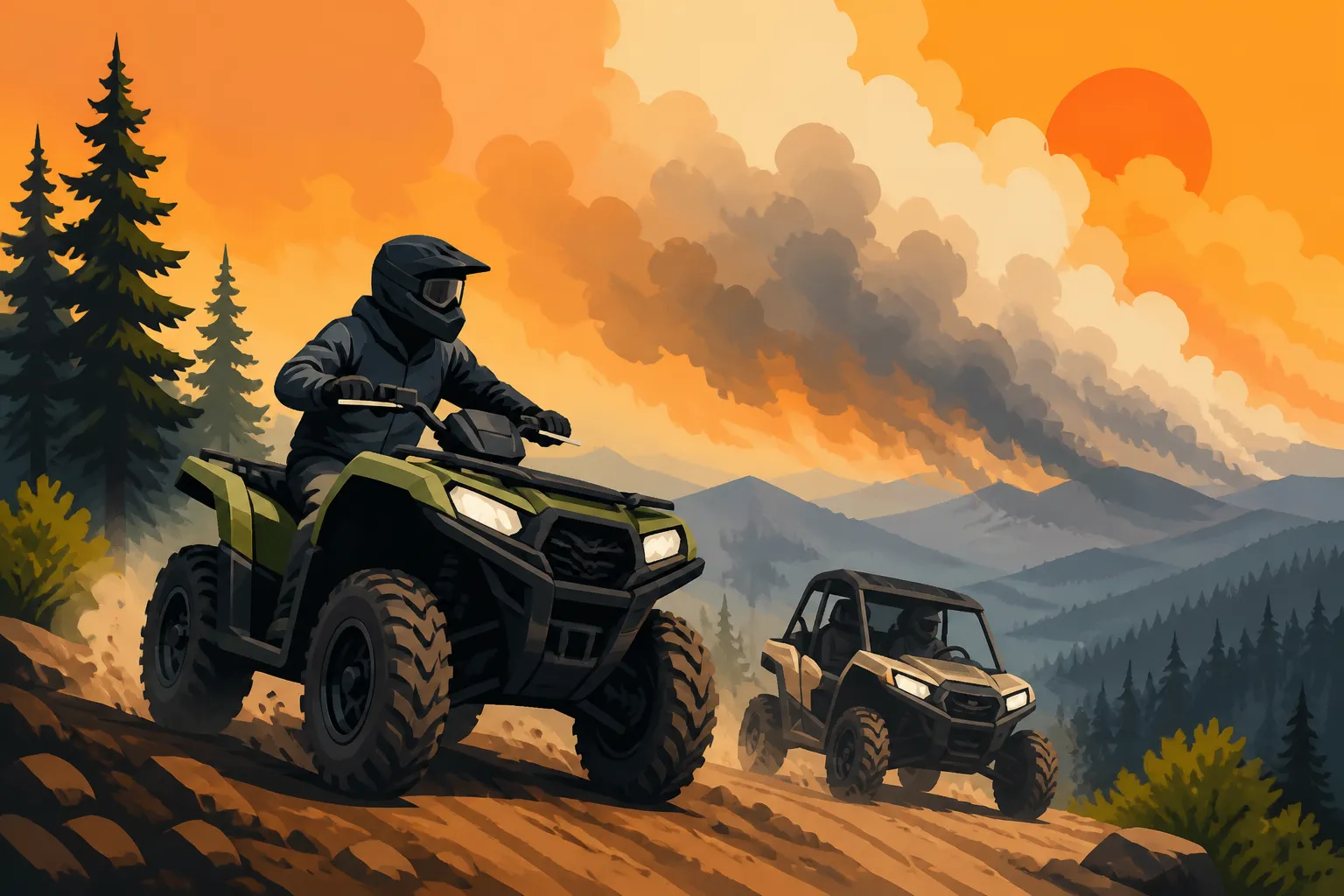
Smoke Season in the East
Smoke can turn a familiar Eastern Washington ride into a health and visibility problem fast: the trail may still be open, but the air can be rough on your lungs and the road ahead hard to see. This guide explains how to judge smoke conditions, plan a safer ATV or UTV outing, and know when to change plans or head home.
Why smoke changes an Eastern Washington ride
Smoke is more than a visibility issue
Wildfire smoke can contain fine particles that irritate your eyes and throat and make breathing harder. On a machine, you may also spend long stretches exposed to dust, exhaust, and physical effort, which can make an already smoky day feel especially draining. A ride that seems manageable at the staging area can become uncomfortable after an hour on an exposed route.
Pay attention to symptoms such as coughing, wheezing, chest tightness, unusual shortness of breath, headache, or irritated eyes. Those are reasons to stop and reassess—not signs you need to push through to finish the loop. People with asthma, heart or lung conditions, and other sensitivities may need to be more cautious. Children can also be more affected by poor air, so a family ride may call for a lower threshold for postponing.
Visibility matters just as much. Smoke can flatten the landscape, hide the shape of a bend, make dust clouds harder to distinguish from haze, and reduce the time you have to react to another rider or a vehicle. That risk can increase on narrow roads, in forested areas, and near active work or fire operations. If you cannot comfortably see the surface and enough distance ahead to stop safely, turn around or stop somewhere safe rather than continuing because the trail is technically open.
Fire danger and smoky air are separate concerns
Smoke does not automatically mean a riding area is closed, and clear skies do not guarantee that a route is safe or open. Fire restrictions, emergency closures, active fire response, and air quality conditions are different things. A trail could be closed because of fire danger or firefighting activity even if the smoke has drifted elsewhere. Conversely, an area may remain open while smoke makes riding unpleasant or unhealthy.
Before loading up, check the land manager’s current notices for the specific trail system, road, or recreation area. Look for closure boundaries, fire restrictions, and any directions to avoid an area. Washington Fire Closures That Shut Trails explains why closures can change access even when a route appears usable on an older map, and Washington Trail Closures to Check First is a useful companion when you are planning around changing conditions.
Treat a posted closure as a hard stop. Do not ride around a gate, follow tracks past a barricade, or assume a route is open because it appears on a recreational map. Fire crews, utility workers, and other responders need clear access, and a road that looks quiet may still be part of an active operation.
How to decide whether to ride
Check air quality, visibility, and the route
Start with local air-quality information and an air quality index reading for the area you plan to visit. Conditions can differ between a town, a staging area, and a higher-elevation trail, so do not assume the nearest city’s reading tells the whole story. Check again shortly before departure and keep checking during the day if conditions are changing.
Use the reading as one input, not as a personal guarantee that riding will be safe. Consider your own health, the people riding with you, how strenuous the outing will be, and whether you can leave quickly if conditions worsen. If someone in your group has a respiratory condition, follow their clinician’s advice about smoke exposure and activity.
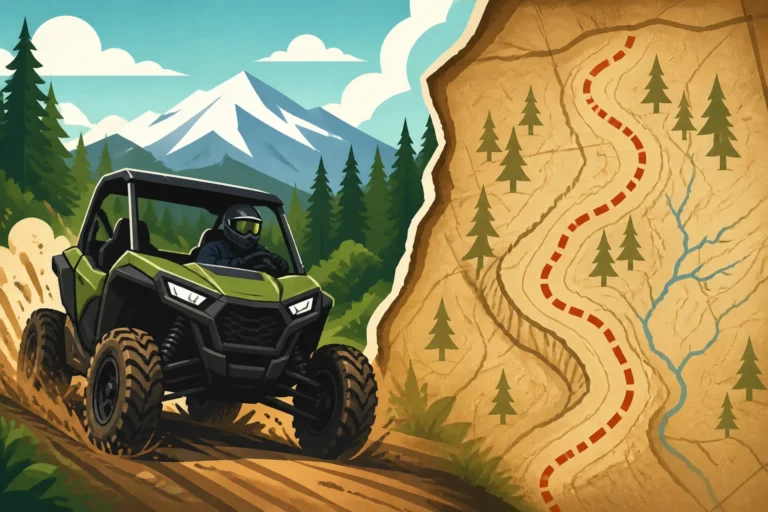
A map app such as onX Offroad can help you organize a planned route and understand where you are in relation to roads, trailheads, and alternate exits. Use it as a navigation aid, not as proof that a route is currently open or that conditions are healthy. Check official land-manager notices separately, and save maps or route details before you lose cell service. For more on planning around changing air conditions, see Air Quality and an August Ride and Washington Riding in August.
| What to check | Why it matters | A cautious response |
|---|---|---|
| Local air-quality information | Smoke exposure can vary by location and time | Postpone or shorten the ride if conditions are concerning for anyone in the group |
| Visibility on the actual route | Haze can conceal turns, obstacles, and other traffic | Stop or turn around if you cannot see far enough to ride safely |
| Fire restrictions and closures | A smoky area may also have access limits or active response | Follow current agency notices and obey barriers |
| Riders’ symptoms | People can react differently to the same conditions | Stop riding if symptoms develop or worsen |
| Exit options and communication | Smoke, closures, or poor visibility can disrupt a planned loop | Keep a conservative route and a clear turnaround plan |
Match the destination to the conditions
Eastern Washington has varied riding terrain, from open sand to forest roads and trails, and each setting presents different challenges in smoke. Open terrain may offer better sightlines, but wind can shift smoke and exposed areas can leave riders with little shelter. Forested routes can provide shade, yet trees and changing grades may reduce visibility and make it harder to spot obstacles ahead.
If you are considering the Ahtanum area near Yakima, review access and conditions for the particular route you want to ride. Forest roads, designated trails, and staging areas may have different status or restrictions. Washington’s Ahtanum State Forest and Washington ORV Areas Near Yakima can help with destination planning, but conditions on the ground still need a fresh check before you leave.
Sand areas have their own trade-offs. At Juniper Dunes or Beverly Sand Dunes, open sightlines may help you see other riders, but wind can carry dust and smoke across exposed terrain. Keep generous spacing, slow down when visibility drops, and do not assume a wide-open view means you can safely ride at your usual pace. For destination-specific context, see Juniper Dunes in Eastern Washington and Riding Beverly Dunes on a Weekend.
If the air looks thick, the smell of smoke is strong, or visibility is changing rapidly, choosing a different day is often the simplest and safest plan. A day spent checking routes and preparing gear is less frustrating than towing a machine across the state only to turn around at a closure or decide the air is too unpleasant to ride.
Plan a flexible ride and reduce avoidable exposure
Build a shorter route with an early exit
When smoke is possible, do not make a long, committed loop your only plan. Choose a route with clear turnaround points and more than one way back to the staging area where practical. Decide in advance what conditions will end the ride: a change in visibility, a closure notice, a rider developing symptoms, or smoke becoming noticeably worse.
Tell someone where you plan to go and when you expect to be back, especially if you are riding beyond reliable cell coverage. Keep your group together, agree on a pace, and identify a meeting point if riders become separated. A downloaded route in onX Offroad or another navigation tool can help you follow your plan when service is limited, but it cannot replace a current closure check or good judgment on the trail.
Keep your schedule flexible. If the wind shifts or smoke thickens, do not feel obligated to complete every planned mile. Turn around while everyone is still feeling well and visibility is still manageable. That is a better outcome than waiting until someone feels unwell or the route back becomes difficult to follow.
Keep the machine and riding group ready to leave
Before setting out, make sure the machine is in good working order and that your group has the basics for a quick return: water, appropriate protective gear, a charged phone or communication device, and the information needed to find the staging area again. Carrying registration and other required documents remains important; Keeping the Registration Inside the Machine covers one practical way to keep paperwork with the vehicle.
Avoid unnecessary idling near other riders or at a staging area, and do not create extra dust by following too closely on dry roads. Leave space between machines, especially when the air is hazy. If someone is already coughing or struggling to breathe, do not add strenuous riding or a difficult route to the day.
Protective equipment is not a substitute for clean air. A helmet and eye protection help with ordinary riding hazards, but they do not make heavy smoke safe to breathe. If conditions call for limiting exposure, the meaningful choice is to reduce time outside, leave the area, or skip the ride.
What to do when smoke worsens during the ride
Stop, reassess, and communicate
If smoke thickens or visibility drops, slow down and find a safe place to stop without blocking a trail or road. Check on every rider, including passengers, and ask directly about breathing, dizziness, headache, or eye irritation. Do not dismiss symptoms as ordinary exertion, dust, or nerves.
Use your route plan to decide on the simplest way back. Avoid improvising onto an unfamiliar road or trail just to escape the smoke; that can lead to a closure, a private-road boundary, or a route that is harder to navigate. If you use onX Offroad, consult your saved route to orient yourself, but confirm any new road or trail choice is permitted and open before taking it.
If anyone has significant breathing difficulty, chest pain, confusion, or another severe symptom, prioritize getting help rather than continuing the ride. Move away from the immediate smoke when you can do so safely and contact emergency services if needed.
After the ride, check for changes before your next outing
Once you are back, review official notices before planning another trip to the same area. Smoke direction and fire activity can change, and an access point that was open earlier may later close. Do not rely on a screenshot, an old map, or a report from a friend as the final word on access.
If you rode through dust or smoke, take a moment to clean and inspect the machine as appropriate for the conditions, particularly air intake areas and other components where dust can collect. Keep an eye on riders who felt unwell during the outing; symptoms that persist or worsen deserve medical attention.
The best smoke-season ride is not always the one that happens as planned. Sometimes it is a shorter loop, a different destination, or a decision to stay home. If you check air conditions, confirm access, build in an easy exit, and take symptoms seriously, you can make that call before a frustrating day turns into a risky one.
Disclaimer
This article is for general informational purposes only and does not constitute professional advice. Laws, prices and regulations vary by location and change over time. Consult a qualified professional for guidance on your specific situation.