Which Highway Segments the Statute Opens to ORVs
One of the biggest head-scratchers for anyone wanting to legally ride their ATV or UTV in Washington is figuring out which roads are actually fair game. It's not as simple as just throwing a plate on and hitting the asphalt; the laws are layered, often confusing, and can leave you feeling like you need a legal degree just to plan a simple ride. This guide is here to untangle the complexities of Washington state law, specifically focusing on the highway segments that the statute explicitly opens to off-road vehicles (ORVs), so you can ride with confidence and stay on the right side of the law.
Understanding Washington's Statutory Highway Access for ORVs
Washington state has made strides in recent years to provide more opportunities for ATV and UTV riders, allowing us to connect trails, access services, and even commute short distances on certain paved surfaces. However, it's crucial to understand that not all "highways" are created equal in the eyes of the law. When we talk about highways, we're not just referring to the massive interstates, but also state routes and county-maintained roads. The statute specifically addresses state highways, offering distinct provisions that differ significantly from how county roads are handled.
Many riders get understandably frustrated trying to parse out the difference between a county road, which might be opened by a local ordinance, and a state highway, which has its own set of rules directly from the state legislature. The core difference lies in who has the authority to open them. Counties have the power to open their own roads (those they maintain) through a resolution or ordinance, often after public hearings and careful consideration. State highways, on the other hand, are under the jurisdiction of the Washington State Department of Transportation (WSDOT), and any ORV access has to be explicitly granted or limited by state law. This distinction is vital because it means even if your county has opened some roads, that doesn't automatically grant you access to state highways passing through it. It's a common misconception that can lead to unexpected fines and a ruined day of riding.
The legal framework is designed to balance recreational access with public safety. Imagine trying to ride your side-by-side on a busy state highway with traffic moving at 60 mph – it's inherently more dangerous than on a quiet rural county road. The statute takes these safety concerns into account, which is why it sets very specific parameters for where and how ORVs can operate on state highways. It's not about making things difficult, but about ensuring that when we do ride on these public thoroughfares, we're doing it in the safest way possible for ourselves and for other motorists. [Street Legal WATVs in Washington: The Short Answer] is a good starting point to grasp the overall picture.
The Specifics: Where the Law Says You Can Ride
So, let's get down to the nitty-gritty: which actual highway segments are open by statute? The Washington state law (specifically RCW 46.09.455) provides some very distinct allowances for ORVs on state highways, but these are highly conditional and not a blanket permission. The general rule of thumb to remember is that these allowances are designed primarily for connectivity, not for high-speed cruising on major thoroughfares.
Roads Posted 35 MPH or Less
The most significant provision states that ORVs are permitted on state highways that are posted at a speed limit of 35 miles per hour or less. This is a huge deal because it means you don't need a specific county or WSDOT ordinance to ride on these particular sections. Think of it as an automatic statutory opening for lower-speed segments. These are typically found as state routes passing through small towns, rural communities, or sections approaching developed areas where the speed limit naturally drops.
For example, you might be riding a trail system and need to cross a short segment of a state route to get to another trail. If that segment is clearly marked with a "Speed Limit 35" sign or lower, you are, by statute, allowed to use it. This is incredibly helpful for connecting popular riding areas or getting to a gas station in a small town without having to load your machine back onto a trailer. However, you must be acutely aware of the posted speed limit. As soon as that limit increases beyond 35 mph, your legal access on that state highway segment ends. This is where many riders get into trouble; they assume if they're on a "state highway" they're good to go, but the speed limit is the absolute deciding factor. [Washington's 35 mph Road Rule] delves deeper into this specific speed restriction.
Crossing a State Highway
Another crucial aspect of the statute concerns crossing state highways. Even if a state highway segment is posted above 35 mph, the law allows for ORVs to cross it at an intersection. This is incredibly important for maintaining trail connectivity, especially when major state routes bisect popular riding areas. However, this isn't a free-for-all; it must be done safely and directly.
When you cross, you're expected to do so at as close to a ninety-degree angle as practicable and only when it is safe to do so. You can't just meander down the shoulder to get to a safer crossing point if that shoulder is part of a higher-speed section of the highway. The intent here is to allow riders to move from one legal riding area to another that's on the opposite side of a state highway, minimizing the time spent on the pavement. Imagine a trail system like Capitol State Forest, where sometimes a state highway runs right through it. Being able to cross legally is the only way to access different parts of the forest without having to trailer your machine. [Washington Rules for Crossing a State Highway] provides more context on this maneuver.
WSDOT-Authorized Segments
While the 35 mph rule and crossing provisions are statutory, there's another pathway for state highway access: segments specifically authorized by WSDOT. The statute grants WSDOT the authority to designate certain portions of state highways as open to ORV use, even if they exceed the 35 mph speed limit. This is typically done in very specific situations, often after extensive review and consideration of safety, traffic volumes, and local needs.
These WSDOT-authorized segments are much less common than the 35 mph statutory openings. They often arise in rural areas where ORV use is a significant part of the local economy or culture, and there might be no practical alternative to using a short, higher-speed section of a state highway to connect trail systems. For example, if a state highway runs through an isolated area with very low traffic and is vital for connecting two large ORV recreation areas, WSDOT might consider opening a specific segment. However, these authorizations are always clearly signed, and riders should never assume a segment is open unless they see specific WSDOT signage indicating ORV use is permitted. Always check the official WSDOT website or local county resources for confirmed lists of such segments, as they are not nearly as prevalent as the locally opened county roads.
Navigating State Highways: Rules, Conditions, and Equipment
Just knowing which segments are technically "open" by statute is only half the battle. When you venture onto any paved surface in Washington, whether it's a county road or a state highway segment, you transform your off-road machine into something that needs to meet specific on-road requirements. Ignoring these rules can lead to serious fines and safety hazards.
Essential Equipment for Road Use
Before you even think about putting a tire on a statutory highway segment, your ORV must be equipped to meet the Washington state requirements for road use. This isn't optional; it's a legal necessity. You can't just have your off-road tabs; your machine needs specific safety features that might not be standard. These typically include:
- Headlights and Taillights: Essential for visibility, especially during dawn, dusk, or in inclement weather. These aren't just for looking cool; they're about being seen.
- Brake Lights: Crucial for signaling your intentions to traffic behind you.
- Turn Signals: You need to be able to indicate turns effectively. Many off-road machines don't come with these factory-installed, so you might need to add an aftermarket kit. Companies like SuperATV offer robust universal turn signal kits designed for ATVs and UTVs, making it easier to meet this requirement without extensive modifications. [Washington Turn Signal Requirements] provides more details.
- Mirrors: You must have at least one mirror, but ideally two, giving you a clear view of traffic approaching from the rear. Again, SuperATV has a range of mirror options, from side-view to rearview, that can easily be mounted on most machines. [Washington Mirror Requirements for Road Use] explains this further.
- Horn: A working horn is necessary to alert other drivers or pedestrians to your presence. [Does Washington Require a Horn on an ORV?]
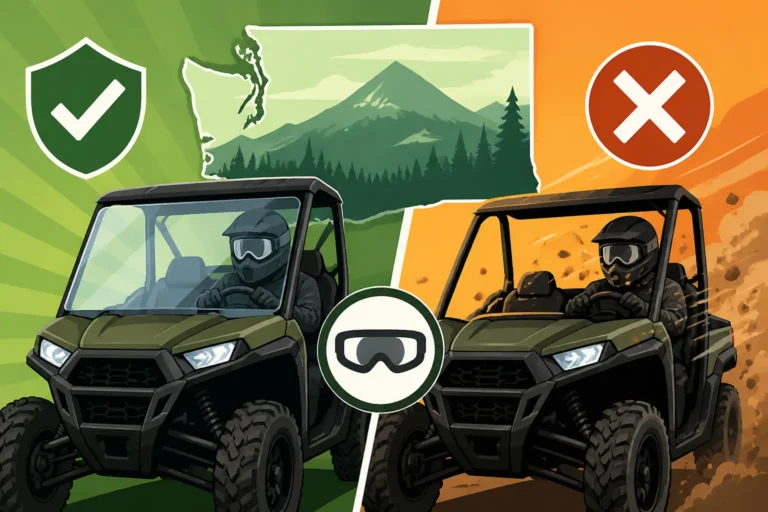
- Windshield or Eye Protection: If your machine doesn't have a windshield, you (and your passengers) must wear adequate eye protection, such as goggles or a face shield.
- Seat Belts: For utility vehicles (UTVs) with side-by-side seating, factory-installed seat belts must be used.
- Spark Arrester and Muffler: Your machine must be equipped with a U.S. Forest Service-approved spark arrester and have a muffler in good working order to keep noise levels reasonable and prevent wildfires.
It’s worth reiterating that these aren't merely suggestions. A state trooper or local sheriff can pull you over if your machine isn't properly equipped, even if you're on a legally open section of highway. This is about being a responsible, visible, and predictable part of traffic.
Driver Licensing and Helmets
Beyond the machine itself, the operator also has responsibilities. Anyone operating an ORV on a public road or highway in Washington must possess a valid driver's license. This isn't a separate ORV permit; it's your standard automotive driver's license. If you're under 18, there are additional supervision rules that apply. [A Valid Driver License on a Washington Road] covers this in more detail.
Furthermore, helmets are mandatory. Washington law requires all operators and passengers of ATVs and UTVs to wear a U.S. DOT-compliant helmet when operating on public roads, streets, or highways. This is a crucial safety measure that can literally save lives, and it applies regardless of your age or the specific type of ORV you're riding. This rule is often overlooked by riders who are used to trail riding where helmet rules might vary or be less strictly enforced for adults in some areas. But on the pavement, it's non-negotiable.
Riding Etiquette and Legal Limitations
Even on statutory segments, you're expected to ride as any other vehicle would, with some key distinctions. You must obey all traffic laws, including speed limits, stop signs, and traffic signals. You also cannot ride two abreast; ORVs must be operated in single file when on a public road or highway. This ensures you're not hogging the lane or creating a wider, less predictable obstacle for other motorists.
It's also important to remember that riding on these segments is primarily for access and connectivity, not for joyriding or prolonged travel. While the statute opens these roads, the spirit of the law is to allow you to get from point A to point B, or to access a trailhead, rather than to treat these as recreational routes in themselves. Be mindful of traffic, use appropriate hand signals (even with turn signals, extra communication never hurts), and always defer to larger vehicles. Being a courteous and safe rider helps ensure that these limited road access opportunities continue to exist. [Washington WATV Road Requirements] outlines many of these general rules for pavement riding.
What the Statute Doesn't Cover: Local Control and Limitations
While the state statute provides a baseline for state highway access under specific conditions, it's equally important to understand what it doesn't cover. This is where local control, particularly at the county level, plays a significant role and where much of the confusion often arises.
County Roads and Local Ordinances
The vast majority of paved road access for ORVs in Washington comes through local county ordinances, not through the state highway statute. Counties have the authority to open or close their own maintained roads to ORV use. This means that if you're looking to ride your ORV on a county road that is posted above 35 mph, or one that doesn't fit the crossing criteria, you must check if your specific county has an ordinance in place allowing it.
This is a critical distinction. The state highway statute is a statewide rule for state-maintained roads. County ordinances, however, are local rules for county-maintained roads. Just because a state highway allows you to cross it, or ride a 35 mph segment, doesn't mean the county roads feeding into it are automatically open. You could be perfectly legal on a short stretch of a state route but immediately illegal as you turn onto a county road that hasn't been opened by local officials. [Washington Rules for Riding a County Road] goes into depth on this topic. Always, always check the county's website or contact their public works department for an official list of approved roads. Ignorance of a local ordinance is not a valid excuse for a citation.
Speed Limits Beyond 35 MPH
The state highway statute is very clear: the 35 mph limit for direct riding on state highway segments is largely non-negotiable, with the rare exception of specific WSDOT authorizations. You cannot ride your ORV on a state highway segment posted at 40 mph, 45 mph, or higher, even if it feels safe or there's no traffic. This is a hard-and-fast rule established for safety reasons. The difference between 35 and 40 mph might seem negligible to you, but legally, it's a monumental divide. Violating this speed restriction means you're operating illegally, even if your machine is fully equipped for road use.
The only time you might encounter a state highway segment above 35 mph that is legally open to ORVs is if WSDOT has explicitly designated it, which, as mentioned, is quite rare and will be clearly signed. For all other segments, the 35 mph cap is your absolute guide. If the speed limit sign says 40, stay off the pavement (unless you're crossing at an intersection).
Highway Segments That Are Never Open
There are also certain highway types and segments that are simply never open to ORVs by statute, regardless of speed limit or local ordinances. These include:
- Limited Access Highways: Freeways, interstates, and other multi-lane highways designed for high-speed, limited-access travel are unequivocally off-limits to ORVs. You won't find any statutory allowance or local ordinance that permits an ORV on I-5, for example.
- Posted Restrictions: Even if a segment could technically fall under the 35 mph rule, if WSDOT or the local authority has explicitly posted signs prohibiting ORV use, then it's closed. These signs take precedence.
- Specific Exclusions: Sometimes, due to unique local conditions or safety concerns, certain stretches of road or specific bridges might be excluded from general ORV access, even if surrounding segments are open. These will typically be clearly marked.
Understanding these exclusions is just as important as knowing the open segments. The goal is to maximize your riding opportunities while strictly adhering to the law, protecting yourself, and maintaining positive relationships with other road users.
Conclusion
Navigating the rules for riding your ATV or UTV on Washington's state highways can feel like a complex puzzle, but by understanding the specific provisions of the state statute, you can demystify much of the process. Remember, the law primarily opens state highway segments posted at 35 mph or less for direct use and allows for crossing state highways at intersections, with very rare WSDOT-authorized exceptions for higher-speed segments.
Always ensure your machine is properly equipped with headlights, taillights, brake lights, turn signals, mirrors, and a horn, as well as a U.S. Forest Service-approved spark arrester. You, the rider, must have a valid driver's license and wear a DOT-compliant helmet. And perhaps most importantly, always distinguish between state highway statutory access and county road access, which depends on local ordinances. Staying informed and compliant ensures you can enjoy the fantastic riding opportunities Washington has to offer, both on and off the trail.
Here's a quick summary of highway access:
| Type of Road/Segment | Statutory ORV Access? | Key Conditions/Limitations |
|---|---|---|
| State Highway (<= 35 mph) | Yes | Must be posted 35 mph or less. ORV must be road-legal. |
| State Highway (Crossing) | Yes | Must cross at an intersection. Done safely and directly. |
| State Highway (> 35 mph) | Rarely (WSDOT authorization only) | Only if WSDOT has explicitly designated the segment (will be clearly signed). |
| Limited Access Highways | No | Freeways, interstates, etc., are strictly prohibited. |
| County Roads | Varies by county (local ordinance required) | Depends entirely on individual county resolutions/ordinances. |
Disclaimer
This article is for general informational purposes only and does not constitute professional advice. Laws, prices and regulations vary by location and change over time. Consult a qualified professional for guidance on your specific situation.