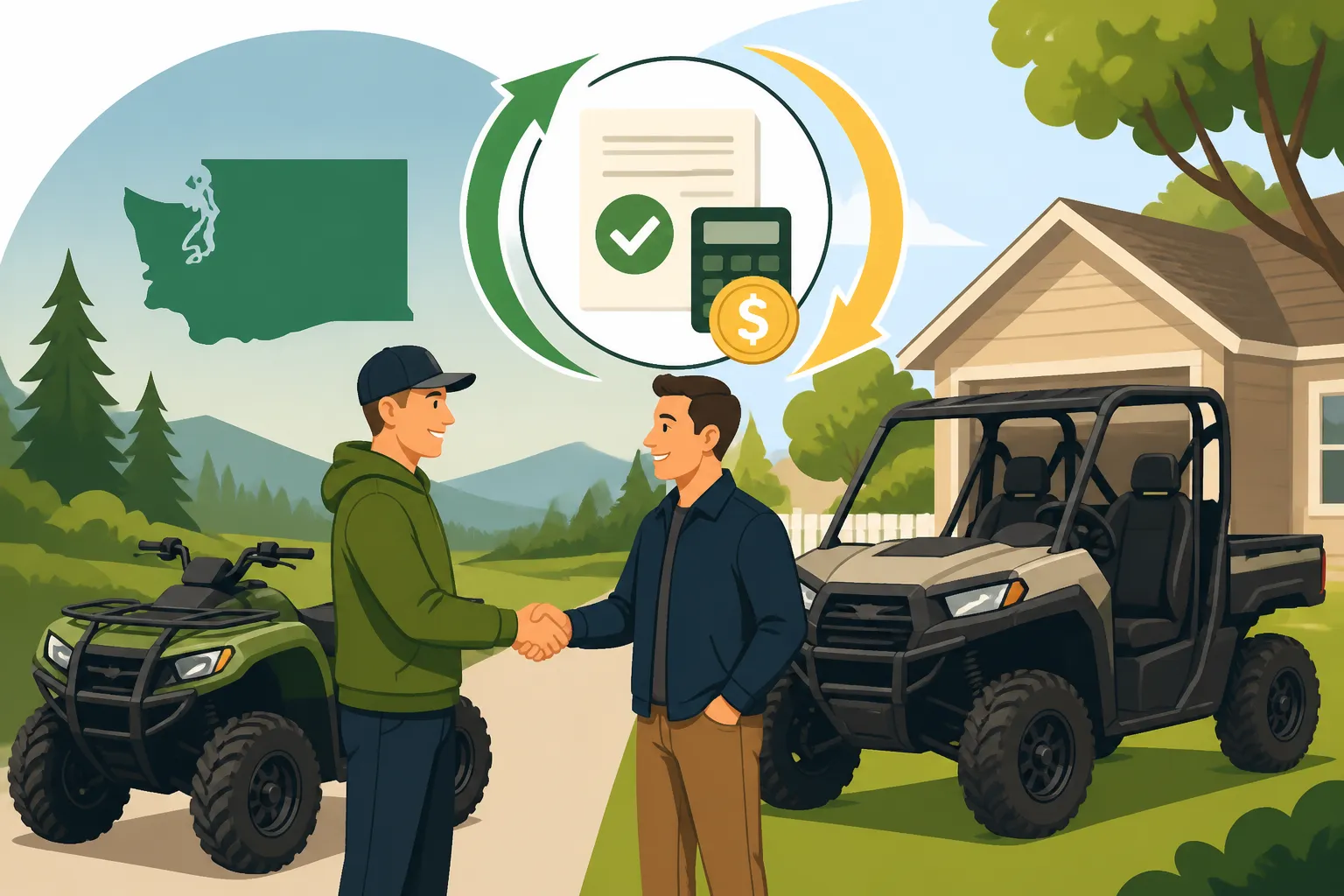
Use Tax When You Buy From a Neighbor
Oh, the joy of finding that perfect ATV or side-by-side! Maybe you stumbled upon a gem on Craigslist, or perhaps your neighbor finally decided to part with their trusty machine. You shake hands, exchange keys for cash, and a wave of excitement washes over you. "No dealer fees, no hassle, no sales tax!" you might think. But then reality sets in, usually when you're standing at the vehicle licensing office, paperwork in hand, ready to get your new-to-you rig registered. That's when you discover Washington's use tax, and it often feels like a punch to the gut. This guide is here to walk you through exactly what use tax is, why it applies to private ATV sales, and how to navigate it without a hitch.
Understanding Washington's Use Tax on Private ATV Sales
Let's be real, the idea of buying something privately often comes with the expectation that you'll avoid some of the usual taxes and fees associated with a dealership purchase. It feels like a handshake deal, simple and direct. But Washington State has a system in place to ensure a level playing field, whether you're buying a brand-new quad from a licensed dealer or picking up a well-loved side-by-side from the guy down the street. This system introduces us to "use tax," and understanding it is key to avoiding an unpleasant surprise.
Why "Use Tax" and Not "Sales Tax" in Private Transactions?
The distinction between "sales tax" and "use tax" is where a lot of the confusion originates. When you walk into a dealership, like a local Kawasaki or Polaris spot, and buy a shiny new WATV, they're licensed to collect sales tax on behalf of the state. It's built into the transaction, and you pay it right there. Sales tax is imposed on retail sales made by businesses.
However, when you buy from a private individual – your neighbor, a friend, or someone you found through an online ad – that person isn't a licensed retailer. They can't collect sales tax. This is where use tax steps in. Essentially, use tax is the same rate as sales tax, but instead of being collected by a vendor, you as the consumer are responsible for remitting it directly to the state. The state's goal is to ensure that all taxable purchases, whether from a business or a private party, contribute equally to public funds. It's about revenue neutrality, making sure everyone pays their fair share, and preventing people from deliberately buying privately just to dodge taxes. For many, this realization is genuinely frustrating because it feels like an unexpected extra cost on what they thought was a straightforward private sale. It's often the last thing on your mind after you've already negotiated a price and handed over the cash.
How the State Calculates Use Tax: Purchase Price vs. Fair Market Value
Now, here's a detail that often trips people up and can lead to even more frustration: Washington doesn't always just take your word for the purchase price when calculating use tax. While you'll submit a [Washington WATV Bill of Sale Requirements] that states what you paid, the Department of Licensing (DOL) has the authority to assess the use tax based on the higher of either your stated purchase price or the machine's "fair market value."
What does this mean in practical terms? Let's say you bought an older quad from a buddy for what seemed like a steal – maybe $1,000. You drew up a quick bill of sale and thought you were golden. However, if the DOL's resources, like industry valuation guides or comparable sales data, indicate that a machine of that make, model, and year typically sells for, say, $2,500, they might assess your use tax based on the $2,500 fair market value instead of your stated $1,000. This often comes as a shock. They're trying to prevent people from artificially lowering the sale price on paper to reduce their tax liability. It's a system designed to catch those "too good to be true" deals, or at least ensure the state gets its due even if you got an amazing bargain. So, while it's tempting to put a low number on the bill of sale, remember that the state has ways of verifying market value, and they generally go with the figure that yields more tax. Always be prepared for the possibility that the DOL might question a significantly low purchase price and rely on external data for their [Washington ATV Use Tax on a Private Sale] calculation. The rule of thumb is "Purchase Price or Fair Market Value, Whichever Is Greater."
Navigating the Use Tax Payment Process
So, you've found your machine, you've made the deal, and you now understand that use tax is part of the package. The next step is knowing how and when to actually pay it. This isn't a separate trip to a tax office; it's integrated into the larger process of making your WATV legally ready for the trails and roads.
When and Where to Pay Your Use Tax
The good news is you don't need to make a special appointment or trek to a different government agency just to pay your use tax. It's handled right at the same time and place you take care of the other essential steps: titling and registering your WATV. This all happens at a local Washington State vehicle licensing office. You know, the place where you renew your car tabs or get your driver's license updated.
Timing is crucial here. Washington has a fairly strict [Washington's Fifteen-Day Registration Deadline]. You typically have fifteen days from the date of purchase to get your newly acquired WATV titled and registered in your name. This 15-day window is also when your use tax becomes due. If you delay past this period, you could face penalties, which is just another headache nobody wants. So, as soon as you've sealed the deal with your neighbor, make it a priority to gather all your documents and head to your nearest licensing office. Don't procrastinate, especially if the 15-day mark falls on a weekend or holiday; plan accordingly to ensure you're within the deadline. It's all part of the process of [Registering a WATV in Washington] and [Titling a WATV in Washington] in your name.
What Documentation You Need for Smooth Processing
To ensure a smooth transaction when you [Paying Use Tax at the Licensing Counter], you'll need a handful of critical documents. Having everything in order before you arrive at the licensing office can save you a ton of time and prevent frustrating multiple trips.
First and foremost, you'll need the signed-over title from the previous owner. This is absolute paramount. If the previous owner never titled it in their name (a surprisingly common issue with older machines or those passed down through families), that's a whole different can of worms you'll need to sort out first. The title proves ownership transfer. Next up is the bill of sale. A well-prepared [A Washington Bill of Sale for a WATV] is incredibly helpful here. It should clearly state the buyer's name, seller's name, the date of sale, the WATV's make, model, year, and its Vehicle Identification Number (VIN). Crucially, it must also clearly state the purchase price. While a handwritten note might technically suffice, using a more formal document, perhaps even a template from a service like LawDepot, can add legitimacy and clarity, especially if there's any ambiguity around the sale price. This document is what the licensing agent will use to determine the use tax, or at least start the conversation about fair market value. You'll also need proof of your identity, typically a valid driver's license. Lastly, ensure that the VIN on your bill of sale matches the VIN on the title and, most importantly, the actual VIN stamped on your machine. Any discrepancies in [Washington WATV VIN Requirements] can halt the process entirely.
Common Scenarios and Avoiding Pitfalls
Understanding the rules is one thing, but real life often throws curveballs. There are common situations where buyers inadvertently run into trouble with Washington's use tax, often stemming from misunderstandings or attempts to sidestep the system. Let's look at a few of these, so you can navigate your private purchase with confidence.
The "Gift" Scenario and What Washington Expects
It's a common thought: "If I just say my neighbor 'gifted' me the ATV, I won't have to pay tax!" This is a tempting idea, especially when you're trying to keep costs down. However, Washington State is quite adept at distinguishing between a genuine gift and a disguised sale. A true gift, such as a parent passing a WATV down to their child, or a family member genuinely donating a machine without any exchange of money or services, is typically exempt from use tax.
But the state looks for patterns and red flags. If you're "gifted" a machine from a casual acquaintance or a non-family member, and especially if that "gift" happened shortly after a cash transaction (even if it was for "something else"), you're likely to raise eyebrows at the licensing office. They might ask for more documentation or challenge the nature of the transaction. Attempting to misrepresent a sale as a gift can lead to penalties and a whole lot of extra paperwork down the road, if an audit occurs. It's simply not worth the risk. Transparency is always the best policy.
Why Transparency in Your Bill of Sale Matters
This brings us back to the importance of the bill of sale. Your bill of sale isn't just a receipt; it's a legal document that protects both you and the seller, and it's the primary piece of evidence the state uses to assess your use tax. An accurate, clear, and honest bill of sale can prevent a lot of headaches. If you're writing up a bill of sale, ensure it includes all the necessary details we discussed earlier – buyer and seller names, addresses, contact info, date of sale, vehicle description (make, model, year), VIN, and the exact purchase price.
Some folks opt for a simple handwritten note, which can work, but a more formal template can be even better. Services like LawDepot offer templates for bills of sale that are legally sound and comprehensive, ensuring you don't miss any critical details. Using such a template ensures clarity and professionalism, making the process smoother at the DOL. Trying to under-report the purchase price on the bill of sale might seem like a clever way to save a few dollars on use tax, but as we discussed with the fair market value rule, the state has mechanisms to detect this. If they determine you deliberately misstated the price, you could face fines or be required to pay the difference plus penalties. Honesty really is the best policy here, not just for legal compliance but for your own peace of mind.
Understanding the Combined Sales Tax Rate
When we talk about use tax, remember that it mirrors the sales tax rate. In Washington, this isn't just a single state rate; it's a combination of state and local taxes. The state sales tax rate is 6.5 percent. However, counties and cities add their own local sales taxes on top of that. This means the actual combined sales tax rate you pay, and therefore the use tax rate, can vary significantly depending on where you live or where the transaction is processed.
For instance, while the [Washington's 6.5 Percent State Rate] applies statewide, if you live in a city like Seattle, Bellevue, or Tacoma, the combined rate will be notably higher, sometimes exceeding 10 percent. This means that a seemingly small percentage can add up to a significant amount when applied to the purchase price (or fair market value) of your WATV. When budgeting for your new-to-you machine, it's wise to look up the combined sales tax rate for your specific location. You can usually find this information on the Department of Revenue's website by searching for local sales tax rates. Don't just budget for 6.5 percent; factor in those local additions to get a realistic picture of your total cost. Knowing this upfront helps you avoid sticker shock when you're ready to [Add a Local Rate to Washington's 6.5 Percent] to your calculations for your use tax payment. It's a key part of understanding the true [Washington ATV Sales Tax Rate] you'll encounter when [Buying a Used ATV in Washington].
Here's a quick comparison of Sales Tax versus Use Tax:
| Feature | Sales Tax | Use Tax |
|---|---|---|
| Who Pays | Consumer (at point of sale) | Consumer (remitted directly to the state) |
| Who Collects | Licensed Retailer / Dealer | No one at point of sale; you pay the state |
| When Applied | On retail purchases from businesses | On items where sales tax was not collected |
| Primary Goal | Revenue generation from commercial transactions | Ensures equitable taxation regardless of vendor |
| Common Scenario | Buying a new ATV from a dealership | Buying a used ATV from a private seller |
Disclaimer
This article is for general informational purposes only and does not constitute professional advice. Laws, prices and regulations vary by location and change over time. Consult a qualified professional for guidance on your specific situation.