Washington Rules for Riding BLM Land
Washington’s Bureau of Land Management (BLM) parcels can look like open country, but that does not mean every road or trail is open to ATVs and UTVs. The key is to check the route’s designation, your machine’s registration status, and any local restrictions before unloading. This guide explains how to prepare for a BLM ride in Washington without confusing federal access rules with state permits.
BLM ownership does not mean unrestricted riding
BLM manages public lands for several uses, including recreation, and motorized access is governed by the rules for the particular area. A road or track visible on a map may be closed to motor vehicles, limited to certain vehicle types, or open only during certain conditions. Riding across open ground is not automatically allowed either.
The practical starting point is to identify the exact BLM parcel and the route you plan to ride. Check current BLM maps, signs at access points, and notices for closures or seasonal limits. Do not assume that a route is open because it appears on a consumer mapping app, an old paper map, or a trail shared online. Those sources may not show the latest management decision, and a visible tire track is not proof of legal access.
BLM land can also sit beside land managed by another agency or a private owner. A route may cross between parcels, and access rules can change at that boundary. Follow posted signs and verify who manages each part of your planned ride. If the public route ends at a locked gate or a closed-road sign, do not ride around it or continue onto neighboring property.
Before heading out, make sure you can answer these questions:
- Is the specific route open to motorized use?
- Is your ATV or UTV allowed on it, including any width or vehicle-type limits?
- Are there temporary closures, seasonal restrictions, or fire-related limits?
- Does the area require a fee, permit, or other recreation pass?
- Can you legally reach the BLM route from your starting point?
This is especially important when a ride involves more than one land manager. Rules for federal land are not necessarily the same as rules for Washington Department of Natural Resources land, state parks, or private timberland. For a broader overview, see Washington Rules for Riding Federal Land. For information about how a route closure can affect a planned trip, Washington Trail Closures to Check First is also useful.
Confirm the route, not just the destination
A listing that says an area is open to OHVs does not necessarily mean every road and trail within it is open. Look for the designated motorized routes or areas and match them to your machine. Some routes may be intended for vehicles of a certain size or type, while other areas may be closed to motorized travel altogether.
When maps and signs appear to conflict, treat the posted restriction as a reason to stop and verify the rule with the responsible BLM office before riding. Keep a map available offline: cell coverage may be limited, and relying on a phone alone can make it difficult to check your position or identify a boundary. A waterproof map case from an outdoor retailer such as Amazon can help keep a paper map readable, but it cannot replace current official route information.
Washington registration and out-of-state reciprocity
BLM land is federal, but riding an ATV or UTV there does not automatically exempt you from Washington’s applicable vehicle and rider requirements. If you are riding a Washington-registered machine, make sure its registration is current and that you have the required documents and decals. Registration is not a blanket authorization to ride every federal route; it establishes the machine’s status, while the land manager controls where motorized travel is allowed.
Washington’s off-road and on-road tabs serve different purposes. An off-road tab is associated with off-road use, while an on-road tab applies to qualifying machines used on eligible roads. Having an on-road tab does not make a closed BLM route open, and an off-road tab does not authorize riding on ordinary public roads. Learn how the state system works in Washington’s Two-Tab System and Washington’s Off-Road Tab Explained.
If you are visiting from another state, do not assume that your home-state sticker or registration will be accepted for every kind of riding in Washington. Reciprocity depends on the applicable rules and on what your home state requires. The details can affect whether you may ride without buying a Washington permit, so check the current conditions before traveling. Washington ORV Reciprocity Rules explains the state’s general approach.
Visitors who do not qualify for reciprocity may need a Washington permit for off-road use. A temporary permit may be an option for a short visit, but it has limits and should not be treated as a road-use authorization. Confirm the permit’s current terms, what documents you need, and whether it covers the specific activity and machine. See Washington Temporary ORV Permit for a Visitor before relying on a temporary permit.
| Your situation | What to check before riding |
|---|---|
| Washington-registered machine | Current registration, required tabs and documents, and whether the BLM route is open to your machine |
| Machine registered in another state | Whether Washington reciprocity applies to your home-state registration and planned use |
| Visitor without qualifying home-state registration | Whether a Washington temporary or other ORV permit is required and what use it allows |
| Machine with an on-road tab | Whether the road itself is open to your machine and whether all road-use requirements are met |
| Machine with an off-road tab | Whether the planned route is designated for off-road use and does not require road authorization |
Keep registration paperwork with the machine as required, and make sure the information matches the vehicle you are riding. A permit or tab connected to one machine should not be assumed to cover another. If you plan to ride a borrowed or rented ATV or UTV, confirm who is responsible for the machine’s registration and what documents must be carried.
Road access, fees, and equipment
A road on BLM land is not automatically a public road open to every vehicle. Some routes are designated for motorized recreation; others may be closed, restricted, or subject to state and local traffic requirements. A WATV’s ability to use a particular route depends on the route designation and the rules that apply there, not just on whether the machine has a road tab.
Before using a BLM road to connect to another route, check that the road is open to your vehicle and that you meet any requirements for road riding. Do not treat a road tab as permission to ride on a closed road or across private land. If your route leaves federal land, verify the rules for the next parcel as well. Washington Road Reciprocity With Its Conditions can help visitors understand why registration in another state does not settle every road-access question.
Fees are another separate issue. A Discover Pass is associated with certain Washington state-managed recreation lands; it is not a universal pass for federal BLM land. Some federal recreation sites may charge fees or have their own pass rules, while other BLM areas may not require an entrance fee. Check the specific site’s current information before you go. A recreation pass, where required, does not authorize motorized travel on a route that is otherwise closed or restricted. For the state-pass distinction, see The Discover Pass and Washington Riders.
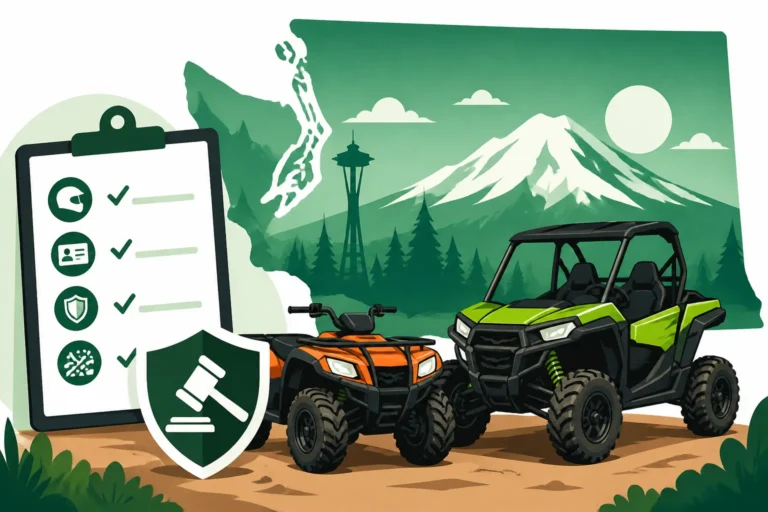
Equipment requirements can depend on the vehicle, the route, and the rules in effect for the area. Before riding, confirm requirements that apply to your machine and riders, including any applicable helmet, lighting, or road-use equipment rules. BLM areas may also have restrictions concerning noise, spark arresters, fire prevention, or other resource-protection measures. Do not assume that equipment accepted for riding on one parcel will satisfy the rules on another.
Carry what you need to show that the machine is properly registered or permitted, and make sure decals are attached where required. If a ranger or other authorized officer asks about your route, being able to identify the map or sign you relied on can make the conversation clearer. Requirements for younger riders are a separate part of trip planning; review Washington’s Supervision Rule for Riders Under 16 and any site-specific rules before bringing a child.
A practical pre-ride checklist
A few minutes of checking can prevent a long detour or an avoidable citation. Use this sequence when planning a BLM ride in Washington:
- Locate the land and access point. Confirm that the parcel is BLM-managed and identify any intervening private or state land.
- Check the current motorized-use map. Choose routes designated for motorized travel and confirm that your ATV or UTV fits any posted limits.
- Look for current notices. Check for closures, seasonal limits, fire restrictions, construction, or other temporary changes.
- Verify registration or permit status. Washington riders should confirm their tabs and paperwork. Visitors should check whether their home-state registration qualifies for reciprocity or whether a Washington permit is needed.
- Check fees and passes for the specific site. Do not assume that a Washington state pass applies to federal land, or that a federal recreation pass allows motorized access.
- Review equipment and rider requirements. Confirm what applies to your machine, the route, and everyone in your group.
- Prepare for limited service. Save maps and contact details before leaving cell coverage, and carry enough supplies to handle a delay or a route change.
- Follow signs and boundaries on the ground. If a route is posted closed or you cannot confirm that it is open, stop and choose a verified route instead.
Plans can change after you arrive. A gate, closure notice, or changed condition may make the route you intended to ride unavailable. Do not bypass the restriction simply because you drove a long way or because another rider has gone through. Turn around, use a route confirmed to be open, and keep the machine on designated roads and trails.
If you are uncertain about access, contact the BLM office responsible for the area and ask about the exact route, vehicle type, and dates of your trip. A broad question such as “Can I ride BLM land?” may not get a useful answer because access is route-specific. Naming the area and route makes it easier to confirm the rule that matters.
Disclaimer
This article is for general informational purposes only and does not constitute professional advice. Laws, prices and regulations vary by location and change over time. Consult a qualified professional for guidance on your specific situation.