Washington ORV Campground Reservations
Planning an ATV or UTV weekend in Washington gets complicated when the campsite is miles from the trailhead, the campground uses a different reservation system, or your preferred site is already booked. This guide explains how to find camping near popular riding areas, understand reservation options, and check the practical details before you load the trailer.
Start With the Riding Area, Then Find a Campsite
Match the campground to your trail plans
A campground that looks close on a map may not be convenient for an ORV trip. The route between camp and trailhead could include a long drive, a narrow forest road, a gate, or a section where riding your machine is not permitted. Before reserving, identify the actual staging area you plan to use and decide whether you will tow your ATV or UTV there each day.
For example, a trip to Walker Valley ORV Area near Mount Vernon calls for a different plan than a weekend at Capitol State Forest near Olympia. In either case, check where overnight camping is allowed, whether a nearby site can accommodate your truck and trailer, and how you will get from camp to the legal riding area. A campground’s proximity on a map does not automatically mean you can ride directly from your site to the trails.
The same check matters at larger forest destinations. Around Tahuya State Forest, Evans Creek ORV Area, and Ahtanum State Forest, visitors may encounter different land managers, access roads, and camping arrangements. Read the current site information for both the campground and the riding area rather than assuming one set of rules covers everything. For destination ideas, see [Washington ORV Areas Compared] and [Camping Near Washington ORV Areas].
Know who manages the campsite
Washington ORV trips can involve campgrounds managed by Washington State Parks, the Department of Natural Resources, the U.S. Forest Service, or a private operator. Each manager may use its own reservation process and set different rules for bookings, vehicles, quiet hours, and site use. A campground near a riding area is not necessarily managed by the agency that manages the trails.
This distinction is easy to miss when you are searching online. You might find a campsite through a general booking page, then discover that the trailhead has a separate parking pass requirement or that the campground allows only a particular number of vehicles per site. Confirm the campground’s official listing and the trail-area information before paying or making a final plan.
A map app can help you compare locations, but treat it as a planning aid, not proof of access or permission. Tools such as onX Offroad can help you inspect route context and spot where a camp-to-trail plan may involve roads or boundaries worth checking. Then confirm the details with the land manager. For a broader look at the different land types riders encounter, read [State Parks, DNR and Fish and Wildlife Land].
How to Make a Useful Reservation
Search the official system for your dates
Once you choose an area, find out which agency or operator manages the campground and follow the reservation instructions on its official site. Search using the campground’s exact name, then check the listing for the dates you want. If you are flexible, compare nearby dates and alternative campgrounds; popular riding weekends can fill sooner than a quieter midweek stay.
Read the listing carefully before selecting a site. Look for details about how many vehicles and camping units are allowed, whether the site accommodates a trailer, and whether the access road is suitable for your tow vehicle. A space that fits a tent and a passenger car may not work for a truck, trailer, and side-by-side. If site dimensions or vehicle limits are unclear, contact the campground operator before booking.
Reservation calendars and site conditions can change, so revisit the official listing before departure. A reservation confirms a place to camp under the conditions stated by the campground; it does not necessarily confirm that your chosen trail is open, that your machine is permitted on every connecting road, or that a separate pass is not required. Check riding-area alerts as well as the booking confirmation. [Washington Trail Closures to Check First] is a useful companion when you are planning around seasonal or temporary access changes.
Choose a site that works with a trailer
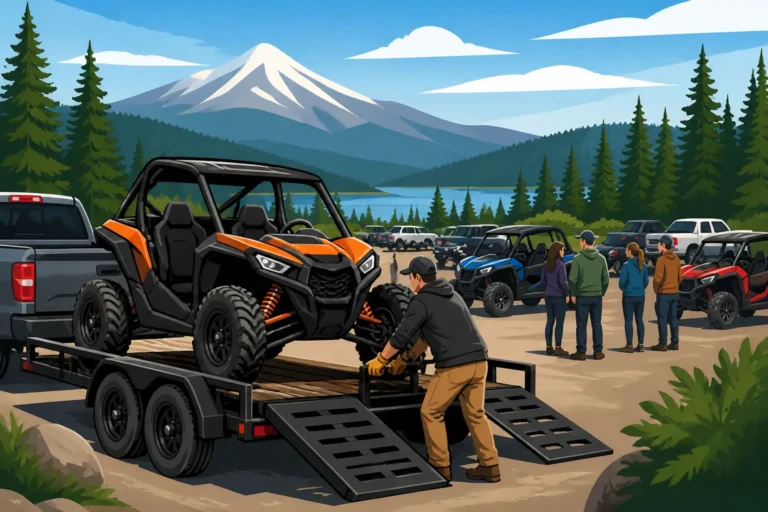
When you ride with a trailer, the best campsite is not always the one with the prettiest view. Think through the whole arrival and departure: whether you can turn around, where you can park the tow vehicle, whether the trailer can remain attached, and whether other campers or traffic could block the route. A tight site can make a late arrival stressful, especially if you are backing a loaded trailer in the dark.
Before booking, compare the site description with the footprint of your setup. Include the tow vehicle, trailer, machine, and any space needed to unload. If the campground has a maximum vehicle count, ask whether your combination of truck and trailer is treated as one unit or more than one. Don’t rely on a small map icon to answer those questions.
Also consider where you will store your machine overnight. Some campgrounds may have rules about unloading, operating, or parking ORVs within the campground. Noise restrictions, quiet hours, and limits on vehicle movement can affect when you can load or move equipment. Check the rules before assuming that a campsite functions as a staging lot. For more trip-planning help, see [Parking a Rig on a Busy Weekend] and [Dispersed Camping Beside a DNR Staging Lot].
Compare Camping Options Before You Book
The right option depends on how much certainty you need, how far you are willing to travel from the trailhead, and whether you need services such as hookups. Treat the table as a planning framework, then confirm the rules for your specific campground.
| Camping option | What may work well | What to verify before booking |
|---|---|---|
| Reserved developed campground | A confirmed site can make a busy weekend easier to plan | Site dimensions, vehicle limits, trailer fit, cancellation terms, and campground rules |
| First-come, first-served campground | Useful if you have flexible timing or a backup plan | Whether sites are actually available, arrival expectations, and the current payment or pass requirements |
| Private campground or RV park | May offer services or space that better suits a larger rig | Distance to the staging area, ORV storage rules, road access, and any separate riding-area fees |
| Dispersed camping where permitted | Can suit a self-contained trip when designated camping is allowed | Land-manager rules, closures, sanitation, fire restrictions, and whether overnight vehicle access is allowed |
Weigh convenience against services
A developed campground may offer amenities that make a family trip more comfortable, while a more basic site may put you closer to your riding plans. Neither is automatically better. If you need electrical hookups, accessible facilities, or a more predictable arrival, search specifically for those features and confirm them with the operator. If you can camp without services, you may have more options, but you still need to check whether overnight camping is allowed at that location.
Consider the needs of everyone in your group. A family with young riders may value toilets, clear boundaries, and an easy route back to camp more than a short drive to the trailhead. A group with a large UTV may need wider access and more room to park than a couple traveling with a small ATV. Discuss those needs before booking so you are not trying to solve a site-fit problem after arriving.
Camping near public land does not mean you can set up wherever there is open ground. Dispersed camping is subject to land-manager rules, closures, and restrictions. Check the official guidance for the particular parcel or recreation area, and do not assume that an old map, an empty pullout, or another camper’s setup establishes permission. For more on planning a stay around a riding area, read [Camping at a Washington ORV Area].
Prepare for Arrival and Keep a Backup Plan
Check access, passes, and rules separately
A campsite reservation and permission to ride are separate things. Before leaving, check the campground’s arrival instructions, the riding area’s current access information, and any pass requirements that apply to your vehicles or the land you will use. A campground may have one set of rules while the riding area or trailhead has another.
This is especially important if the trip crosses different land managers. For instance, an overnight stay near a national forest riding area may involve campground instructions from one source and trail or parking information from another. Do not assume a reservation includes trail access, parking, or a required recreation pass. Review [The Discover Pass and Washington Riders] and [Why Evans Creek Needs a Northwest Forest Pass] when checking which passes may apply to your plans.
Confirm your planned route, too. A road that appears to connect camp and trail on a map may be closed, restricted, or unsuitable for your vehicle or trailer. onX Offroad can be useful for reviewing the general route and identifying points you want to investigate, but use official agency notices to confirm access and closures. If you are uncertain about a road or trail, contact the managing agency rather than relying on a line drawn on a map.
Make a realistic arrival and parking plan
Write down the campground’s arrival instructions and keep your reservation details accessible offline in case cell service is weak. Note the site number, any check-in steps, and the contact details or instructions provided by the operator. If your group is arriving in separate vehicles, agree on where to meet and how to avoid blocking campground roads while unloading.
Plan for the possibility that you arrive later than expected. Mountain roads, ferry travel, traffic, weather, and slow trailer driving can all extend a trip. If late arrival could affect your booking, check the campground’s policy before setting off. Avoid counting on a last-minute phone connection at a forest campground, where reception may be limited.
Before you leave home, confirm that your camping equipment and riding setup are compatible with the site. Check trailer lights and tie-downs, secure fuel and gear appropriately, and make sure you know where the machine is allowed to be unloaded or parked. If rain is in the forecast, plan for muddy boots, wet riding gear, and a way to keep the registration and other paperwork dry. [Keeping Paperwork Dry in the Rain] covers a small detail that can save frustration on a wet trip.
Keep alternatives in mind
Even a well-planned reservation does not guarantee perfect conditions. A closure, road problem, weather change, or unexpected site issue can disrupt the itinerary. Choose a backup campground or a different riding day before you travel, and check that the alternative is open and suitable for your setup. A second option is most useful when you know its location, rules, and access requirements in advance.
If a campground is full, broaden your search carefully rather than booking the first place that appears nearby. Check whether the alternative is actually open to overnight camping, whether it accepts your vehicle combination, and how long the drive to the staging area will take. A site that is farther away but practical may be less stressful than a closer spot that cannot accommodate your trailer.
Finally, check official alerts shortly before departure and again if conditions change during the trip. Use onX Offroad or another map tool to help organize your route and identify questions, but verify restrictions, reservations, and closures with the relevant campground or land manager. That combination of early booking, realistic site checks, and a backup plan makes a Washington ORV camping weekend much easier to manage.
Disclaimer
This article is for general informational purposes only and does not constitute professional advice. Laws, prices and regulations vary by location and change over time. Consult a qualified professional for guidance on your specific situation.