Crossing a Highway Posted Fifty
It's incredibly frustrating when you're out exploring Washington's incredible landscapes on your WATV, and you encounter a paved highway that stands between you and the next stretch of trail. The rules for riding an off-road vehicle on pavement are already a bit of a maze, but when it comes to simply crossing a state highway – especially one with a higher speed limit like 50 mph – the confusion can really put a damper on your adventure. This guide aims to clear up the precise regulations and common-sense approaches for safely and legally crossing a highway posted 50 mph in Washington, ensuring you can keep your ride going without unexpected detours or citations.
The Nuance of Washington's WATV Road Rules
Navigating Washington's road system with a wheeled all-terrain vehicle (WATV) can feel like trying to solve a riddle wrapped in an enigma. Many riders know the general rule that WATVs are limited to roads posted 35 mph or less in counties and cities that have opted to open their streets. But what about those moments when a higher-speed highway intersects your route, and you just need to get from one side to the other? It’s a common scenario, especially in rural areas where trails often crisscross state routes. The good news is that Washington law does provide provisions for these crossings, but understanding the specifics is absolutely crucial. You can't just assume every road is fair game, and misinterpreting the rules can lead to fines, or worse, dangerous situations.
Understanding the 35 MPH Baseline
Let's first establish the foundation: for general travel on public roads, Washington's statute sets a default limit. WATVs are primarily allowed on county roads or city streets where the posted speed limit is 35 miles per hour or less, and where the local jurisdiction (the county or city council) has explicitly passed an ordinance to open those roads to WATV use. This means you can't just pick any 35 mph road and start riding; the local government has to give the green light. For instance, in some parts of Pierce County, you might find designated segments of unincorporated roads where you can legally ride your WATV if they meet the speed criteria and the county has opened them. [Washington's 35 mph Road Rule] is a concept deeply embedded in how Washington manages WATV access.
This specific limitation is designed to integrate slower-moving WATVs safely into traffic flows. On roads where vehicles typically move faster than 35 mph, the speed differential between a WATV and other traffic can become a significant safety hazard. That's why the default is set low, and why local approval is so critical. Riders often find themselves poring over county maps and ordinances to figure out exactly which roads are accessible, which can be a time-consuming but necessary task. Getting this wrong can quickly lead to a conversation with a local law enforcement officer that you'd rather avoid.
Why Crossing a Highway is Different
Here's where the critical distinction comes in. The rules for riding on a road are not the same as the rules for simply crossing it. Washington state law recognizes that sometimes, a brief and direct traversal of a higher-speed road is unavoidable to connect two legal segments of trail or road. This recognition is vital for the practicality of enjoying multi-segment trail systems and accessing services like gas or food. Imagine riding through Capitol State Forest and needing to briefly cross a state highway to access another section of the trail system or a local diner; without a crossing provision, your ride would be severely limited.
The intent behind this distinction is to allow for practical connectivity while still minimizing exposure to high-speed traffic. When you're merely crossing, your interaction with the higher-speed traffic is intended to be minimal in duration and direct in path. You're not meant to merge into traffic and travel for miles alongside cars and trucks moving at 50 mph or more. This brief interaction reduces the cumulative risk compared to sustained travel. This distinction is often a point of confusion, and many riders mistakenly believe that if they can't ride on a 50 mph road, they can't cross it either. Understanding [Washington Rules for Getting Across a Road] is key to enjoying Washington's diverse riding opportunities.
The Specifics of Crossing a 50 MPH Highway
So, you've hit a state highway posted at 50 mph, and you need to get to the other side. What's the legal framework for this? Washington law does indeed provide for WATVs to cross state highways with speed limits higher than 35 mph, with a specific ceiling. This is where many riders get nervous, and rightfully so, as the stakes are higher on these busier roads. However, with the right knowledge and careful execution, these crossings can be made safely and legally. The state's Department of Transportation (WSDOT) guidance and the Revised Code of Washington (RCW) spell out exactly what's permitted.
The 60 MPH Crossing Limit Explained
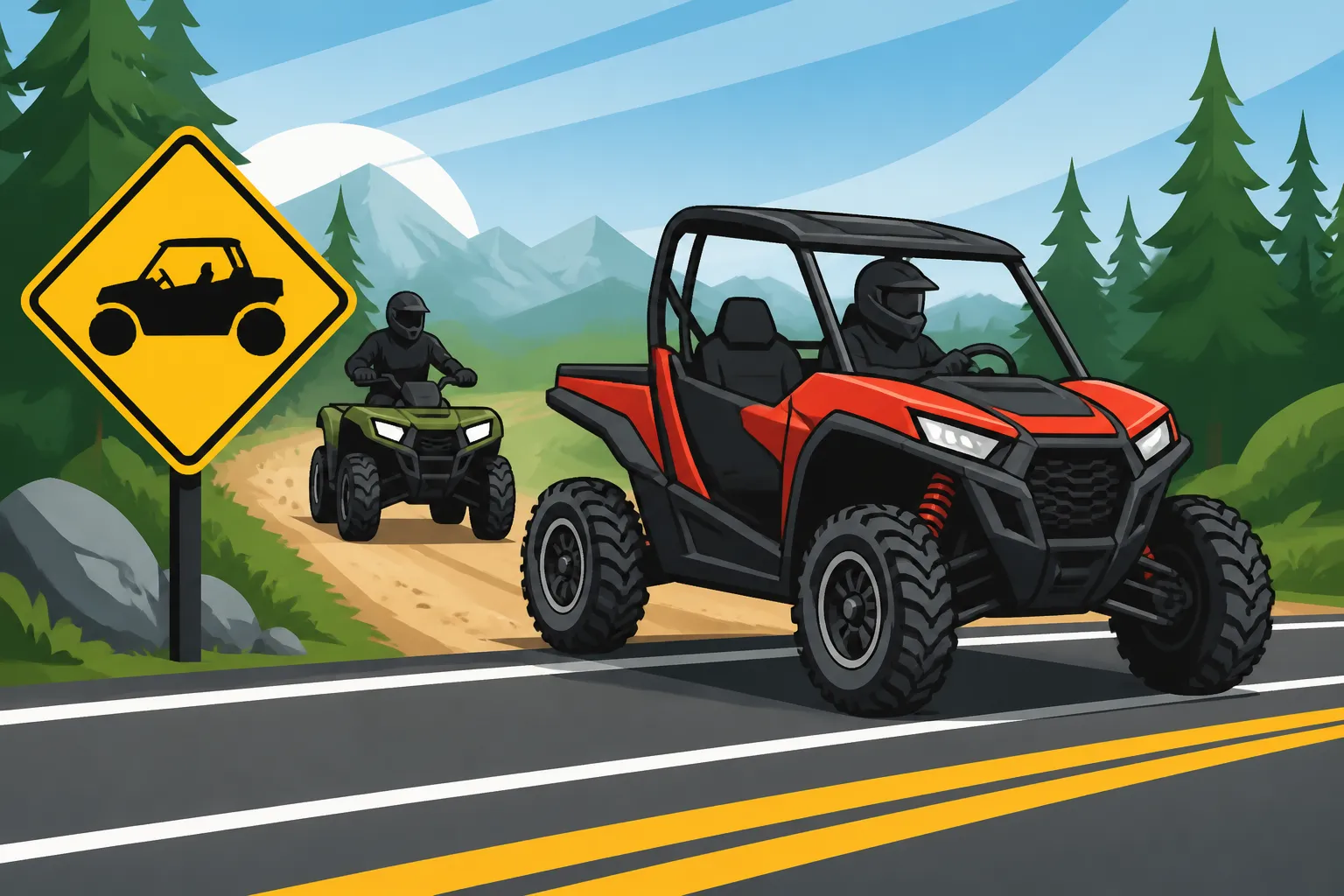
The statutory language allows WATVs to cross any state highway if the speed limit on that highway is 60 miles per hour or less. This means if you encounter a state highway posted 50 mph, you are legally permitted to cross it. The same applies if it's 55 mph or even 60 mph. However, if that highway is posted 65 mph, then crossing is explicitly prohibited. This 60 mph ceiling is a critical detail, and it's the speed limit of the highway you are crossing, not how fast your WATV can go, or how fast you are allowed to cross. You should always cross at a safe and appropriate speed, respecting the flow of traffic. [Crossing a Highway Posted Between 35 and 60] is a specific provision designed to facilitate limited access for WATVs.
The rationale behind the 60 mph limit is rooted in safety and traffic dynamics. Highways with speed limits exceeding 60 mph typically involve higher volumes of traffic, more complex intersections, and vehicles traveling at significantly greater speeds. The risk associated with a WATV making a brief crossing increases exponentially as the speed of the highway traffic rises. Therefore, the state has drawn a clear line in the sand at 60 mph, trying to balance accessibility for riders with the paramount concern for public safety. It’s a pragmatic compromise that allows riders reasonable access without unduly endangering themselves or others.
"Brief and Direct" – What It Really Means
The law doesn't just say you can cross; it specifies that the crossing must be "brief and direct." This isn't just bureaucratic jargon; it's a fundamental principle for safe and legal highway interaction. A "brief" crossing implies minimizing the time you spend on the paved surface, exposed to other traffic. You shouldn't dilly-dally, stop for a selfie in the middle, or wait for multiple light cycles if there's a clear opportunity. "Direct" means moving straight across the highway, perpendicular to the flow of traffic, without veering off course or traveling down the highway lane itself, even for a short distance.
Think of it this way: if you're coming off a forest road and need to get to another forest road directly opposite across a 50 mph state highway, that's a classic "brief and direct" crossing. Similarly, if you're trying to reach a gas station located just off the highway, a brief crossing from one side to the other to access the station's driveway would likely qualify. However, driving down the shoulder for a quarter mile to get to a better intersection, or traveling a block or two on the main highway itself, would generally not be considered brief and direct. The intent is to connect points that are otherwise disconnected by the highway, not to use the highway as part of your route. [Riding Pavement With Only the Off-Road Tab] is generally restricted, making these brief crossings a critical exception.
Equipment, Licensing, and Safety Considerations for Highway Crossings
Even though a highway crossing might only take a few seconds, it’s still a moment of heightened risk and legal scrutiny. You’re sharing a very fast-moving environment with heavy vehicles, and state troopers are acutely aware of WATV regulations, especially on state routes. It might seem like overkill for a 20-second crossing, but safety and legality are absolutely paramount. Your machine needs to be up to snuff, and you as the rider need to be properly licensed and prepared. Cutting corners here isn't just risking a ticket; it's risking your well-being.
Essential Equipment for Road Use
For any road use, including crossings, your WATV needs to meet certain basic equipment standards to ensure visibility and the ability to signal your intentions. While some of these might seem optional for pure off-road trail riding, they become critical when you interact with vehicular traffic. This includes working headlamps and taillamps, adequate mirrors, and a functional horn. Many riders, especially those with utility vehicles (UTVs), find that adding aftermarket accessories, such as a full turn signal kit, drastically improves safety and compliance. Companies like SuperATV offer a range of products, from turn signal kits to brighter LED lighting, that can make your machine much more visible and communicative to other drivers. [Equipment a Washington WATV Needs on a Road] is a non-negotiable list that ensures you are seen and understood.
Specifically, turn signals are often overlooked by riders who primarily use their machines off-road, but they are incredibly important for safety on any paved surface. Even for a brief crossing, clearly indicating your intention to turn or proceed straight can prevent confusion and potential accidents. [Turn Signals on a Washington Road Machine] are a strong recommendation, even if the strict letter of the law for crossing might not explicitly demand them in the same way it does for sustained road use. Furthermore, having [Mirrors and a Horn for Washington Road Use] allows you to be aware of surrounding traffic and alert others to your presence. A quality horn, for example, can be a vital piece of safety equipment if a car isn't seeing you.
Driver Requirements and Insurance
Beyond the machine itself, the person operating it also has obligations. In Washington, to operate a WATV on any public road, including for crossings, you must possess a valid driver's license. This means a standard automobile driver's license – a motorcycle endorsement isn't specifically required for WATVs, but a fundamental understanding of road rules is. Furthermore, Washington's helmet law extends to WATV riders and passengers whenever the machine is operated on public roads, even briefly. This means you and any passenger must be wearing a U.S. DOT-compliant helmet. It’s not just a good idea; it’s the law, and especially crucial when exposed to high-speed traffic. [Washington Helmet Law for WATV Riders] protects you and is enforced roadside.
While Washington does not require liability insurance for off-road-only WATV use, if your machine is equipped with the optional on-road tab (the $12 tab that allows for riding on open county roads and city streets), then state law does require proof of financial responsibility (i.e., insurance) for that road use. Even if you only have the off-road tab, for any public road use, you are still subject to general traffic laws. It's always a good idea to check your personal insurance policy to understand what coverage you have for WATV use, especially if you venture onto public roads. While a quick crossing might not always be the first thing an insurer thinks of, knowing your coverage limits beforehand is smart. Carrying your registration and any relevant permits, neatly stowed in a waterproof pouch on your machine, is also smart practice in case you are stopped. [Washington WATV Insurance Requirement] is critical if you plan any on-road use beyond just off-road designated trails.
Navigating Washington's Diverse Road Network
Washington's landscape is a patchwork of state highways, county roads, city streets, and vast tracts of public and private forest lands. Each has its own set of rules for WATV access, making it a challenge for riders to keep it all straight. Understanding how a 50 mph highway crossing fits into this larger network is essential for planning safe and legal rides. You might be connecting two segments of DNR land, or trying to reach a small town for supplies; the rules for the connecting pavement differ significantly depending on who owns and maintains that road.
County Roads vs. State Highways
The distinction between county roads and state highways is pivotal for WATV riders. As mentioned, county roads (and city streets) can be opened for WATV travel if their speed limit is 35 mph or less and the local government passes an ordinance. This means you might be able to ride on a county road to get from point A to point B. State highways, on the other hand, are typically much busier and are generally not open for continuous WATV travel, regardless of their speed limit, unless specifically designated by WSDOT, which is rare outside of very specific circumstances (like crossing). So, while you might ride a county road for a mile, a state highway is almost exclusively for direct crossing. [Washington Rules for Riding a County Road] are much more permissive than state highway rules.
This difference is important because it influences how you plan your route. If your destination is just across a 50 mph state highway, you know you can cross. But if your map shows that to reach your destination you’d have to travel a mile along that same 50 mph highway, that segment is simply off-limits. You'd need to find an alternative route, perhaps using lower-speed county roads that are legally open to WATVs, or even trailering your machine. Never assume that because a county has opened some of its roads, it automatically grants special privileges on state highways. Each type of road has its own set of regulations.
Practical Tips for Safe and Legal Crossings
Making a safe and legal crossing of a 50 mph highway demands more than just knowing the rules; it requires careful planning and a heightened sense of awareness. These brief moments are some of the most critical during your ride. First and foremost, always scout your crossing point if possible. Understand sight lines for oncoming traffic, look for any posted signs, and choose a point that offers maximum visibility for both you and approaching vehicles. Avoid blind curves or hillcrests.
Before you even approach the highway, come to a complete stop and look both ways multiple times. Use your mirrors, even those you might have purchased from SuperATV for better visibility, and ensure your headlamps and taillights are on, making you as conspicuous as possible. Consider wearing bright, high-visibility clothing. Signal your intentions clearly. If you have aftermarket turn signals, use them. Yield to all oncoming traffic. Wait for a gap that is not just sufficient for you to start crossing, but for you to complete the crossing entirely and reach the other side safely. Never rush. Once you commit, cross directly and efficiently. A Washington State Trooper will be checking your tabs and any safety equipment during any roadside stop, even a brief one. [What a Washington Trooper Checks Roadside] can include everything from your registration to your helmet.
Table: Washington WATV Road Access Summary
To help clarify the various rules, here's a quick summary of WATV access on different road types in Washington:
| Road Type | Speed Limit (Posted) | General WATV Use | Highway Crossing Limit | Key Conditions |
|---|---|---|---|---|
| County Road / City Street | 35 mph or less | Allowed | N/A | Local ordinance must open the road; WATV must be registered and equipped. |
| County Road / City Street | Over 35 mph | Not Allowed | N/A | WATV use is prohibited on roads faster than 35 mph, even if a local ordinance exists. |
| State Highway (Crossing) | Up to 60 mph | Crossing Only | Up to 60 mph | Crossing must be "brief and direct"; WATV must be registered and equipped; rider licensed. |
| State Highway (Crossing) | Over 60 mph | Not Allowed | Prohibited | No WATV crossing permitted if the posted speed limit is above 60 mph. |
| State Highway (Riding Along) | Any Speed | Not Allowed | N/A | General travel along state highways is prohibited for WATVs. |
| Private Roads (With Consent) | Any Speed | Allowed | N/A | Requires explicit permission from landowner. |
This table simplifies the rules, but remember that specific local ordinances and the exact wording of state law are what truly govern your actions. Always double-check the local jurisdiction's rules for county and city roads, and for state highways, always defer to the 60 mph crossing limit and the "brief and direct" requirement.
Disclaimer
This article is for general informational purposes only and does not constitute professional advice. Laws, prices and regulations vary by location and change over time. Consult a qualified professional for guidance on your specific situation.