Keeping the Registration Inside the Machine
It’s a common frustration for anyone who loves hitting the trails or cruising the backroads on their Washington ATV or UTV: how in the world are you supposed to keep all that important paperwork safe, dry, and accessible while you’re out riding? The elements are unforgiving, and the last thing you want is a soggy registration card or, worse, nothing at all if a ranger stops you. This guide is all about navigating the practical realities of protecting your vital documents and making sure you’re always prepared for whatever the Washington wilderness (or a friendly law enforcement officer) throws your way.
Why Washington Requires You to Carry Your WATV Registration
Let's be real, nobody enjoys having to worry about paper when they're trying to have an adventure. You bought your quad or side-by-side to escape the mundane, not to add more bureaucratic headaches. However, Washington State law is pretty clear on this: when you're out riding your WATV, whether it's on a designated off-road trail or a county road opened for street-legal use, you need to have proof of your current registration with you. This isn't just a suggestion; it's a legal requirement that helps ensure accountability and the proper funding of our incredible trail systems.
The Law's Expectation for Riders
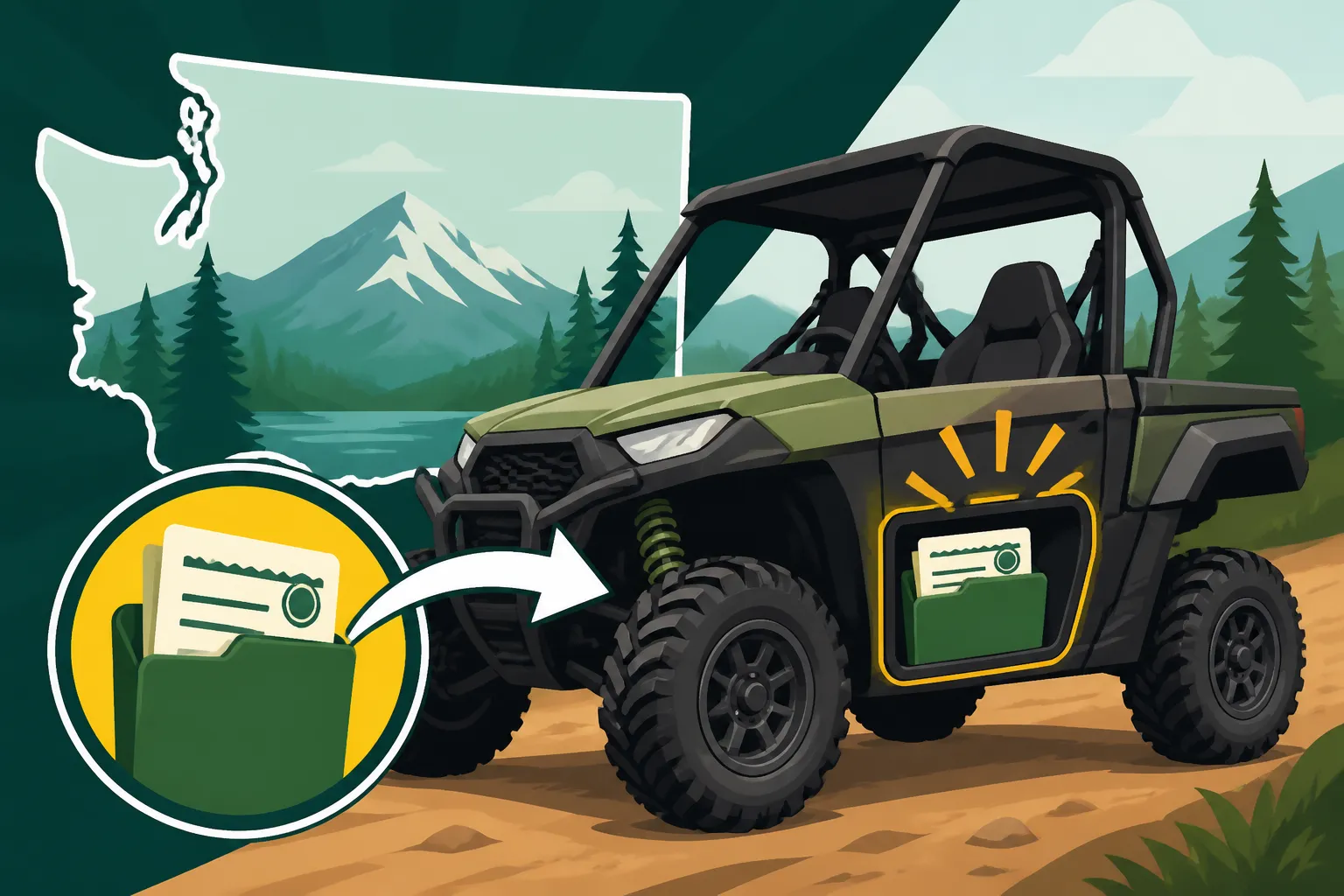
The Washington State Legislature, through various statutes, mandates that operators of off-road vehicles carry their current registration certificate. Think of it like driving your car; you wouldn't head out on I-5 without your vehicle registration and driver's license tucked away, right? The same principle applies here. When you registered your WATV, you received a paper certificate that officially links you and your machine to the state's system. This document is your official proof that your tabs are current and that you're operating legally. It’s designed to be easily presented to an official upon request, verifying that your machine is properly registered and ready for the trail. You can delve deeper into the specifics of this requirement in [Carrying the Registration in the Machine].
This requirement isn't about making your life harder; it's about making sure that the funds generated from registration fees go back into maintaining and expanding the very trails and roads we all enjoy. Without a clear system for verifying who has registered their machines, it would be much harder to ensure everyone is contributing their fair share to the upkeep of our riding areas. So, while it feels like "just another piece of paper," it's actually a vital part of the funding mechanism for our outdoor recreation infrastructure.
Immediate Proof for Enforcement Encounters
Imagine you're deep in Capitol State Forest, enjoying a perfect day of riding, when you encounter a DNR ranger or a county sheriff's deputy. These dedicated individuals are out there to ensure safety, protect our natural resources, and enforce state laws. One of the first things they'll ask for is your identification and proof of your machine's registration. If you can't produce it on the spot, it can lead to immediate complications. It's not usually an accusation of wrongdoing, but rather an administrative hurdle that can quickly sour a fun day.
Having your registration readily available makes these roadside stops quick and painless. It demonstrates that you're a responsible rider who respects the rules. Without it, even if your machine is registered, the officer might have to spend extra time verifying it through their system, or worse, they might issue a citation, assuming non-compliance. A quick flash of the proper paperwork means you're back to riding in minutes, rather than facing delays or potential penalties. You can understand more about what an officer looks for by reading [What a Washington Trooper Checks Roadside].
The Importance of Up-to-Date Documentation
Your WATV registration isn't a one-and-done deal. Just like your car tabs, it needs to be renewed regularly. Typically, this is an annual process, and forgetting to renew or riding on expired tabs can lead to fines and other issues. The registration document you carry is only valid if it reflects your current, paid-up status. It's easy to lose track of dates, especially when you're busy, but neglecting this can put a serious dent in your riding plans.
Always double-check the expiration date on your registration before heading out, especially at the start of a new riding season. If you've just renewed, make sure to replace the old certificate with the new one in your waterproof storage. This simple habit ensures that you always have valid proof, avoiding any misunderstandings with law enforcement. For details on how to keep your registration current, check out [Renewing a Washington ORV Registration Yearly]. An expired document, even if you eventually renew it, won't hold up in a roadside check.
Practical Solutions for Keeping Your Paperwork Dry and Safe
Okay, so we know why you need to carry your registration. Now comes the million-dollar question: how do you do it without ending up with a pulpy mess? Washington weather is notoriously unpredictable. One minute you're basking in sunshine, the next you're riding through a sudden downpour, or splashing through creeks that seem to appear out of nowhere. Your paperwork doesn't stand a chance if it's just tossed into a glove box or an open cargo net. Investing a little time and thought into proper storage will save you a lot of grief in the long run.
Waterproof Storage Options
The market is flooded with fantastic options for keeping your essentials dry. For your registration, you want something compact, robust, and truly waterproof. A basic heavy-duty Ziploc bag is a good start, but it's often not enough on its own, especially if it gets jostled around or rubbed against other items. Many riders opt for small, hard-shell waterproof cases (like those from brands similar to Pelican or OtterBox) that can withstand submersion and impact. These often come with rubber gaskets and secure latches, providing excellent protection.
Another popular choice is a dedicated "tool tube" or "document tube," which is a durable plastic cylinder with screw-on caps that can be easily mounted to the frame or cargo rack of your machine. These are fantastic for keeping important papers tightly rolled and completely sealed away from moisture and dirt. Whatever you choose, make sure it's rated for continuous immersion, not just splash resistance. And remember, even the best waterproof case is only as good as its seal, so check it regularly for cracks or debris that could compromise its integrity. Explore more ways to protect your documents in [Keeping Paperwork Dry in the Rain].
Digitizing and Physical Backup Considerations
While a physical copy of your registration is generally what law enforcement expects to see, having a digital backup on your smartphone can be an excellent safety net. Take clear photos or scan your registration card, your driver's license, and any insurance cards, then save them in a secure folder on your phone or in a cloud service. In a pinch, if your physical copy is lost or damaged beyond recognition, a digital image might help to start the verification process. However, it's crucial to understand that a digital copy typically does not replace the requirement for a physical document, but it's a good extra layer of preparedness.
Some riders also keep a spare, laminated copy of their registration at home or in their tow vehicle as a true backup. For those who like to keep all their vital documents organized, even personal legal forms, services like LawDepot offer templates that can help you manage things like a [Washington Bill of Sale for a WATV] or other important vehicle records, which could then be stored securely. The key is redundancy and accessibility. You want a primary, waterproof physical copy on your machine, and then a secondary digital (or physical off-site) copy for emergencies.
Placement on Your Machine
Where you store your registration is almost as important as what you store it in. You need a spot that is secure, easily accessible, and out of the way of general wear and tear or potential damage from branches and debris. Many riders find the under-seat storage compartment of their ATV or UTV to be an ideal spot, as it's often somewhat protected from the elements already and less likely to be jostled. If you have a cargo box or a glove compartment that seals well, that can also work.
For those using tool tubes, mounting them to the frame near the rear wheel or alongside the cargo rack keeps them out of the way but within reach. The main goal is to find a place where the container won't vibrate loose, get snagged, or be crushed. Test your chosen location on a few bumpy rides to ensure everything stays put. And always, always make sure you can get to it quickly if a ranger pulls you over without having to unload half your gear.
What Happens If You Don't Have Your Registration
So, you're out on the trail, feeling the breeze, when suddenly those flashing lights appear. Your heart sinks as you realize you either forgot your registration, or it's now a soggy, illegible mess. It's a scenario no one wants to face, but it's important to understand the potential ramifications of riding without your required documentation in Washington State. It's rarely a fun conversation, and it can quickly turn a great day into a frustrating one.
The Immediate Consequences
If you are stopped by law enforcement and cannot produce valid proof of registration, the immediate consequence is often a citation. The specific fine can vary, but generally, riding an unregistered WATV or failing to carry proof of registration falls under similar categories of infractions. While it's unlikely your machine will be impounded on the spot solely for a missing paper registration (assuming your tabs are actually current and visible), it's a possibility if the machine is truly unregistered. You can learn more about the financial penalties for non-compliance in [Washington Fines for an Unregistered WATV].
Beyond the fine, there's the inconvenience and stress of dealing with the situation. You might be asked to leave the trail, or in some cases, if the machine is confirmed to be unregistered, you could face more severe penalties. The goal of enforcement isn't always to punish, but to ensure everyone is following the rules that help keep our recreational areas maintained and safe. Your registration is a key part of that system.
Dealing with a Roadside Stop
Encountering a law enforcement officer while riding can be a bit intimidating, even if you know you haven't done anything wrong. If you are stopped and realize you don't have your registration, remain calm and be polite. Explain the situation clearly, and if you have a digital photo on your phone, offer to show that as a secondary form of proof. Provide your driver's license or other identification willingly. The officer will likely have access to a database to verify if your machine is, in fact, registered, even if you can't produce the physical document.
Cooperation and honesty go a long way. If your tabs are clearly visible on your machine, point those out. While the physical paper is required, these visual cues can help the officer confirm your story. The more cooperative you are, the more likely the situation will be resolved with a warning or a less severe penalty, especially if it's an honest mistake and your machine is indeed registered. However, be prepared for a citation, as the law does require you to carry the document.
Proving Ownership After the Fact
Let's say you receive a citation for not carrying your registration. You get home, find the document, and realize it was just misplaced or damaged. Now you have the hassle of having to deal with the court or the Department of Licensing (DOL) to prove that your machine was indeed registered at the time of the stop. This often means a trip to a DOL office or a court appearance, which eats up valuable time and can be a significant headache.
You might be able to get the citation dismissed or reduced if you can provide proof of valid registration from the date of the incident. However, this is not guaranteed and requires extra effort on your part. It highlights why having that document securely stored on your machine in the first place is so important – it prevents all this post-ride administrative burden. Better to be prepared on the trail than to be dealing with paperwork in a government office later. For more information on your required documents, check out [Washington WATV Registration Paperwork].
Other Important Documents and Items to Carry
While the WATV registration is paramount, it's not the only piece of essential documentation you should have with you when you hit the trails or venture onto open county roads. Think of your machine as a mini-vehicle, and yourself as its driver; many of the same rules of thumb apply. Being thoroughly prepared means having everything necessary for identification, legal compliance, and emergency situations.
Your Driver's License or State ID
This might seem obvious, but it's crucial. Whenever you're operating a motorized vehicle, whether it's on public roads, county roads, or even certain off-road trails, you need to be able to identify yourself. A valid driver's license is the standard, proving you are legally authorized to operate a vehicle and establishing your identity. If you're riding a WATV on a public road, a valid driver's license is absolutely mandatory. Even purely off-road, carrying photo identification is a good practice for any emergency situation.
Just like your registration, your driver's license should be kept in a waterproof and secure location. Many riders keep it in the same pouch or case as their WATV registration. It's your primary form of identification, and officials will always ask for it first. For a detailed look at who needs a license to ride, see [Washington Driver License Rules for WATVs]. For younger riders who don't have a license, appropriate identification should still be carried, along with proof that they meet Washington's age and supervision requirements for riding.
ORV Tabs and Metal Tag
While your paper registration certificate is key, the physical ORV tabs and metal tag on your machine are also critical forms of visible proof. The square decals (off-road and/or on-road) are affixed to the front of your WATV, usually on a fender or plastic bodywork. These indicate that your registration fees are paid for the current year. You can learn about these specific decals in [Washington's Off-Road Tab Explained] and [Washington's On-Road Tab Explained].
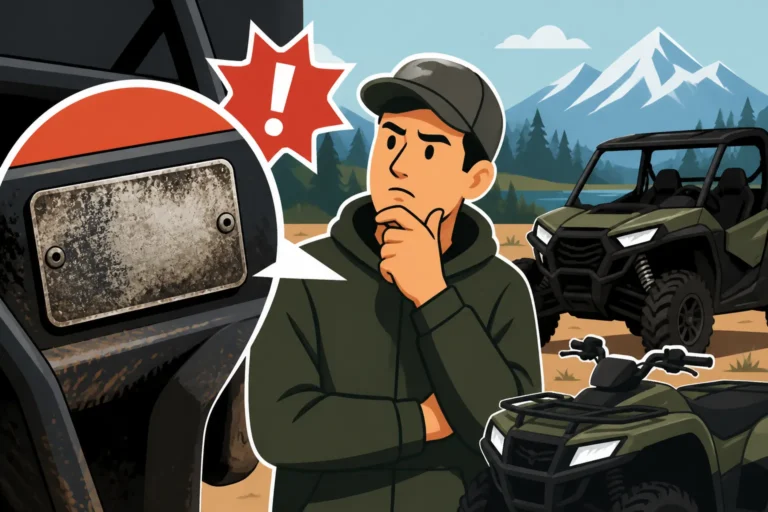
Then there's the metal tag, a small, durable plate that bolts onto your machine. This tag carries a unique identifier and helps link your machine to its registration, acting as a more permanent identifier than the yearly decals. It's replaced much less frequently than the yearly tabs, usually every seven years, but it's still a mandatory piece of identification for your WATV. Details on this can be found in [Washington's Metal Tag Explained]. While these items are physically on your machine, they're part of the overall "proof of registration" package that officials will check.
Insurance Information for Road-Legal Machines
If you've opted for the Washington on-road tab, meaning your WATV is street-legal on approved county roads, then carrying proof of insurance becomes just as important as it would be for your car. Washington law requires liability insurance for any motor vehicle operating on public roads. This means you need to have your insurance card or declaration of coverage readily available.
Again, waterproof storage is your friend here. Keep your insurance card alongside your driver's license and WATV registration. It's another layer of protection for you and others, ensuring that if an incident occurs on a public road, you have the necessary documentation. Failing to provide proof of insurance when operating on a public road can lead to separate fines and penalties. For all the specifics on insurance, refer to [Washington WATV Insurance Requirements]. Being fully prepared means having all your bases covered, from physical registration to visual tabs and critical insurance details.
| Document Type | Purpose | Where to Keep It | Required for Road Use? |
|---|---|---|---|
| WATV Registration Card | Proof of current annual registration | Waterproof case on machine | Yes |
| Driver's License/ID | Personal identification, driving privilege | Waterproof case on machine | Yes |
| ORV Decals (Tabs) | Visual proof of current annual registration | Affixed to WATV front fender | Yes |
| Metal Tag | Permanent machine identifier | Bolted to WATV frame | Yes |
| Insurance Card | Proof of liability coverage (if road-legal) | Waterproof case on machine | Yes (if on road) |
Disclaimer
This article is for general informational purposes only and does not constitute professional advice. Laws, prices and regulations vary by location and change over time. Consult a qualified professional for guidance on your specific situation.