Capitol Forest After a Week of Rain
A week of rain can turn Capitol Forest’s familiar gravel and dirt into slick clay, standing water, and ruts that are hard to read until you’re already in them. The ride may still be worthwhile, but conditions can change quickly across the forest. This guide helps you plan a safer wet-weather trip, choose sensible routes, and know when to turn around.
What Capitol Forest Is Like After a Week of Rain
Expect different conditions from one part of the forest to another
Capitol Forest sits in the Coast Range west of Olympia, where wet weather can linger and shaded roads may stay muddy long after rainfall eases. A week of rain does not make every route equally difficult. A broad gravel road might drain reasonably well, while a narrow trail under dense trees can stay soft, slippery, or waterlogged. Elevation, shade, soil, traffic, and drainage all matter.
That variation is easy to underestimate when you arrive from a paved road. The staging area may feel firm underfoot, but the first shaded section can have slick roots or clay. Conversely, a muddy-looking stretch may have a firm base beneath the surface. Don’t judge the whole forest from one entrance or one patch of trail. Check conditions as you go, and make your route flexible enough to turn around without pressure.
For a broader look at how rain affects riding across the state, see [Washington Riding in the Wet Season]. If you’re new to the area, [Capitol State Forest Near Olympia, Washington] is a useful starting point for understanding the riding area and its setting.
Mud, roots, and water can make an easy route feel technical
On wet ground, the main challenge is often traction rather than steepness. Clay can feel greasy beneath the tires, especially where riders have polished the surface or churned it into ruts. Roots and embedded rocks become harder to grip, and a shallow puddle may hide a deeper hole, a sharp rut, or an uneven bottom. Even a machine that handles dry trails comfortably may feel unpredictable when the surface is soaked.
Use smooth throttle and steering inputs. Sudden acceleration can spin a tire and dig a rut; abrupt braking can make the machine slide. Approach uncertain patches slowly, look for a firm line, and avoid cutting across the trail edge to get around mud. The edge may be soft, steep, or environmentally sensitive, and widening the route damages the ground and can create a new hazard for the next rider.
A wet ride can also make familiar landmarks less obvious. Rain, mist, and low cloud can reduce visibility, while water may cover small holes or wash loose material across a road. If you’re unsure how to read a muddy surface, [Riding a Wet Forest Trail] and [Root Balls and Slick Clay] offer more focused advice on common wet-weather obstacles.
Rain does not guarantee access
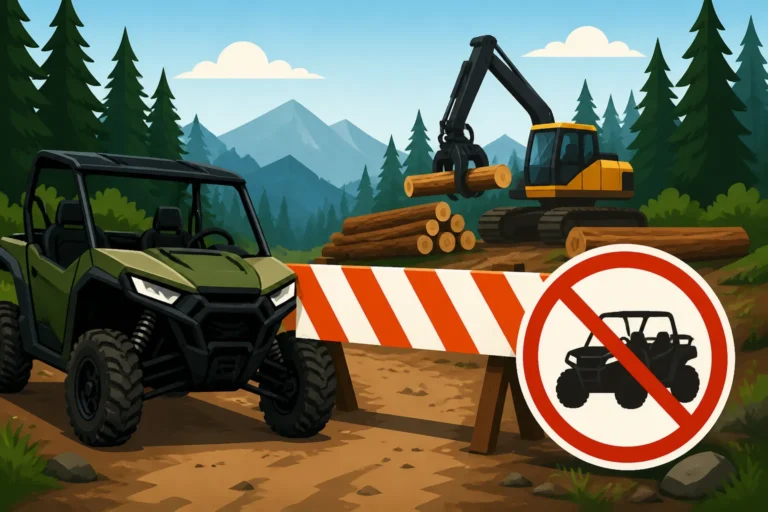
Trail conditions and trail access are not the same thing. A route may be physically passable but closed by a gate, seasonal restriction, active work, or a posted notice. A road that appeared on an older map may have changed since the map was made. Never assume that a route is open simply because you can reach it or because another rider used it recently.
Before leaving home, check the managing agency’s current information and any notices posted at the entrance. On the ground, follow signs and barriers, and don’t ride around a closed gate. Closures can protect riders from hazards as well as protect roads, trails, and nearby resources from damage. For a practical checklist, see [Washington Trail Closures to Check First] and [Reading a DNR Recreation Map].
Planning a Wet-Weather Capitol Forest Ride
Choose a route that gives you options
After a rainy week, plan a shorter first loop than you might choose in dry weather. A compact route gives you more chances to assess traction and lets you return to the staging area before fatigue, poor visibility, or worsening conditions become a problem. It’s also easier to adjust plans when a road is blocked or a trail is too soft to ride responsibly.
Think about more than distance. A route with frequent junctions, clear landmarks, and a straightforward return may be a better choice than a longer loop that relies on unfamiliar turns. If you’re traveling with a group, agree on a turnaround point and make sure everyone knows the plan. The slowest rider should set a pace that keeps the group together, rather than feeling pushed to catch up on slippery ground.
A mapping app such as onX Offroad can help you prepare by reviewing route options and getting familiar with nearby junctions before the ride. Use it as a planning aid, not proof that a route is open. Compare what you see on the screen with current agency information and posted signs, and be ready to follow a closure even if your app still displays the route.
Pack for a longer day than you expect
Wet-weather rides often take longer than dry ones. A slow climb, a muddy section that needs careful spacing, or a detour around a closure can add time. Pack warm layers, water, food, a basic first-aid kit, and a charged phone. Keep essential items in waterproof bags, and carry a paper map or another backup if you rely on a phone for navigation. Cold rain and wet gloves can make small tasks—like checking a map or fastening gear—surprisingly frustrating.
Before unloading, check your machine and trailer. Make sure tie-downs are secure, tires look sound, and the machine has the basic equipment you need for the planned ride. Bring a small tool kit and recovery gear appropriate to your experience and vehicle. Recovery equipment is not a reason to attempt a questionable crossing or climb; it is there to help with reasonable problems, not to make an unsafe route safe.
Save the day’s plan offline if your navigation app allows it. onX Offroad may be useful for reviewing your intended route and keeping a digital map available when reception is weak, but don’t make your entire safety plan depend on cellular service. Tell someone where you expect to ride and when you plan to be back, especially if you’re unfamiliar with the forest.
Use the map, then keep checking the ground
A map can help you understand where you are, but the trail itself provides the latest clues about whether continuing makes sense. Watch for fresh washouts, water flowing across the route, deepening ruts, slick off-camber sections, and tire tracks that appear to be cutting into soft ground. If you encounter a hazard you can’t assess confidently, stop somewhere safe and decide whether to turn around.
| What you notice | Why it matters | A sensible response |
|---|---|---|
| Water covering the trail | The depth and surface underneath may be hidden | Stop and assess from a safe position; don’t enter if you can’t judge the bottom |
| Deep, soft ruts | The machine may lose traction or become stuck | Avoid forcing through; turn around if there’s no firm, responsible line |
| Slick roots or clay | Steering and braking may be less predictable | Slow down, keep inputs smooth, and give riders space |
| Fresh erosion or a washout | The route may be unstable or unsafe | Don’t cross an uncertain edge; retreat and report the hazard if appropriate |
| A closure sign or barrier | The route is not open for riding | Follow the restriction, even if the track looks passable |
When conditions on the ground don’t match your plan, trust the evidence in front of you. A route on a screen can look simple while the real surface is saturated, damaged, or blocked. Use onX Offroad to orient yourself if needed, but confirm your location with trail signs and junctions. If you can’t confidently tell where you are or which way leads back, pause rather than continuing deeper into unfamiliar terrain.
Riding Responsibly and Deciding When to Turn Back
Keep your machine on the established route
Wet soil is especially easy to damage. Repeated wheelspin can deepen ruts, push water into the trail, and widen a muddy section as riders try to find firmer ground. Stay on the designated route, avoid creating bypasses, and don’t ride through vegetation to get around a puddle. If a route has become too soft to use without digging it up, turning back is usually the better choice.
Give other riders room, particularly on narrow or uneven sections. Wait until the rider ahead has cleared a steep or slippery patch before you enter it, and avoid stopping where you block the route or create a blind-corner hazard. If you’re riding with a group, use a pace that allows each person to choose a safe line without pressure. A rider who feels rushed may take a poor line or make a sudden correction.
Keep noise and speed appropriate for the setting, and watch for people, wildlife, and other forest users. Wet conditions can make it harder to stop quickly, and a spray of mud can obscure a rider’s view or visibility to others. [Washington's Off-Road Vehicle Rules Explained] provides additional context on riding responsibly and following applicable rules.
Know when the best decision is to turn around
Turning around isn’t a failure or a wasted trip. It’s a practical response when the trail is deteriorating, your machine is losing traction, the group is getting cold or tired, or you’re no longer sure how to return. The decision is easier if you set a turnaround time or distance before you start. That way, you’re less likely to push onward simply because you’ve already driven to the forest or unloaded the machine.
Pay attention to the least experienced rider and the machine with the least suitable tires or clearance. A route that feels manageable to one rider may be uncomfortable for another. Stop somewhere safe, talk through the options, and avoid splitting the group unless everyone has agreed on a clear, safe plan. If a rider is stuck, assess the situation before attempting a recovery; pulling from an unstable angle or rushing into soft ground can create a second problem.
Also watch the weather while you ride. Rain can return, fog can thicken, and a wet trail can become more difficult as temperatures drop or daylight fades. If visibility is worsening or the return route is likely to be more challenging than the way in, head back early. For route-specific orientation, [Riding Capitol Forest From the North End] and [Riding Capitol Forest From the South End] can help you think through which side of the forest suits your plans.
Leave the forest ready for the next ride
Mud packed onto a machine can conceal damage and carry seeds or soil to another riding area. Once you’re home, clean the machine before moving to a different forest, paying attention to tires, undercarriage, and crevices where mud collects. Check for loose hardware, torn boots, damaged hoses, and anything that may have been hit or scraped during the ride. Wet conditions can also leave you cold and tired, so give yourself time to inspect and dry gear instead of rushing straight into the next task.
Make a note of what worked and what didn’t. Record the entrance you used, where conditions changed, how long the loop took, and what you’d choose differently next time. If you used onX Offroad or another map app, update your saved plan with useful personal notes, but don’t treat those notes as a substitute for checking conditions before your next visit. A route that was firm one weekend may be saturated or closed after the next storm.
A rainy week doesn’t automatically rule out Capitol Forest, but it does call for a more cautious plan. Start with a manageable route, confirm access, ride smoothly, and treat muddy or flooded sections as a reason to reassess—not as an obstacle you have to conquer. When the ground is too soft or the return becomes uncertain, turning around protects you, your machine, and the trail.
Disclaimer
This article is for general informational purposes only and does not constitute professional advice. Laws, prices and regulations vary by location and change over time. Consult a qualified professional for guidance on your specific situation.