Fifteen Days Before the Penalty
You just brought home your new (or new-to-you) all-terrain vehicle (ATV) or utility terrain vehicle (UTV) in Washington State, and you're buzzing with excitement to hit the trails or maybe even get it street legal. But before you get too carried away with visions of kicking up dust, there's a critical detail that can trip up even the most enthusiastic rider: Washington's strict 15-day deadline for registration. Missing this short window can quickly turn your excitement into a headache, leading to unexpected fees and legal woes. This guide will walk you through exactly what that 15-day period means, how to navigate the registration process efficiently, and most importantly, how to avoid those frustrating penalties that nobody wants to deal with.
Understanding Washington's 15-Day Registration Deadline
Bringing a new machine home, whether it's a shiny side-by-side from a dealership or a used quad you found through a private sale, is always a thrill. You're probably already thinking about where you'll ride first, or what accessories you'll add. But in Washington, that excitement needs to be quickly channeled into action because the state gives you a very narrow window to get your off-road vehicle (ORV), which includes ATVs and UTVs (often referred to as WATVs in Washington), registered and titled. This isn't just a suggestion; it's a hard and fast rule designed to ensure machines are properly documented and taxes are paid in a timely manner. The moment you take possession, the clock starts ticking.
Why the Clock Starts Ticking Immediately
The state's Department of Licensing (DOL) operates with a clear expectation: any vehicle operating on public or permitted lands, or even potentially crossing public roads, needs to be accounted for. The 15-day deadline serves several purposes. Firstly, it ensures the swift transfer of ownership records, which is vital for preventing fraud and tracking vehicles. Secondly, it helps the state collect sales and use taxes promptly, contributing to the funds that maintain trails and manage ORV programs. For new owners, this can feel like an unnecessary rush, especially if you're unfamiliar with the process or if you've bought a machine that needs some TLC before it's trail-ready. You might be thinking, "I just bought it, I'm not even going to ride it for a month!" But the law doesn't make that distinction. The obligation to register begins the moment of purchase, regardless of your immediate riding plans. Ignoring this deadline can lead to fines and complications down the road, making a simple process much more cumbersome. It’s definitely one of those "better safe than sorry" situations, and trust me, you don't want the state catching up to you later.
What Counts as the "Purchase Date"
This is where many people get tripped up. It's not when you first thought about buying the machine, or when you finally got around to picking it up from your friend's barn. In Washington, the "purchase date" is typically the date recorded on your bill of sale or purchase agreement. This is why a well-documented [A Washington Bill of Sale for a WATV] is absolutely crucial. If you buy a machine from a dealer, they will often handle the initial paperwork and titling for you, which simplifies things. However, if you're buying privately, you and the seller are responsible for accurately dating the bill of sale.
Counting those 15 days correctly is also important. It's not 15 business days; it's 15 calendar days, starting from the day after the purchase date. So, if you bought your ATV on a Saturday, day one of your 15-day window would be Sunday. This can catch people off guard, especially if they wait until the following weekend to start thinking about the paperwork. If the 15th day falls on a weekend or a holiday when the licensing offices are closed, you typically get until the next business day to complete the process. However, it's never wise to cut it that close. Always aim to get your paperwork in well before the deadline, giving yourself a buffer against unexpected delays or office closures.
The Initial Steps You Must Take Within 15 Days
So, you've got your machine and the clock is ticking. What exactly do you need to do in this short window? Your primary goal is to either complete the [Titling a WATV in Washington] process and begin registration, or at the very least, initiate the transfer of ownership at a Washington State licensing agent. For privately purchased machines, this means obtaining the original title signed over by the previous owner, along with a completed bill of sale. If the machine was financed, you'll need the proper lien release documentation if the previous owner had a loan. Without a proper title, you're going to face significant hurdles, and it’s always best practice to ensure the seller has a clear title to provide you before you even hand over payment.
Beyond the title, you'll need to fill out the necessary application forms for registration and potentially for your off-road or on-road tabs. This includes an application for title and registration. If you plan to make your WATV street-legal, an inspection might also be required, and scheduling that within 15 days can be a tight squeeze. While the full registration might involve multiple steps, the most critical part within the 15-day window is getting that initial ownership transfer recorded with the Department of Licensing. Delaying this first step can lead to penalties on top of the registration fees. Getting your [Registering a WATV in Washington] paperwork started promptly avoids a lot of stress.
Navigating the Registration Process Under Pressure
Even for experienced riders, navigating the bureaucratic maze of vehicle registration can be a bit daunting, especially with a tight deadline looming. It feels like there’s always one more form, one more signature, or one more piece of information needed. But with a clear plan and a bit of diligence, you can tackle the process efficiently and avoid those late fees. The key is to be organized and proactive, recognizing that even minor omissions can cause significant delays.
Gathering Essential Paperwork Quickly
The first and most crucial step is to gather all the required documents. This usually includes:
- The Certificate of Title: This must be signed by the previous owner (if buying used) or be the manufacturer’s certificate of origin (MCO) if buying new. Make sure the VIN matches exactly.
- Bill of Sale: A detailed bill of sale, including the purchase price, date of sale, names, addresses, and signatures of both buyer and seller. This is where tools like LawDepot can be incredibly helpful for generating professional, legally sound documents that meet Washington’s requirements, ensuring no critical details are missed.
- Odometer Disclosure Statement: For most WATVs, this isn't strictly required as they don't have odometers in the same way cars do, but if it has one and is being titled, be prepared.
- Application for Title and Registration (Form TD-420-001): This form needs to be accurately completed with all your personal information and details about the machine.
- Proof of Identity: Your valid driver's license or state-issued ID.
- Payment: Fees for title transfer, registration, and any applicable sales or use taxes.
It’s tempting to rush through these forms, but accuracy is paramount. Even a small typo can result in your application being rejected, sending you back to square one and further eating into your 15-day window. Take your time, double-check every field, and if you’re unsure about something, don’t hesitate to call the DOL or a licensing subagent for clarification. Having all your [Washington WATV Registration Paperwork] in order will make the process much smoother.
Addressing the Safety Inspection (If Applicable)
This step often surprises new WATV owners, especially those who primarily think of their machine as an off-road toy. In Washington, if you intend to equip your WATV for street-legal use—meaning you want to ride it on approved public roads, not just trails—it will likely need a safety inspection. This inspection confirms that your machine meets specific equipment requirements for on-road operation, such as having proper headlights, taillights, turn signals, mirrors, and a horn.
The tricky part here is the timing. You usually can't get an inspection until the machine is legally in your name, or at least the titling process is underway. Finding a qualified inspector and getting an appointment within your 15-day window can be challenging. Washington law caps the cost of this inspection, which is helpful to know for budgeting purposes. The [Washington WATV Safety Inspection Cost] can vary, but knowing the cap helps manage expectations. You also need to ensure that the shop performing the inspection is authorized to do so. Generally, any licensed vehicle repair shop can perform the inspection and sign off on the required form, but it's always wise to call ahead and confirm. [Who Can Perform a Washington Inspection] can include most automotive repair facilities, but specifically mentioning it's for a WATV inspection helps them prepare. Don't assume your local powersports dealer automatically performs these; verify beforehand. Remember, this inspection is only if you want the "on-road" tab; if you're sticking to trails, it's not required.
Where and How to Submit Your Application
Once you have all your paperwork meticulously prepared, the next step is submission. You have a few options in Washington State:
- Department of Licensing (DOL) Vehicle Licensing Office: These are the official state offices. While they handle all vehicle licensing, they can sometimes have longer wait times due to the volume of traffic.
- Vehicle Licensing Subagents: These are private businesses (often grocery stores, car dealerships, or other small businesses) authorized by the DOL to process vehicle transactions. They often have more convenient hours and shorter lines, making them a popular choice for getting things done quickly. They charge a small service fee on top of the state fees, which is a small price to pay for the convenience, especially when you're under a deadline. [Where to Register a WATV in Washington] can literally be a corner store in some towns, so it's worth checking your local options.
When you go, bring all your original documents, including your ID. It's a good idea to make copies of everything for your records before you go, just in case. Be prepared to pay the fees, which typically include title transfer fees, the annual registration fee for your off-road tab, and potentially the optional on-road tab fee. You'll also pay Washington sales or use tax on the purchase price of your machine if you bought it from a private party and haven't already paid sales tax to a dealer. The use tax is usually calculated on the purchase price or fair market value, whichever is higher, so don’t try to lowball the price on the bill of sale. A skilled clerk at the subagent can walk you through the specifics.
Consequences of Missing the Deadline and How to Avoid Them
The 15-day deadline isn't just a suggestion; it's a legal requirement. Missing it can lead to various frustrations, from financial penalties to potential legal issues if you're caught riding an unregistered machine. Understanding these consequences is often the best motivator for getting things done on time.
Penalties for Late Registration
If you fail to register your WATV within the 15-day window, Washington State imposes a late penalty fee. This fee is added on top of your standard registration and titling costs. While specific amounts can change, these penalties are designed to encourage timely compliance and can definitely add an unwelcome cost to your new machine. Think of it as a "being late tax" that you really don't want to pay.
Beyond just a financial penalty, riding an unregistered WATV on public lands or approved roads in Washington can lead to a citation. A law enforcement officer could pull you over or check your registration at a trailhead, and finding an unregistered machine could result in a fine for no valid tabs. These [Washington Fines for an Unregistered WATV] can be far more substantial than the late registration fee itself, making the decision to delay even more costly. It also creates a paper trail of non-compliance, which is never a good thing. It's simply not worth the risk.
Temporary Solutions and Exceptions
What if you genuinely can't get everything together in 15 days? Washington State does offer a limited temporary solution in some specific circumstances: the [Washington's $15.75 Temporary ORV Permit]. This permit allows you to ride for 60 consecutive days and is typically used by out-of-state visitors whose home state doesn't have a reciprocal ORV registration program, or by new Washington residents awaiting their permanent plates. However, it's crucial to understand that this temporary permit is for off-road use only; it does not authorize you to ride on approved public roads. If you're buying a machine in Washington, the primary expectation is that you will register it and title it promptly. Relying on a temporary permit to bypass the 15-day titling deadline for a newly purchased machine by a resident isn't typically the intended use, and it won't prevent the late penalty for the title transfer.
There are very few, if any, formal exceptions to the 15-day titling deadline for new purchases. If you encounter an unusual circumstance, like a problem with the seller providing the correct title, document everything. A licensing agent might be able to offer specific guidance, but generally, the responsibility to complete the process rests firmly with the buyer. Don't count on a "grace period" or unspoken extension; they typically don't exist for this particular deadline.
Practical Tips for a Smooth Registration
To ensure you don't fall victim to the 15-day penalty, here are some actionable tips:
- Start Immediately: The moment you shake hands on the deal, assume the clock has started. Don't wait until the next weekend.
- Get a Complete Bill of Sale: Ensure the bill of sale is filled out thoroughly and accurately, with the correct date of sale. If you're buying privately, consider using a template from a reputable source like LawDepot to ensure all necessary fields are included and it's legally sound. This minimizes disputes and clarifies the purchase date for the DOL.
- Verify the Title: Before purchase, ensure the seller has a clear title in their name and is ready to sign it over to you. Inspect the VIN on the title against the machine's actual VIN. [Why a Title Must Be in Your Name First] is critical; you can't register what you don't legally own.
- Create a Checklist: Write down every document you need and check them off as you gather them. This prevents last-minute scrambling.
- Call Ahead: If you have questions about specific forms or requirements, call your local DOL office or a licensing subagent. They are there to help clarify the process.
- Schedule Inspection Early (If Needed): If you plan on road-registering your WATV, call a shop as soon as possible to schedule the safety inspection.
- Choose a Subagent for Speed: If time is of the essence, a vehicle licensing subagent often provides quicker service than a main DOL office. While they charge a small convenience fee, it's usually worth it to avoid penalties and long waits.
- Budget for Fees: Know what fees to expect: title transfer, registration tabs (off-road and optional on-road), and sales/use tax. Having funds ready prevents delays at the counter. [Washington WATV Registration Cost] can add up, so be prepared.
- Keep Records: Make copies of everything you submit, and keep them in a safe place. This is invaluable if any issues arise later.
By following these tips and taking the 15-day deadline seriously, you can avoid unnecessary stress and penalties, ensuring your new Washington ATV or UTV experience starts off on the right foot.
| Action Item | Deadline (from Purchase Date) | Key Document/Consideration | Potential Consequence of Delay |
|---|---|---|---|
| Secure Signed Title & Bill of Sale | Immediate | Bill of Sale, Original Title | Cannot Register, Ownership Issues |
| Complete Application for Title & Registration | Within 15 Days | TD-420-001, Proof of ID | Late Penalty, Registration Delays |
| Obtain Safety Inspection (if road-legal) | Within 15 Days (Ideally) | Signed Inspection Form | Cannot Get On-Road Tab, Delayed Road Use |
| Submit Paperwork & Pay Fees | Within 15 Days | All gathered documents, Payment for fees/taxes | Late Penalty, Fines for Unregistered Machine |
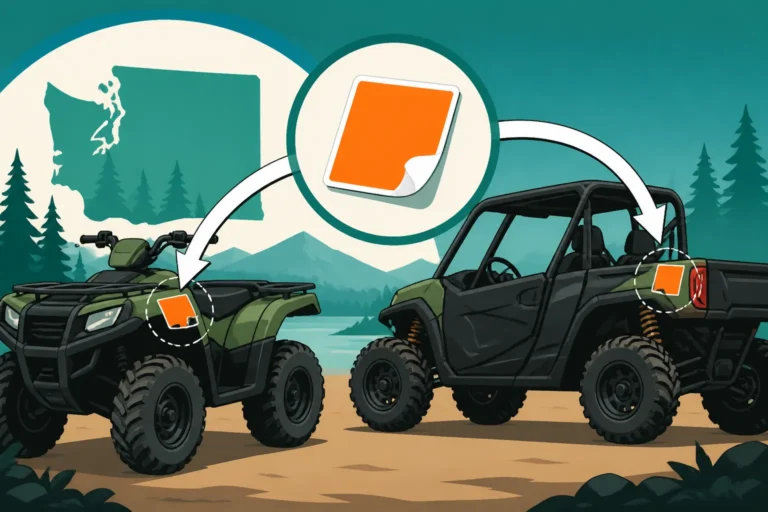
| Obtain Tabs & Decals | After Submission | DOL-issued tabs & metal tag | Citation for No Tabs (if riding) |
Disclaimer
This article is for general informational purposes only and does not constitute professional advice. Laws, prices and regulations vary by location and change over time. Consult a qualified professional for guidance on your specific situation.