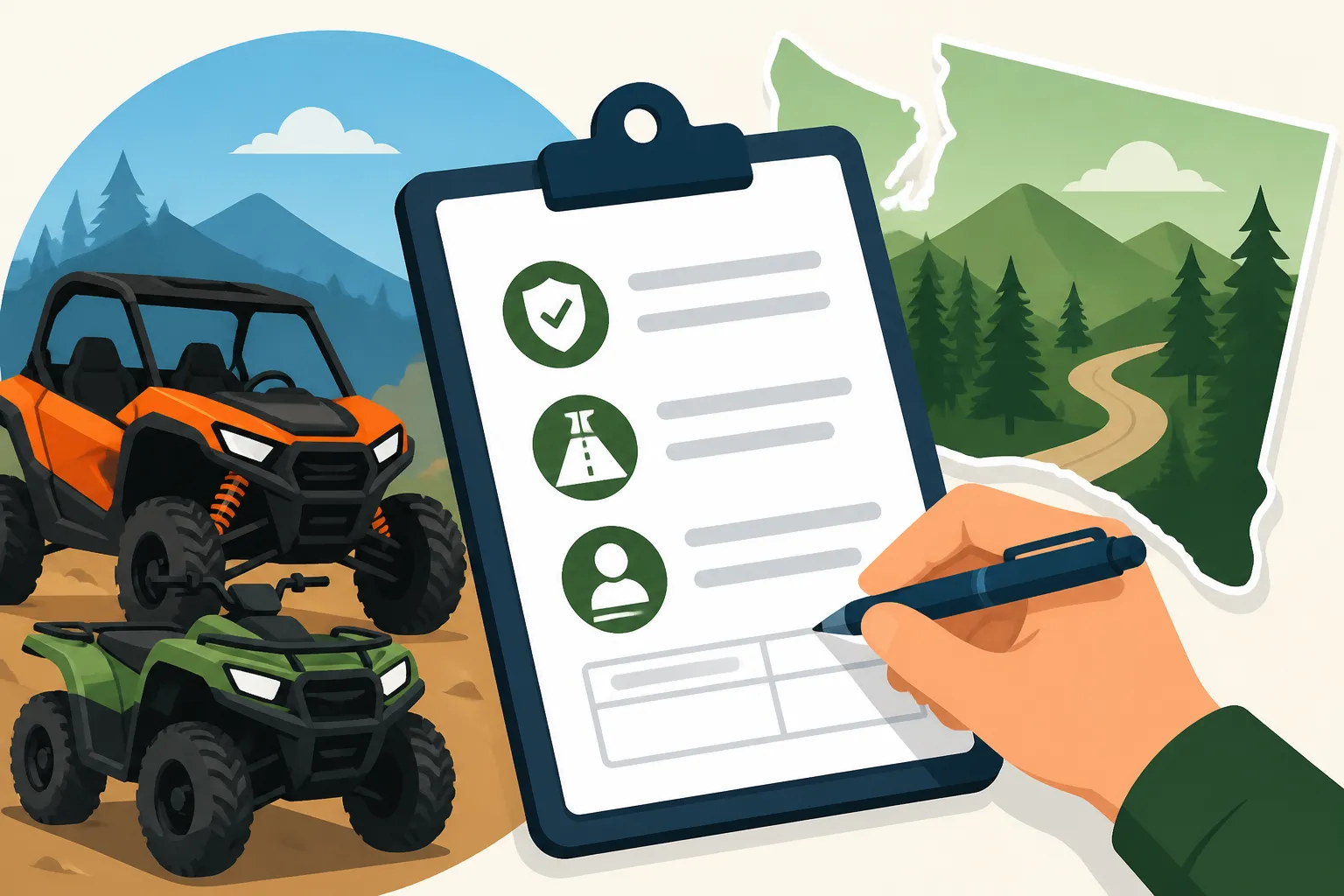
Filling Out the Road Use Declaration
Navigating the world of Washington WATV registration can feel like deciphering ancient scrolls, especially when you're itching to get your machine out on those approved county roads or city streets. One piece of paper that often trips folks up is the Road Use Declaration – it’s a crucial step that can feel a bit intimidating if you’ve never seen it before. This guide is here to break down exactly what this form is, why it matters, and how to fill it out correctly so you can confidently hit the pavement where it’s allowed.
Understanding the Washington Road Use Declaration
Let's be honest, nobody enjoys paperwork, especially when it stands between you and your next great ride. But when it comes to getting your WATV (Wheeled All-Terrain Vehicle) street legal in Washington, the Road Use Declaration isn't just another form; it's the key that unlocks a whole new world of riding opportunities. This isn't just a casual signup sheet; it's a legal declaration that lets the state know you intend to use your off-road machine on public roadways.
What This Form Really Is For
At its heart, the Washington Road Use Declaration is your formal statement of intent to operate your WATV on approved public roads within the state. It’s not just for logging miles on trails or cruising through the woods. This form specifically addresses the "on-road" aspect of WATV use, acknowledging that your machine meets or will meet the necessary equipment requirements for limited street legality. Without this declaration, the state wouldn't issue you the specialized "on-road" tab that signifies your machine is approved for road use. It’s essentially a promise that you understand the rules and are ready to follow them.
Think of it this way: Washington recognizes that many riders want the convenience of connecting trails via short stretches of pavement, or simply want to ride their machines to the gas station or local store in towns where it's permitted. This form is the mechanism by which you signal your desire to participate in that expanded access, and it ensures you’re aware of the responsibilities that come with it. It’s part of the diligent process the Department of Licensing (DOL) uses to keep everyone safe and accountable on the roads.
Why It's So Important for Street Legal WATVs
The Road Use Declaration is absolutely non-negotiable if you want your WATV to be considered street legal for permitted road segments in Washington. It’s the foundational document that allows you to purchase and display the [Washington's On-Road Tab Explained]. Without a properly completed and submitted declaration, your application for that invaluable tab will simply be rejected. It serves as your official acknowledgment of the specific laws and regulations that govern WATV use on public roads, differentiating your machine from those strictly limited to off-road trails.
Beyond just getting the tab, this declaration reinforces the idea that riding on public roads comes with increased scrutiny and responsibility. It ensures you, as the owner, have formally committed to complying with state and local ordinances, which often include specific equipment requirements like mirrors, turn signals, and proper lighting. This document helps the state maintain a clear record of which machines are declared for road use, aiding in enforcement and ensuring that only compliant vehicles are operating in these mixed-use environments.
Who Needs to Fill Out This Form
Generally, anyone who wants to obtain or maintain the on-road tab for their WATV in Washington will need to complete the Road Use Declaration. This includes several common scenarios:
- First-time registration: If you’re bringing a brand-new WATV home or a used one you just purchased and want to ensure it’s street legal from day one, this form is part of your initial [Registering a WATV in Washington] paperwork.
- Adding the on-road tab later: Maybe you initially only registered your WATV for off-road use, but now you want to expand your riding options. You’ll need to complete this form to add the on-road portion of the registration.
- Transferring ownership: When you buy a used WATV that was previously registered for road use, you'll need to submit a new Road Use Declaration as part of the [Washington ORV Registration Transfer] process. The previous owner's declaration doesn't carry over; it's specific to the individual owner.
It's crucial to remember that this form isn't a one-time thing if you ever sell your machine. Each new owner who wishes to utilize the on-road privileges must submit their own declaration. It's a personal commitment tied directly to the individual who will be legally responsible for the machine's operation on public roads.
Getting Your Hands on the Form
Alright, you understand why this form is important. Now, let’s talk about the practicalities of obtaining it and making sure you’re ready to tackle it without any unnecessary hiccups. It's a pretty standard form, but knowing where to get it and what information to have on hand will make the process much smoother.
Where to Find the Official Document
The official Washington Road Use Declaration form, often referred to as a "Road Use Declaration (ATV/UTV)" or similar, is provided by the Washington State Department of Licensing (DOL). You've got a couple of primary avenues for acquiring it:
- Online: The quickest and often easiest way is to download it directly from the DOL website. A quick search for "[Washington Road Use Declaration Form]" on the DOL site should lead you straight to the printable PDF. This allows you to print it at your convenience, fill it out at home, and bring it with you to the licensing office.
- In-person at a licensing agent: All vehicle licensing offices (subagents) across Washington State will have physical copies of the form available. These are the same offices where you’ll complete your registration and titling. If you prefer to fill it out on-site or want to ask a quick question as you go, this is a perfectly valid option.
While there are many resources for general legal documents online, like LawDepot, for this specific official state form, you must use the version provided directly by the Washington DOL. Other sites might offer generic declaration templates, but they won't be the correct, legally recognized form for your WATV registration in Washington. Always double-check that you're using the most current version from the DOL to avoid any processing delays.
Preparing for the Paperwork Party
Before you even pick up a pen or start typing, it's wise to gather all the necessary information and documents. This proactive step can save you a world of frustration and a potential extra trip to the licensing office. Here's a checklist of what you'll likely need:
- Your WATV's Title: This document contains vital information like the Vehicle Identification Number (VIN), year, make, and model. It's the ultimate source of truth for your machine's identity. If you're also in the process of [Titling a WATV in Washington] for the first time, make sure you have all the relevant purchase paperwork.
- Proof of Ownership: This could be a bill of sale, if you purchased the machine from a private party, or dealer paperwork if you bought it new. While not always directly on the declaration form, it's essential for the overall registration process, and you might need to reference details from it. LawDepot can be a helpful resource if you're looking for a blank bill of sale template for a private sale, though remember the official declaration form itself comes from the DOL.
- Your Personal Information: Full legal name, current address, driver's license number, and contact information. These details need to match what's on your driver's license and other official records.
- Payment for Fees: While not directly for the declaration form, you'll be paying for the on-road tab and any other associated registration fees when you submit this form. Be prepared for those costs.
Having all these items neatly organized before you begin will ensure a smooth process. It's like preparing your gear before a big ride – you wouldn't want to get halfway down the trail only to realize you forgot your helmet!
Navigating the Digital vs. Paper Debate
In today's world, you often have a choice: print something out and fill it by hand, or complete it digitally. For the Road Use Declaration, both options have their merits:
- Filling it out by hand (Printed PDF):
- Pros: Some people prefer the tactile experience of a pen and paper. It's easy to correct minor mistakes with correction fluid if you're careful, and you can take your time without worrying about software glitches.
- Cons: Handwriting needs to be legible, or the form might be rejected. You might make mistakes that require reprinting and restarting.
- Filling it out digitally (Editable PDF):
- Pros: Ensures legibility, as all text is typed. Many PDFs allow you to save your progress. It can feel more professional and organized.
- Cons: Not all PDF readers allow direct typing into forms, which can be frustrating. You'll still need to print it out for a physical signature, as electronic signatures typically aren't accepted for these types of state documents. You can't just email it in; it needs to be presented at a licensing office.
Ultimately, the best method is the one you're most comfortable with. Just remember that even if you fill it out digitally, you’ll still need to print it and provide a physical signature before submission. The goal is to produce a clear, accurate, and completely filled-out document that the DOL can easily process.
Step-by-Step Guide to Filling Out the Road Use Declaration
Now for the main event! While the form itself is relatively straightforward, walking through each section can alleviate any anxiety and ensure you don’t miss any critical details. Take your time, read each prompt carefully, and remember that accuracy is your best friend here.
Section 1: Your Personal and Machine Information
This section is all about identifying you as the owner and your specific WATV. It's where you lay out the foundational details that link you to your machine for road-use purposes.
- Vehicle Identification Number (VIN): This is perhaps the most critical piece of information. Your VIN is a unique 17-character code stamped on your machine’s frame. Double-check this against your title or manufacturer's documentation. An incorrect VIN will lead to immediate rejection of your application. Make sure to transcribe it perfectly, including any letters and numbers, as even a single digit error can cause problems.
- Year, Make, and Model: These details should also match your title precisely. If your title says "Honda Rancher" and you write "Honda TRX420," that could be a discrepancy. Stick to the official registered descriptions.
- Owner’s Information: This is where your personal details come in. Provide your full legal name, current residential address, and your Washington State driver's license number. It’s vital that this information is accurate and matches your official identification. If you've recently moved, ensure your address is updated with the DOL first, or be prepared to update it simultaneously. Remember, the form is about you, the individual, making a legal declaration.
Always take an extra moment to verify these details. It’s like checking your tire pressure before a long ride – a small check now can prevent a big headache later. Incorrect information in this section is a common reason for processing delays.
Section 2: The Core Declaration of Intent
This is the heart of the form, where you make the actual declaration regarding your intent to operate your WATV on public roads. It's often a pre-printed statement that you acknowledge by signing.
- The "I understand and declare" statement: This paragraph typically outlines several key points. It will likely state that you understand the conditions for operating a WATV on public roads, which often includes requirements for specific equipment (like mirrors, turn signals, and a horn), wearing an approved helmet, having a valid driver's license, and adhering to posted speed limits. It also confirms your understanding that WATVs are restricted to roads with a speed limit of 35 mph or less, unless specifically authorized to cross higher-speed highways.
- Affirmation of Compliance: By [Signing the Road Use Declaration for On-Road Tabs], you are legally affirming that your WATV either already complies with these equipment requirements, or that you will ensure it complies before operating it on any approved public road. This isn’t just a formality; it’s a commitment to responsible and legal operation. The state relies on this declaration as a good-faith statement from you, the owner, that you will uphold the safety and legal standards required for road use.
Read this section very carefully. It's easy to just skim over boilerplate legal text, but understanding what you're agreeing to is fundamental to being a responsible WATV owner and rider. This declaration is a key part of what makes [Washington WATV Road Requirements] enforceable.
Section 3: Signatures and Dates
The final section is where you seal the deal with your signature and the date. This is your personal confirmation of everything stated above.
- Your Signature: This is where you physically sign your name. It must be your legal signature, matching how you typically sign other official documents. Make sure it's clear and legible. This signature is what makes the declaration legally binding.
- Date: Enter the current date when you are signing the form. This establishes when you made the declaration. If you're filling out the form in advance, just make sure to date it accurately on the day you actually sign it, not the day you plan to submit it.
- Additional Signatures (if applicable): In some cases, if there are multiple owners listed on the title, all owners might need to sign the declaration. Always check the specific form for instructions regarding multiple owners to ensure all required signatures are present. Failing to get all necessary signatures is another common reason for a form to be rejected, causing frustrating delays.
Once signed and dated, the form is ready for submission to the DOL. Double-check everything one last time before you head to the licensing office!
Common Pitfalls and How to Avoid Them
Even with a straightforward form like the Road Use Declaration, it’s surprisingly easy to make small mistakes that can cause big delays. Having your paperwork rejected means more trips, more time, and more frustration. Let’s look at some common pitfalls and how you can sidestep them entirely.
Missing Information
Leaving a blank space on any official form is almost always a recipe for rejection. The DOL processing agents need complete information to do their job, and an incomplete form simply cannot be processed.
- The "Skipped a Box" Scenario: Imagine you’re rushing through the form, maybe you’re distracted by the thought of your next ride, and you accidentally skip the "driver's license number" field. Or perhaps you forget to fill in the date. These small omissions, while seemingly minor to you, are significant to the processing agent. They can’t assume the information or proceed without it.
- How to Avoid It: Before you submit, review the form meticulously. A great trick is to use a highlighter and mark each box after you’ve filled it in. Go line by line, comparing what you’ve written to the requirements. It's like doing a final safety check on your machine before you head out – you wouldn't forget to check your brakes, so don't forget to check your form! If you're ever unsure what a particular box is asking for, don't guess. Ask a licensing agent for clarification, or if you're using a resource like LawDepot for general legal document guidance, you've likely learned the importance of clear, complete information.
Incorrect Machine Details
Your WATV's identity is crucial for its registration. Any mismatch between what you put on the form and what’s on its title or in the DOL system will cause problems.
- The Mismatched VIN: This is the most critical error. Let’s say you copy down the VIN from a sticker that’s partially rubbed off, or you transpose a couple of numbers. If the VIN on your Road Use Declaration doesn't exactly match the VIN on your title, the DOL won't be able to link the declaration to your specific machine. This means your on-road tab application will be dead in the water.
- Make/Model Discrepancies: Sometimes people get creative with their machine’s description, or they use a common nickname instead of the official model name. For instance, if your title says "Polaris Ranger XP 1000" and you write "Polaris Side-by-Side," that might not fly. The processing system relies on exact matches.
- How to Avoid It: Always, always reference your official title or manufacturer's certificate of origin when filling out the VIN, year, make, and model. Don't rely on memory or what's written on a handwritten bill of sale. Take the extra time to compare each character of the VIN and each word of the make and model. Think of your title as your WATV's birth certificate – it needs to be perfectly accurate on all official documents.
Forgetting to Sign or Date
This might sound incredibly obvious, but you’d be surprised how often this simple oversight occurs. In the rush to get everything done, the very last step, which is arguably the most important, gets missed.
- The Unsigned Declaration: You’ve filled out every other detail perfectly, but you’ve left the signature line blank. Without your signature, the form is merely a piece of paper with information; it's not a legally binding declaration from you. The DOL cannot process an unsigned declaration, as it essentially means you haven't agreed to the terms outlined.
- The Missing Date: Similar to the signature, omitting the date means the declaration is incomplete. The date confirms when you made this legal commitment, which can be important for record-keeping and establishing timelines.
- How to Avoid It: Make signing and dating the absolute last step after you've thoroughly reviewed everything else. Better yet, incorporate it into your final review checklist. For example, if you make a "Before You Submit" checklist (see our table below!), "Signature" and "Date" should be at the very top. Don't rush these final actions. They are your confirmation that all the information is correct and that you understand the responsibilities of having a road-legal WATV.
By taking a few extra moments to be diligent, you can prevent these common errors and ensure your Road Use Declaration is accepted the first time around, getting you closer to hitting those open roads on your WATV.
Before You Submit: Your Road Use Declaration Checklist
To make sure you don't miss any critical details, use this handy checklist before heading to the licensing office.
| Item | Requirement | Status (Check When Done) |
|---|---|---|
| Owner Information | ||
| Full Legal Name | Matches driver's license | [ ] |
| Current Residential Address | Matches DOL records | [ ] |
| Driver's License Number | Valid Washington State driver's license number | [ ] |
| WATV Information | ||
| Vehicle Identification (VIN) | Exact match to title/MCO (17 characters) | [ ] |
| Year | Matches title/MCO | [ ] |
| Make | Matches title/MCO | [ ] |
| Model | Matches title/MCO | [ ] |
| Declaration & Signature | ||
| Read & Understood | Fully read and comprehended the declaration statement | [ ] |
| Signature | Owner's legal, physical signature | [ ] |
| Date | Current date of signing | [ ] |
| Supporting Documents | (Bring these with your declaration for overall registration, not just the form) | |
| WATV Title/MCO | Original or certified copy | [ ] |
| Bill of Sale | If privately purchased (or dealer paperwork) | [ ] |
| Safety Inspection Report | If required and already completed | [ ] |
| Payment Method | For registration, tabs, and inspection fees | [ ] |
What Happens After You Fill It Out
You've done the hard part – filling out the form accurately. Now, what's next? The Road Use Declaration isn't a standalone document; it's a piece of a larger puzzle that culminates in you legally riding your WATV on designated public roads.
Submitting the Form
Once your Road Use Declaration is complete and signed, you'll submit it along with your other [Washington WATV Registration Paperwork] at a local Washington vehicle licensing office (a subagent of the DOL). You can't typically mail this form in by itself, nor can you submit it online (as it requires a physical signature). It's part of an in-person transaction that often involves paying fees and receiving your physical tabs.
When you bring it in, the licensing agent will review it along with your title application, bill of sale, and any other required documents. They'll check for completeness and accuracy, ensuring that all the information lines up. This is why all that prep work we talked about earlier is so important; a smooth submission process hinges on having everything in order. If you're also registering the machine for the first time, or transferring ownership, this will all happen in one go.
The Role of the Safety Inspection
The Road Use Declaration often goes hand-in-hand with another crucial step: the WATV safety inspection. While the declaration confirms your intent and understanding of road-use rules, the safety inspection physically verifies that your machine actually meets those [Washington WATV Road Requirements].
- Why it's necessary: For your WATV to be legal on public roads, it must be equipped with specific safety features, such as a headlight, taillight, brake light, turn signals, mirrors, and a horn. The inspection ensures these components are present and functioning correctly.
- When it happens: Often, you'll complete the safety inspection before you even head to the licensing office to submit your declaration and other paperwork. The certified inspector will provide you with a signed inspection report, which you then present to the DOL. This report is proof that your machine is physically compliant. Without it, even a perfectly filled-out Road Use Declaration won't get you the on-road tab. Remember, there's a [Washington WATV Safety Inspection Cost] associated with this, so budget for it.
It's a two-pronged approach to ensure safety: your declaration is your promise, and the inspection is the proof. Both are essential for [Street Legal WATVs in Washington: The Short Answer].
Receiving Your On-Road Tab
This is the moment of truth! Once your Road Use Declaration is accepted, your WATV passes its safety inspection, and all applicable fees are paid, the licensing agent will issue you the coveted on-road tab.
- What it is: The on-road tab is typically a small, distinctive decal that is affixed to your license plate or designated area on your WATV. It visually signifies to law enforcement that your machine is registered for limited road use. This tab will have an expiration date, indicating when your registration needs to be renewed.
- The final reward: With the on-road tab proudly displayed, you can now legally operate your WATV on those approved public roads and city streets within Washington State, subject to all the conditions you declared. This opens up possibilities for connecting trails, running errands, or simply enjoying a different kind of ride where permitted. Always remember that riding on roads still comes with strict rules, such as helmet laws and adhering to speed limits. But knowing you've navigated the bureaucracy and completed the necessary steps makes that first legal road ride even more satisfying. You've conquered the paperwork, now go enjoy the ride!
Disclaimer
This article is for general informational purposes only and does not constitute professional advice. Laws, prices and regulations vary by location and change over time. Consult a qualified professional for guidance on your specific situation.